
Ethics Commission Grants Ex-SFO Operations Chief Limited Revolving-Door Waiver
Ethics Commission • San FranciscoSeptember 11, 2026
Locunity is an independent informational service and is not an official government page for this commission. All information is sourced from public footage and an analysis of official agendas with the aid of responsible, fact-checked AI. to report an error or omission.
San Francisco's Ethics Commission on Sept. 11, 2026, let a former San Francisco International Airport operations director work with her old department on behalf of United Airlines, but only on day-to-day operations and safety. The 5-0 vote granted a narrow waiver of the city's one-year post-employment ban. Commissioners also approved two small Form 700 penalties and advanced a technical fix to campaign ad disclaimers, each by unanimous vote.
- Limited revolving-door waiver approved 5-0 for former SFO operations director now at United
- Contracts, leases and procurement excluded from what Nancy Byun Riedel may discuss with SFO
- $2,300 and $600 penalties approved in two Form 700 and ethics training cases
- Ordinance replacing "sfethics.org" in campaign disclaimers advances ahead of a state-mandated website move
Airport Insider Gets Narrow Path Back to SFO
The basics: Section 3.234 of the city's Campaign and Governmental Conduct Code bars former city employees from communicating with their old department for one year after leaving. The rule is meant to keep departing staff from trading on inside access. The commission can grant waivers.
Why it matters: The waiver sets terms for how former airport staff can work with their old department on behalf of airlines. The commission drew the line at operations and safety, not money.
Where things stand: Riedel left the Airport Integrated Operations Center (AIOC) at the end of August 2026 to become United Airlines' managing director of its station operations center at SFO. She asked for a waiver on Aug. 16.
Ryan Ibussa, Senior Policy Research Specialist, told commissioners that most of her expected communications would be routine information requests or ministerial actions, which are already exempt from the ban. Some operational matters, however, could count as attempts to influence a government decision. On that basis, staff recommended a limited waiver.
Riedel framed the request as standard industry practice. She said every major carrier has a liaison role like hers, and that airline representatives sit inside the AIOC itself. She said she would route contracts, leases and procurement to United colleagues who are not covered by the restriction.
"I'm requesting a narrow waiver so I can perform that part of my job," said Nancy Byun Riedel, Managing Director, Station Operations Center at SFO, United Airlines.
The airport's view: SFO did not object. Chris DiPrima, Acting Director of the Airport Integrated Operations Center, said the airport considers the scope reasonable. He also addressed the core concern behind revolving-door rules, which is that a former insider carries knowledge competitors lack.
"I can attest that the knowledge of the AIOC's processes are shared with the airport airline community by design," said DiPrima.
No public comment was heard. A caller trying to speak on the item disconnected repeatedly.
Decisions and stakeholder impacts: Chair Flores Fang thanked the applicant and staff for their submissions. She then moved to grant the waiver, limited to routine day-to-day operational coordination and safety or emergency incident management on United's behalf. The motion passed. For: 5 (Commissioner Yeh, Commissioner Francois, Commissioner Tsai, Vice Chair Salahi, Chair Flores Fang). Against: 0. Absent: 0.
- United Airlines gains a liaison who knows SFO's operations center from the inside, available immediately for operations and emergencies.
- SFO keeps a working operational channel with a major carrier. Its contracting, leasing and procurement decisions remain walled off from its former director.
- Other carriers and former airport staff now have a template for what the commission will and won't allow.
What's next: The one-year restriction still applies to everything outside the waiver's scope, including contracts, leases and procurement.
Form 700 Audits Net Two Small Penalties
Why it matters: The commission's annual review of Form 700 filings, the economic-interest disclosure form, is reaching back into earlier reporting periods. That includes officials who have since moved to other city bodies.
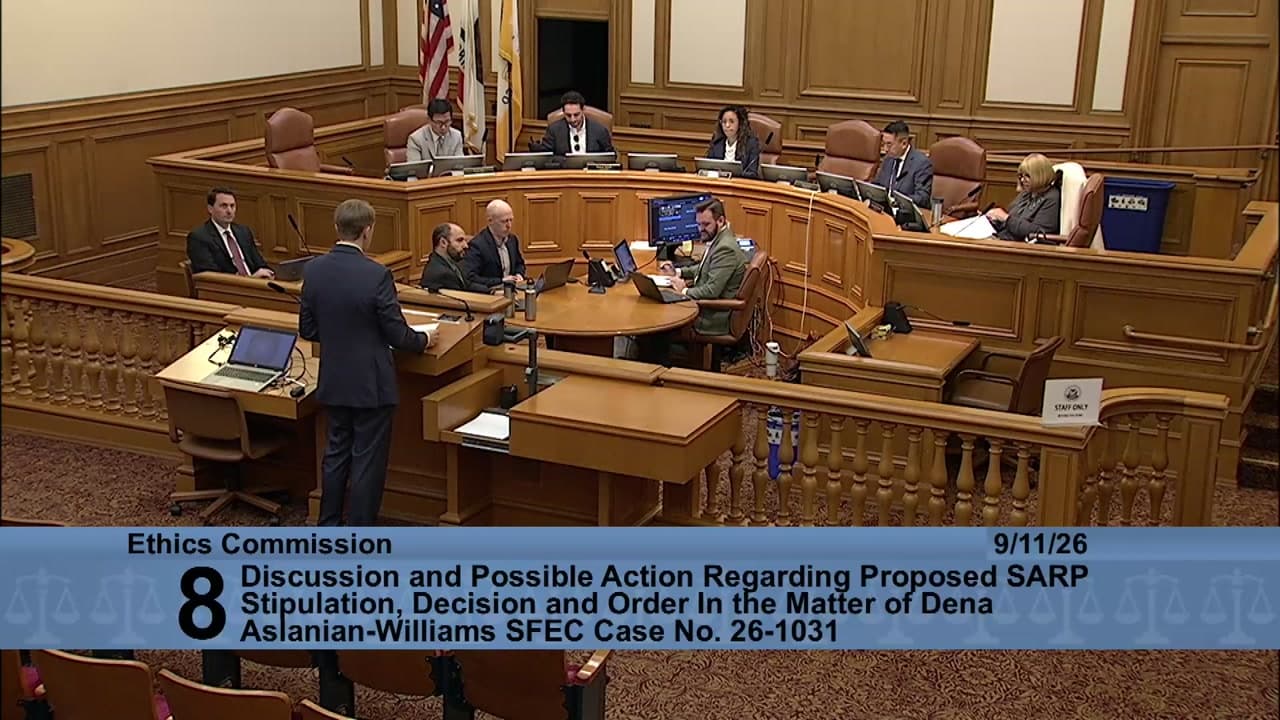
Where things stand: Eric Willett, Senior Investigator, presented two settlements under the commission's Administrative Resolution Program (SARP). The program handles lower-complexity, lower-harm violations. Both cases came out of the Enforcement Division's assessment of 2025 Form 700 filings and trainings.
- Dena Aslanian-Williams (SFEC Case No. 26-1031) is a former Homelessness Oversight Commission member and a current Elections Commissioner. She failed to meet Form 700 and training requirements, did not fully disclose reportable interests and acted while disqualified. The settlement imposes a $2,300 penalty across four counts.
- Janetta Johnson (SFEC Case No. 26-1037) is a member of the SOMA Community Stabilization Fund Advisory Committee. She had similar failures, and her settlement imposes a $600 penalty across three counts.
Both respondents completed corrective action on time. Staff found no aggravating factors in either case, which kept both in the first-tier penalty range.
Under questioning: Chair Flores Fang asked how the lapse occurred. Willett said the respondent was unfamiliar with how to disclose contract employment.
A commissioner asked whether older violations surface only because of a recent one. Willett said staff review the full filing history of anyone identified through the annual assessment. He added that the assessments appear to be working:
"Each year we have greater levels of compliance on the first go-round without that assessment having been conducted," said Willett.
Decisions and stakeholder impacts: Both stipulations passed. For: 5 (Commissioner Yeh, Commissioner Francois, Commissioner Tsai, Vice Chair Salahi, Chair Flores Fang). Against: 0. Absent: 0.
For the hundreds of city commissioners and advisory body members who file Form 700s, the message is that missed filings can come back years later. Penalties stay modest when filers fix their reports promptly.
No public comment was received on Item 8. On Item 9, one caller could not be heard and raised a procedural complaint instead (see below).
A Website Move Forces a Campaign Ad Fix
Why it matters: Every campaign ad and electioneering communication in San Francisco must point voters to sfethics.org for financial disclosures. That address is about to change, and the disclaimer rule needs to change with it.
Where things stand: Tricia Lim, Policy Research Specialist, explained that state law requires cities and counties to move their websites to a .ca.gov domain by Jan. 1, 2029. The commission plans to move earlier.
The ordinance amends Sections 1.161 and 1.162 of the Campaign and Governmental Conduct Code. Rather than naming a new URL, it would require disclaimers to cite whatever address the commission designates. That avoids another ordinance if the address changes again.
"This update simply ensures that the website address included in these disclaimers remain current," said Lim.
Lim said the substance of the disclaimer is unchanged and no concerns surfaced in interested-persons meetings. Board of Supervisors President Mandelman is sponsoring the ordinance.
The policy backbone: The fix is one recommendation pulled from last year's streamlining project. That project's three ordinances were continued at the Board's Government Audit and Oversight Committee in July and have not been rescheduled. Splitting off the time-sensitive piece keeps it from waiting on the larger package.
Chair Flores Fang asked whether the move would complicate the pending legislation. Michael Canning, Policy and Legislative Affairs Manager, said the campaign finance ordinance will return to the commission anyway, and any duplicate language could be removed then.
"Spinning this out of the campaign finance ordinance from last year shouldn't cause any complications with that one," said Canning.
Decisions and stakeholder impacts: The ordinance passed. For: 5 (Commissioner Yeh, Commissioner Francois, Commissioner Tsai, Vice Chair Salahi, Chair Flores Fang). Against: 0. Absent: 0. Campaigns, committees and the vendors who produce their ads will need to watch for the commission's designated address once the switch happens.
What's next: The ordinance requires a supermajority at both the commission and the Board of Supervisors. It now heads to the board.
Minor Items
- Consent calendar adopted 5-0, including draft minutes of the Aug. 14, 2026, regular meeting.
- Callers on Items 9 and 11 said dial-in failed and demanded a meeting redo. The clerk said earlier queues showed no raised hands. "The control room confirmed that the technical problem was on the caller's end," said the clerk. The commission took no action on the request.
- Executive Director's Report and quarterly reports were not taken up on the record. These covered enforcement, audits, and engagement and compliance.
- No items proposed for future meetings. Both general public comment periods drew no speakers.
Looking ahead: The disclaimer ordinance needs a Board of Supervisors supermajority. The broader streamlining package remains parked at the Government Audit and Oversight Committee with no hearing date.