
Entertainment Commission - Jun 02, 2026 - Meeting

Entertainment Commission - Jun 02, 2026 - Meeting

Entertainment CommissionSan FranciscoJune 2, 2026

Sources:

Locunity is a independent informational service and is not an official government page for this commission.We use AI-assisted analysis and human editorial review to publish information.

Sacred Taco Wins Conditional Permit After Three Citations and Marina Neighbor Showdown

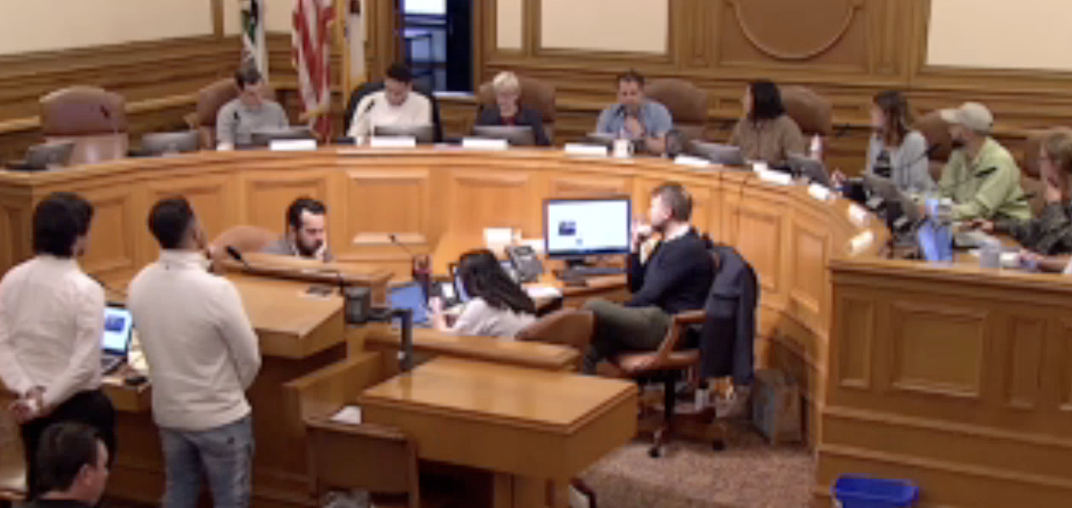
The San Francisco Entertainment Commission approved four entertainment permits, continued a smoke-free bar patio bill indefinitely, and heard a wave of policy updates — from new entertainment zones launching across the city to cannabis café legislation clearing the Planning Commission — during a nearly two-hour meeting on June 2.

  • Sacred Taco in the Marina gets indoor entertainment permit but only four days a week after three citations for unpermitted late-night events and a neighbor's 18-page evidence binder

  • Smoke-free bar patio legislation shelved as the Board of Supervisors pulls the bill with no return date; industry and public health advocates clash sharply over worker safety

  • Entertainment zones launch in North Beach, Fisherman's Wharf, and Belden Lane; cannabis café legislation and a ticket resale cap also advance

  • Sunset Cantina wins outdoor music permit in the Outer Sunset over residential objections; Commission educates neighbors on enforcement framework

  • Phoenix Hotel's new owners secure Place of Entertainment permit for the iconic Tenderloin courtyard venue

  • Commission requests new economic impact study from the Controller's Office, noting the last one is over a decade old


Three Strikes, Four Days: Sacred Taco's Permit Fight

The most contentious hearing of the night centered on Sacred Taco at 1875 Union Street, a Marina restaurant seeking a limited live performance (LLP) permit after receiving three citations for hosting unpermitted entertainment — including events running past midnight.

Why it matters: The Commission's decision to restrict entertainment to just four days a week signals that a history of violations can narrow the scope of a new permit — a compliance-based precedent that other applicants may want to note.

Where things stand: Staff presented the case, noting the restaurant features a rear private event space with a glass roof and skylight structure that allows sound to escape into the neighborhood. Deputy Director Kaitlyn Azevedo detailed the enforcement history: "We issued a notice of violation and then we issued three citations, actually, because the entertainment continued. Unpermitted entertainment continued."

A neighbor identified as Robert, a resident of 2816 Laguna Street, presented a detailed evidence binder arguing four grounds for denial. He contended the performance area is 864 square feet — well above the 200-square-foot LLP limit — and that the venue's own advertising on PeerSpace and Eventbrite showed ticketed DJ events running past 2 a.m. "The rear yard contains a total of 864 square feet," he said, arguing the space "functions as a commercial nightclub rather than a restaurant with incidental entertainment."

Staff clarified a key regulatory distinction. Deputy Director Azevedo explained: "The 200 square foot requirement for the LLP permit is the performance area. So the dimensions of the performance area, which is what we consider the space that the performers occupy." That measurement applies only to where performers stand, not the entire room.

The other side: The applicant, Christian, acknowledged past violations, said he had paid fines and ceased entertainment, and committed to an 11 p.m. hard stop. He said the ticketed DJ events that appeared in online listings were not organized by him. President Ben Bleiman disclosed that he had previously owned the property at 1875 Union Street and had dealt with similar sound issues there. "So I used to own this place actually, and we had issues. Ongoing conversations with the neighbors who lived right there," he said, suggesting sound-absorbing blankets over the skylights as a practical mitigation.

Executive Director Maggie Weiland was candid about the violation history: "I like to give applicants the benefit of doubt, but it does give me pause with the three notices of violation." She proposed limiting entertainment to certain days of the week.

Decisions: The Commission approved the LLP permit unanimously, 7-0, but with modified conditions: indoor entertainment limited to Friday, Saturday, Sunday, and Monday, 11 a.m. to 11 p.m. Doors and windows must remain closed during entertainment, and the applicant must post a direct contact number and comply with the good neighbor policy.


Smoke-Free Bar Patios: Bill Shelved, Debate Rages

The Commission continued its review of BOS File 260361, which would ban smoking on bar patios, after learning the Board of Supervisors had pulled the bill to the call of the chair with no timeline for its return. Despite the procedural continuance, three public commenters delivered extensive, passionate testimony that crystallized the split between the nightlife industry and public health advocates.

Why it matters: Over 100 California cities already require smoke-free patios. San Francisco's delay leaves nightlife workers and patrons in regulatory limbo on secondhand smoke exposure — and the hearing laid bare the enforcement gap at the center of the debate.

Where things stand: Steven Torres, a former entertainment commissioner and nightlife industry advocate, argued the ordinance lacks any real enforcement mechanism and would instead punish the workers it claims to protect. "There is no mechanism for enforcement aside from having workers be the enforcers of this ban and also be the people that would be directly penalized," he said, later calling the measure "virtue signaling masquerading as public safety." Torres noted his comments came days before the anniversary of the Pulse nightclub massacre and urged the Commission to focus on tangible worker protections.

The other side: Bob Gordon of the American Cancer Society Cancer Action Network, a Castro resident, urged support, citing historical precedents showing that restaurant and bar smoking bans did not hurt businesses and that clean air attracts more customers. Brian Davis, co-chair of the SF Tobacco Free Coalition, presented survey data: "174 of them said they would go more often and 178 said they would go as often if the city required all bar patios to be smoke free. That's 174 people who will stay longer, drink more and bring their friends." Davis also cited 13 SF bar patio workers who signed forms supporting the legislation and read testimony from workers and community members about health impacts.

Decisions: The Commission voted 7-0 to continue the item to the call of the chair, matching the Board's action. No return date was set.


Entertainment Zones, Cannabis Cafés, and a Ticket Resale Cap

Ben Van Houten of the Office of Economic and Workforce Development delivered a dense policy update covering state legislation, new entertainment districts, and cannabis consumption reform.

Why it matters: These policy changes could reshape San Francisco's nightlife landscape — adding new entertainment districts, creating cannabis social spaces, and protecting concertgoers from predatory ticket resale markups.

Where things stand: At the state level, AB 1720 (Assemblymember Haney) would cap independent venue ticket resale at 10% above face value. "That recently passed the Assembly, so it is now pending in the Senate and moving forward," Van Houten reported.

Locally, the Board of Supervisors adopted the mayor's legislation streamlining special event permitting for block parties and fairs, allowing SFMTA to administratively approve events of three blocks or fewer without ISCOT hearings. The Board also approved on first reading legislation establishing entertainment zones in North Beach, at the Ferry Building, and along Belden Lane. The Fisherman's Wharf Entertainment Zone was set to launch the following weekend.

On cannabis, Board President Mandelman introduced legislation implementing AB 1775, which would allow cannabis retailers to serve food and non-alcoholic beverages, expand consumption areas, and create new cannabis café permits. Van Houten described the vision: "This would enable the creation of spaces, starting with existing retailers being open to being able to open new spaces, spaces that are for consumption on premises only. So really truly social spaces for cannabis." The Planning Commission unanimously recommended the legislation.

The Board also passed legislation implementing Sen. Wiener's SB 395 to create 10 new non-transferable liquor licenses for Union Square and Yerba Buena restaurants. "10 licenses will be made available through a lottery process in fall 2026," Van Houten said.


Sunset Cantina: Outdoor Music Approved Over Residential Pushback

Sunset Cantina at 3414 Judah Street in the Outer Sunset won approval for an LLP permit covering indoor entertainment, daily outdoor amplified sound through a fixed speaker, and outdoor entertainment in the parklet once per month. The business had been playing outdoor music since opening in 2019 without knowing it needed a permit.

Why it matters: The hearing became a tutorial on the Commission's enforcement framework: President Bleiman used the case to explain to frustrated neighbors that a permitted venue gives them a department to call and a formal complaint process — unlike unpermitted operations, where the only recourse is calling police, who rarely respond to noise complaints.

The other side: Joe, a neighboring property owner, testified that amplified sound during Bay to Breakers penetrated his double-paned windows. Pavel Moloditsky, a resident at 3425 Judah Street since 1992, said the outdoor speaker runs noon to 10 or 11 p.m. daily and prevents him from opening his windows.

The owner, Brendan, said live entertainment would only happen six or seven times per year for events like Cinco de Mayo and Bay to Breakers. President Bleiman offered practical advice about repositioning speakers closer to patrons to reduce the volume reaching neighboring homes.

"When somebody comes under our jurisdiction, the neighbors usually are very opposed to it at first. And just for the record, we're unable to deny a permit if it meets the criteria," Bleiman told the neighbors, explaining that the Commission's enforcement framework provides better recourse than calling police.

Decisions: Approved 6-0 with Vice President Cyn Wang recused.


Phoenix Hotel's New Owners Take the Reins

New owner Alka Patel of Phoenix Hotel and Chambers TL LLC secured a change-of-ownership Place of Entertainment permit for the iconic venue at 601 Eddy Street in the Tenderloin. The hotel's courtyard has hosted entertainment under a POE since 2011.

Operations will remain the same: occasional indoor entertainment until 2 a.m., outdoor entertainment and amplified sound daily 9 a.m. to 10 p.m., not to exceed six hours per day. All events will be ticketed or private with security guards. Events Director Preeti Patel said the new ownership is taking things slowly, with only three events booked through year-end.

Previous owner Isabelle Manchester appeared in support, noting that most complaints over the years came from one longtime vocal neighbor and emphasizing communication as the key to success. Staff added a verbal calendaring condition requiring monthly event notifications to SFPD Tenderloin Station, the Commission, and interested neighbors.

President Bleiman praised the venue: "The Phoenix Hotel is like a gem that we just don't have in San Francisco. And it harkens to a real California scene that is more common in other parts of the state and we don't have here."

Decisions: Approved 6-0 with Commissioner Anthony Schlander recused.


Minor Items

  • Minutes approved from the May 19 meeting (7-0).

  • Howard House permit application continued to a future date due to an unresolved Planning Department issue (7-0).

  • Steps of Rome at 402 Columbus Avenue in North Beach approved for an LLP permit with outdoor amplified sound after previously operating without authorization; the Flasi family, who have operated Mona Lisa Restaurant since 1997, committed to prerecorded background music only. Four letters of neighbor opposition were received. Approved 7-0.

  • Mercury Cafe at 201 Octavia received a notice of violation after an inspector measured 92.8 dBA — nearly 10 dBA above its approved outdoor limit of 83 dBA. Commissioner Jordan Wilson reported 114 311 complaints since the last hearing. Staff announced it will not permit 10 South Van Ness past 2 a.m. going forward.

  • Club Dark at Oracle Park continues to draw bass complaints; staff described the venue as "a big huge tin can" where fire department requirements to keep doors open conflict with sound containment. Staff is meeting with Golden Voice and the Giants to pursue sound mitigation during the off-season.

  • 16th Annual Nightlife and Entertainment Summit drew 187 in-person attendees, 12 city departments, and nearly 300 online viewers on May 6. A new health and safety toolkit and compliance training video for nightlife businesses were launched.

  • Ira Sandler, longtime owner of 1015 Folsom since its 1987 opening, was mourned by the Commission. The meeting was adjourned in his honor at 7:27 p.m. Executive Director Weiland noted: "1015 nearly made it to 40 years under his ownership. They opened in 1987. So next year they'll be celebrating 40 years."

  • OEWD released RFQs and RFPs for museum sustainability consulting, an arts and innovation conference, the SF Live arts marketing campaign, and SF Music Week continuation.

  • Resident Jim Kelly, a 30-year resident of the 24th and Mission neighborhood, complained during general public comment about preachers using amplified loudspeakers for hours without permits. He said the noise is audible inside his home with windows closed. Commissioner Maria Davis directed him to email entertainment.commission@sfgov.org.

  • Economic impact study: Executive Director Weiland requested staff work with the Controller's Office to produce a new economic impact study of the entertainment industry, noting the last one was over a decade old and that outdated data was being cited at the nightlife summit.

  • Upcoming schedule: June 16 meeting with Deputy Director Azevedo acting as director; July 7 meeting canceled; July 21 election for commission president and vice president.

Sacred Taco Wins Conditional Permit After Three Citations and Marina Neighbor Showdown | Entertainment Commission | Locunity