
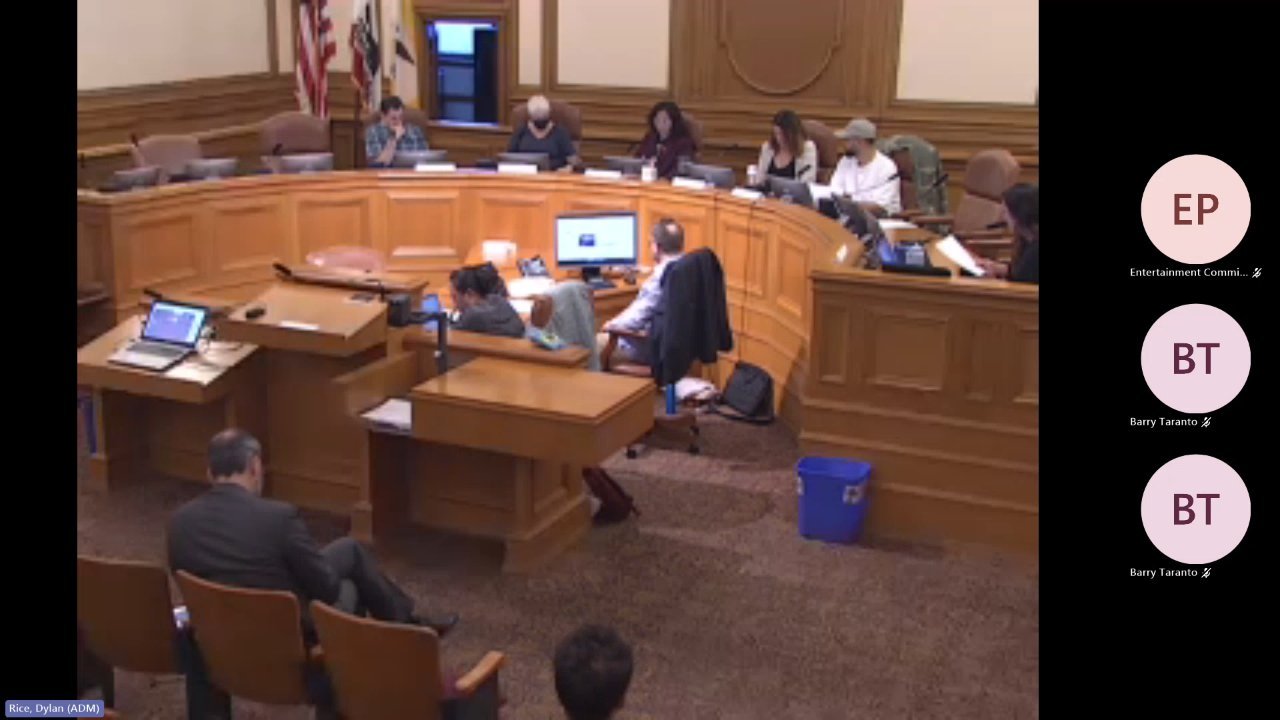
Entertainment Commission - Sep 01, 2026 - Meeting
Entertainment Commission • San FranciscoSeptember 1, 2026
Locunity is a independent informational service and is not an official government page for this commission.We use AI-assisted analysis and human editorial review to publish information.
Folsom Foundry Wins Nightclub Permit After Intensive Neighbor Mediation
The San Francisco Entertainment Commission's Sept. 1 meeting centered on a landmark permit decision for a Folsom Street nightclub — and a mediation process that could reshape how the city handles entertainment venues next to homes in SoMa.
Folsom Foundry at 1425 Folsom St. conditionally approved for a place of entertainment permit with outdoor amplified sound after the new owner and Juniper Street neighbors negotiated conditions on sound, security and emergency egress (4-0 vote, one recusal, one absent)
Three venues cited for sound and entertainment violations, including the Phoenix Hotel pool measured at 91.6 dBA against an 88 dBA limit
Key state nightlife bills die in Sacramento — a ticket resale price cap and extended weekend transit hours both stalled, while drink-spiking protections and a $20M music festival grant program head to the governor
Cannabis cafes cleared for entertainment permits after the mayor signed legislation allowing food, beverages and expanded consumption areas at cannabis retailers
Four new entertainment zones adopted in North Beach, Ferry Building, Belden Lane and Chestnut Street, with Lower Haight pending
Folsom Foundry: A Template for SoMa Nightlife?
The basics: Andrew Wasilewski of Folsom Foundry Music LLC applied for a change-in-ownership Place of Entertainment permit with outdoor amplified sound at 1425 Folsom St. The venue, previously operating under an LLP permit, became the first Folsom Street business to receive a POE after District 6 zoning changes in 2023. The new owner sought daily entertainment from 6 a.m. to 2 a.m. and outdoor amplified sound from 9 a.m. to 10 p.m., with a maximum of six hours per day and eight hours during the Folsom Street Fair and Dory Alley events.
Why it matters: This is the first nighttime entertainment POE ownership transfer on Folsom Street under the 2023 D6 zoning controls. The mediation-driven conditions negotiated here could become a template for how the Commission handles future entertainment permits near residential areas across SoMa — a neighborhood where the tension between a thriving nightlife economy and a small but rooted residential population is a defining political fault line.
Where things stand: Deputy Director Kaitlyn Azevedo presented two versions of staff recommendations — the original memo and an updated Sept. 1 version reflecting outcomes from an in-person mediation at the venue on Aug. 21 and subsequent discussions. She corrected the characterization of the neighbors' submission, noting it was not merely a "packet of concern" but a formal opposition: "The neighbor has asked that I clarify that what they submitted is actually a list of suggested additional conditions and that they are in fact asking the Commission to not approve the permit on the present record unless the identified issues are adequately addressed and there are clear and enforceable conditions."
Six permanent residents of Juniper Street — a residential block running parallel to the entertainment corridor on 11th Street, roughly 200 feet from the venue — had organized formal opposition focused on sound transmission through a ventilation vent providing a direct line of sight for noise, routine use of the Juniper Street emergency exit for nightclub operations, patron loitering, and rideshare pickups on their residential street.
Wasilewski told the Commission he had already begun spending money to address the core concerns. "We went to their home, tested inside, found that there is a direct line of sight to a ventilation vent in the side of our building that does provide direct sound transmission," he said. "I had meetings this morning with our architect and an HVAC specialist to look at plans to move those vents to our ceiling and put mufflers on them."
Through mediation, Wasilewski agreed to a detailed set of conditions: using the Juniper Street door for emergency egress only, posting security to direct patrons away from the residential street, installing HVAC modifications to block sound transmission, purchasing a sound limiter set to approved levels, installing a live decibel reader at the testing location, maintaining at least two security guards on weekdays and three on weekends, providing the top three manager contacts to residents, and limiting garage use on Juniper Street to items that cannot fit through the front door.
The other side: A Juniper Street resident spoke during public comment, thanking both the applicant and staff while explaining the deeper context behind the neighborhood's vigilance. The intensity of concern, the resident said, stems from longstanding problems with clubs on 11th Street. The six permanent residents feel "locked in" by the entertainment corridor, and the resident expressed hope the Commission would address the broader 11th Street issues going forward.
Commissioner Leonard Poggio pressed Wasilewski on security cameras, learning the venue has 16 cameras installed with two-year footage retention planned. Poggio accepted Wasilewski's pledge to make footage available to police for investigations rather than imposing a formal condition: "I'll take a pledge, and then if we have an issue where it's not made available to the police department, then we will reopen the permit."
Commissioner Maria Davis, speaking as the Commission's industry representative and a bar and club owner herself, recommended live camera monitoring: "I have found it makes things so much easier to have a live feed that you can refer to in real time. It really has made my job easier and has made disputes with neighbors or customers just go so much smoother."
Decisions: Wasilewski confirmed acceptance of all updated staff recommendations, telling commissioners: "I feel those recommendations do not affect the ability for us to operate our business successfully and also provide the best possible means for us and our neighbors to coexist peacefully." The motion to approve, made by Commissioner Davis, passed 4-0. Vice President Cyn Wang recused herself; President Ben Bleiman was absent. Commissioner Laura Thomas, who presided over the item, read the formal findings into the record, confirming no denial criteria under Police Code Articles 15.1 and 15.2 applied.
What's next: The mediation model piloted here — including in-home sound testing, HVAC commitments and detailed operating conditions — will likely be referenced in future SoMa permit applications. Commissioners signaled they would revisit the permit if the applicant failed to follow through on pledges around security footage and egress restrictions.
Sacramento Scorecard: Transit, Tickets and Drink Safety
Ben Van Houten of the Office of Economic and Workforce Development delivered the state legislative wrap-up. Several bills important to San Francisco's nightlife industry died as the two-year session closed.
AB 342 from Assemblymember Matt Haney, which would have extended weekend transit service hours, was held in the Senate Governmental Organization Committee. AB 1720, also from Haney, which would have capped ticket resale prices at 10% above face value for independent venues, died in Senate Appropriations. AB 668 from Assemblymember Josh Lowenthal, requiring drink-spiking test kits at large outdoor events with more than 10,000 attendees, met the same fate.
Two bills advancing to the governor carry direct implications for San Francisco venues. AB 1982 from Assemblymember Lowenthal would make permanent the expiring requirements for type 48 licensees to provide drink lids and testing kits, with improved signage language. Van Houten highlighted the upgrade: the current "Don't get roofied" signs would be replaced with professional alternatives reading, in part, "Drink spiking is a crime we take seriously … Drink lids and test kits are available. Ask a staff member for details."
SB 865 from Senator Bill Ashby would create a $20 million Music Festival Preservation Grant program targeting independent large-scale festivals with more than 60,000 total paid admissions.
The other side: AB 1349 from Assemblymember Isaac Brian, imposing new ticket listing and disclosure requirements, passed the legislature — but Van Houten noted it now faces a surprising backlash. "That bill did receive some recent criticism from some of the venue advocates who had originally supported the measure," he said. "There is certainly some advocacy happening from the National Independent Venue Association and others actually hoping that the governor vetoes that measure."
Cannabis Cafes Enter the Entertainment Pipeline
Van Houten reported that the mayor signed Supervisor Rafael Mandelman's cannabis cafe legislation, which enables cannabis retailers with consumption areas to serve food and non-alcoholic beverages, allows retailers to expand consumption areas beyond the previous one-third-of-premises limit, and creates a new cannabis cafe permit for retail spaces selling cannabis for on-premises consumption only.
Deputy Director Azevedo confirmed the Entertainment Commission's role: "We will be working in tandem, but we come pretty last in the order of operations. But yeah, absolutely. LLPs for all the cannabis cafes." Currently three to five cannabis retailers hold LLP permits from the Commission. The new category represents a meaningful expansion of the nightlife ecosystem — blending food service, cannabis retail and entertainment under a single regulatory umbrella.
Three Venues Cited for Sound Violations
Deputy Director Azevedo read the enforcement report covering 7,231 complaints received since the Aug. 18 meeting. Three venues were issued notices of violation:
Resto Bar/Area at 2300 Chestnut St. — cited for outdoor amplified sound without a permit; an inspector found a speaker playing prerecorded music outside, which is not allowed under the venue's LLP.
Chambers at the Phoenix Hotel, 601 Eddy St. — cited for exceeding outdoor sound limits during a DJ event by the pool. Inspectors measured 91.6 dBA and 113.9 dBC against approved limits of 88 dBA and 101 dBC. Inspector Young Rice worked with sound engineers on-site to reduce volume to compliant levels.
Roxton at 4753 Mission St. — cited for hosting a karaoke party after 11 p.m. in violation of LLP conditions.
Minor Items
August 18, 2026, meeting minutes approved 5-0 (President Bleiman absent).
81 Cedar controller appeal hearing scheduled for Sept. 17.
Four new entertainment zones adopted — North Beach, Ferry Building, Belden Lane and Chestnut Street — with a Lower Haight zone pending before the Board of Supervisors.
ABC annual liquor license applications open in September, including type 87 non-transferable restaurant licenses available in Bayview, San Bruno Avenue, Excelsior, Ocean Avenue and outer Sunset corridors, plus the new downtown hospitality zone near Union Square. Leland Avenue has reached its cap with no licenses available this year.
OEWD Disaster Relief grants reopened, offering up to $10,000 for businesses damaged by fires or vehicular accidents, available first-come, first-served.
Commissioner Maria Davis resworn as industry representative. Commissioner Leonard Poggio reappointed through July 2030.
Commissioner Laura Thomas praised Deputy Director Azevedo's mediation work: "I appreciate so much the work that Caitlin does in mediating and improving communication between applicants and neighbors."