
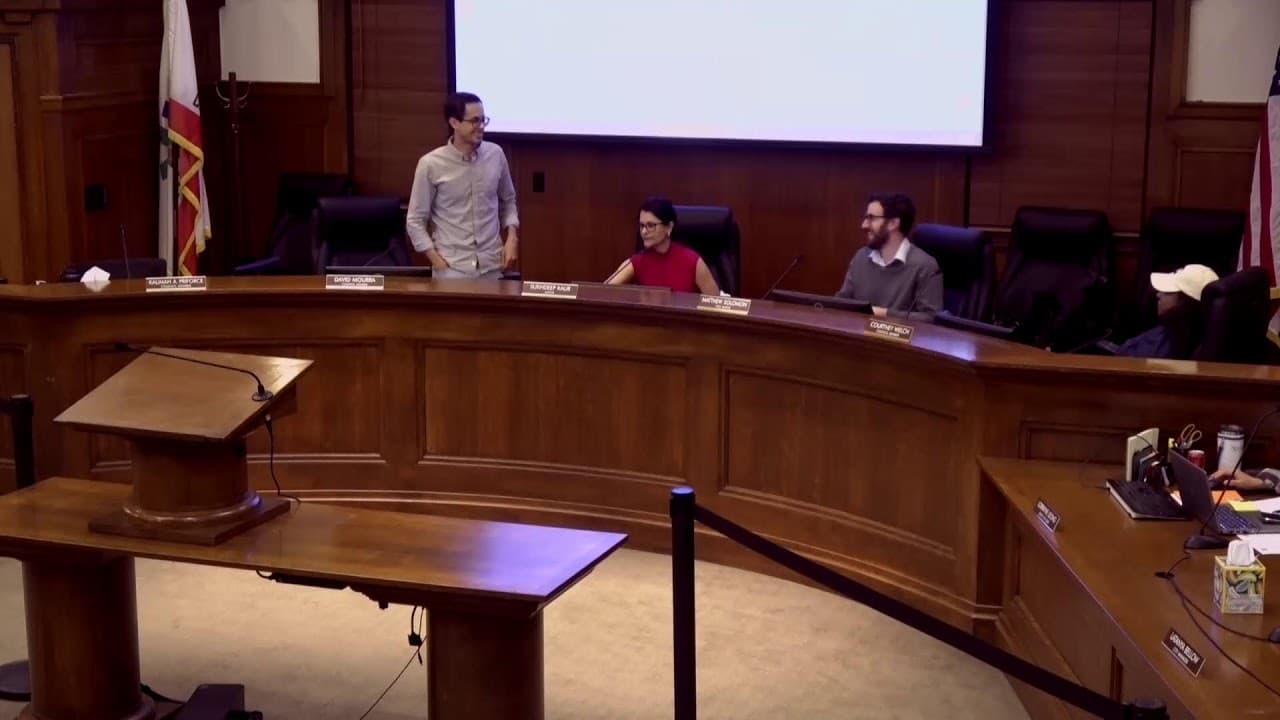
Emeryville Council Charts Biggest Tenant Protection Overhaul Since 2017
City Council • EmeryvilleOctober 6, 2026
Locunity is an independent informational service and is not an official government page for this commission. All information is sourced from public footage and an analysis of official agendas with the aid of responsible, fact-checked AI. to report an error or omission.
Emeryville is preparing its most significant expansion of renter protections since its eviction ordinance took effect in April 2017. At an Oct. 6, 2026, study session, the City Council steered staff toward drafting roughly 35 amendments. It held back on the costliest pieces, including a rental registry and city-funded emergency relocation, until it sees price tags.
- Tenant protection overhaul advances to drafting, with an ordinance expected around year-end.
- 2,108 eviction notices in about 2.5 years, 96% for unpaid rent, drive the push.
- Council backs a one-month-rent threshold before landlords can issue 3-day notices.
- Rental registry and emergency relocation aid stall pending cost estimates.
- Pro-Housing application approved 5-0, seeking 89 points where 30 are required.
Tenant Protections Move Toward an Ordinance
The basics: Emeryville's eviction rules sit in Municipal Code Title 5, Chapter 40. An "unlawful detainer" is the court filing that formally starts an eviction. A 3-day notice is the landlord's demand to pay rent or leave.
Why it matters: The city's data shows how often evictions start over small debts. Of 2,108 termination notices, 635 involved less than $1,000, and about 65% contained errors.
Where things stand: Economic Development and Housing Manager Valerie Bernardo framed the night as a request for direction. "We're not asking you guys to adopt the ordinance this evening," she said. The work is funded in part by a Metropolitan Transportation Commission Transit Oriented Communities grant, with consultant Placeworks.
The city has tracked eviction data since 2022. Over that period it logged 12 no-fault notices and 401 unlawful detainer filings. Staff's main recommendations include:
- Treat REITs, corporations and LLCs as large landlords regardless of size.
- Extend coverage to live-work units.
- Limit owner move-ins to once every five years. The owner would need a 50% ownership stake and would have to move in within 90 days.
- Bar no-fault evictions of households with school-age children during the school calendar.
- Create three tiers of relocation aid. Displacements of two to five days would earn a per diem. Six to 29 days would earn comparable housing or 3x/2x prorated fair market rent. Displacements past 30 days would earn permanent relocation.
- Expand anti-harassment rules and adopt a standard tenant rights form.
Staff also proposed requiring at least one month's fair market rent in arrears before a 3-day notice can issue. Other proposals would set minimum damages of 3x plus fees and require landlords to file notices with the city. Under the filing rule, "failure to file is an affirmative defense against the eviction," Bernardo said. Mayor Sukhdeep Kaur said the rent threshold "seems to be reasonable, and we can proceed with that."
Right to organize: Staff proposed tenant associations in buildings of five or more units, triggered by a 50% tenant petition. Councilmember Kalimah Priforce suggested a 10% to 20% model for large buildings, and staff answered, "Absolutely." He noted that the California Apartment Association had sent a letter discouraging changes just before the meeting. He then recused himself from the final policies, so four members handled the second half.
Decisions and stakeholder impacts: Council backed grandparent and grandchild move-ins, moving-cost help for tenants with disabilities, and higher Tier 3 payments from small landlords. Staff explained the Tier 3 change: without it, "it is more beneficial for a tenant to be evicted than it is for a landlord to pay temporary relocation." A proposed benefit for vulnerable populations stalled. Councilmember David Mourra worried landlords would avoid renting to those tenants, Priforce disagreed, and Kaur asked for more detail.
What's next: Staff expect to return around year-end with an ordinance and cost estimates. It would take effect about 120 days after adoption.
Registry, Relocation Aid Hit a Cost Wall
Why it matters: The fights that remain are about money. Each would require ongoing city spending or fees that could reach tenants.
Where things stand: The proposed rental registry would collect addresses, unit counts, ownership and contacts, but not rents. Registration would be tied to whether a 3-day notice is valid. Staff cited comparable fees of about $50 per unit in Newark and about $5 in Concord, and said local estimates are not yet developed.
The other side: Mourra opposed spending resources exploring the registry. "I'm a little concerned about the cost to administer them," he said. Vice Mayor Matthew Solomon liked the idea in theory but asked about collecting rents and costs. Priforce called the registry "connective tissue" for enforcement.
Kaur set the bar: "I think it would be fair for the staff to return with the estimated cost, annual cost, the proposed per-unit fee, and staffing requirements and privacy protections."
Emergency relocation: State law lets cities advance relocation payments when a government order forces tenants out and the landlord doesn't pay. Cities can then recover the money plus a penalty of up to half, capped at $10,000, and place a lien on the property. Staff said such "red-tag" orders are very rare and know of one past case. They have set aside $15,000 in the Operation Dignity contract for a pilot.
Mourra first objected: "But I don't think that we have the ability to fund every well-intentioned good cause out there." Solomon said, "I would be in support of this." Priforce urged a cost analysis, and Mourra later accepted costing.
Education gap: Kaur asked, "should we establish a stronger additional outreach program so both tenants and landlords understand the rules?" Staff answered that education is "huge" but the city lacks a database of landlords and tenants to reach them. Only three people attended the last in-person training. Staff said fact sheets and the standard rights form are planned.
Public voices:
- Vicki Josuel, a two-unit landlord, offered a low-cost fix: "you could send me that information with my business tax bill and I would read it."
- Maya, a renter and disabled domestic violence survivor, urged hybrid fair-housing education. She agreed the 50% organizing threshold is hard to meet in large buildings. "I applied to over 70 apartments before I was able to get a habitable wheelchair-accessible apartment that would take my housing voucher," she said.
- Adam Morton, senior staff attorney at the California Center for Movement Legal Services, pressed for registry rent data and stronger civil remedies. "Presently the anti-harassment provisions in Emeryville don't really do anything," he said.
- Another resident called the proposal a "baby step." "Emeryville is just very, very pro-business and not so much pro-resident," the resident said.
What's next: Staff will return with costing on the registry, fees, emergency relocation and vulnerable-population benefits.
Council Seeks Renewed Pro-Housing Status, 5-0
Why it matters: The city's prior state Pro-Housing designation brought nearly $600,000 in 2024. The current designation expires Jan. 1, and renewal could improve Emeryville's competitiveness for state housing funds.
Where things stand: The state Department of Housing and Community Development requires only 30 points for designation. "As you can see here, we're seeking 89 points," city staff told the council. Inclusionary zoning is the only remaining two-year commitment, expected by mid-2027. All three public commenters spoke in favor. Community Development Director Chadrick Smalley reported that at its Sept. 24, 2026, meeting "the commission unanimously recommended that the City Council approve the application."
Kaur asked about Measure C, a $50M housing bond about 9% spent through fiscal year 2025, and about the Nellie Hannon Gateway project. Staff will send updated figures.
Decisions and stakeholder impacts: Mourra moved approval and Solomon seconded. "We are a small city, but we're definitely a leader in this area," Mourra said. The vote was For: 5 (Kaur, Solomon, Mourra, Priforce, Welch), Against: 0, Absent: 0. Affordable housing developers and the city's grant pipeline stand to benefit most.
Minor Items
- Police chief raises: The consent calendar, approved without audible dissent, gives the police chief 3% raises in 2026, 2027 and 2028, a 1% market adjustment and a $1,000 non-pensionable lump sum. Only part of the roll call could be clearly confirmed.
- Arts honors: Cal Cities' Sam Brightman presented the Helen Putnam Award for the Rotten City Cultural District, one of 12 winners statewide.
- Proclamations: The council honored Folkmanis Puppets' 50th anniversary and declared October 2026 Art and Culture Month.
- Wage signal: Priforce said he will consult staff on "expanding the minimum wage to $30 an hour" and on data center moratoria.
- Pledge request: A request for a Pledge of Allegiance study session lacked majority support.
Looking Ahead
Watch for the tenant protection ordinance and its cost estimates around year-end. Kaur also reported that an amended Murrieta land-use resolution passed at the Cal Cities General Assembly, and Cal Cities will form a working group on local land-use authority and affordable housing funding.