
El Cerrito Council Shelves Advisory Board Overhaul After Public Pushback
City Council • El CerritoNovember 17, 2026
Locunity is an independent informational service and is not an official government page for this commission. All information is sourced from public footage and an analysis of official agendas with the aid of responsible, fact-checked AI. to report an error or omission.
El Cerrito's push to shrink, merge and disband citizen advisory bodies stalled Nov. 17, 2026, after more than two dozen speakers lined up to defend them, most of all the Financial Advisory Board. The council took no vote on the study session's eight recommendations. Instead, members agreed to have staff plan a town hall, likely after the new year. The council also approved a three-year police contract and a $43,000 traffic safety grant, with one condition attached to the grant.
- No action on eight proposals to restructure advisory bodies; a town hall is next.
- Speakers rally behind the five-member Financial Advisory Board, rejecting a two-member council committee.
- Police contract approved 4-0: 3% annual raises through June 2029, plus a $75,131 appropriation.
- $43,000 traffic grant accepted, but staff must first explain any pedestrian enforcement.
- Streaming services may soon pay the city's 8% utility users tax, according to staff.
Advisory Body Overhaul Hits a Wall
The basics: A two-member ad hoc committee, Mayor Gabriel Quinto and Mayor Pro Tem Rebecca Saltzman, reviewed SB 707, data from surrounding cities, a member survey and staff workload. SB 707 is a state law that gives eligible advisory bodies more flexibility to meet by teleconference. The committee estimated advisory bodies consume roughly 65 to 70 staff hours a month, about $210,000 a year, plus about $27,000 for membership support.
Where things stand: The committee made eight recommendations:
- Take no action on SB 707 teleconferencing while moving to hybrid public participation.
- Cut maximum committee membership from 15 to seven.
- Align committee appointments with those for commissions.
- Merge Arts and Culture with Human Relations.
- Merge Parks and Recreation with Urban Forest.
- Consider disbanding the Economic Development Committee.
- Restructure the Financial Advisory Board as a council standing committee.
- Move advisory bodies to bimonthly meetings.
Saltzman set the tone early: "We are not going to vote on any of this tonight," said Saltzman.
Quinto framed the effort as a fix for attendance problems. "We've been having difficulties in achieving a quorum on many of the committees and the boards that exist in the City of El Cerrito," said Quinto. He backed combining Parks and Recreation with Urban Forest and said he was open on the advisory board question.
The other side: Committee chairs and members spoke against the plan in an organized show of opposition. "I'm here to express my strong opposition for the proposed consolidation of our commission with the Art Commission," said Champagne Brown, chair of the Human Relations Commission. She disputed claims that the two bodies had a history of collaboration and noted that her commission has no funding.
Jean Shrem, chair of the Economic Development Committee, described the events her volunteers run. "I respectfully request that the council direct staff to retain the Economic Development Committee," said Shrem.
Robin Mitchell, a member of the Urban Forest Committee, objected to the process itself. "I urge you not to accept the proposal as written and to create a new ad hoc committee to review the issue in more depth," said Mitchell.
A few speakers sided with the ad hoc committee's diagnosis. Megan Steffen, a public commenter, called committees too heavy. "We need ways for people to engage that aren't exclusionary, where you don't have to apply and you don't have to be an expert to have the right to speak your mind and help shape a decision," said Steffen.
Decisions and stakeholder impacts: The council was divided in tone, if not in outcome.
- Councilmember Carolyn Wysinger urged restraint. "I don't want us to kind of go scorched earth yet," said Wysinger.
- Councilmember Lisa Montoyama raised opportunity cost and flagged "bullying staff, that's an issue too, and I think that is completely unacceptable."
- Councilmember William Ktsanes defended the committees as channels for public engagement.
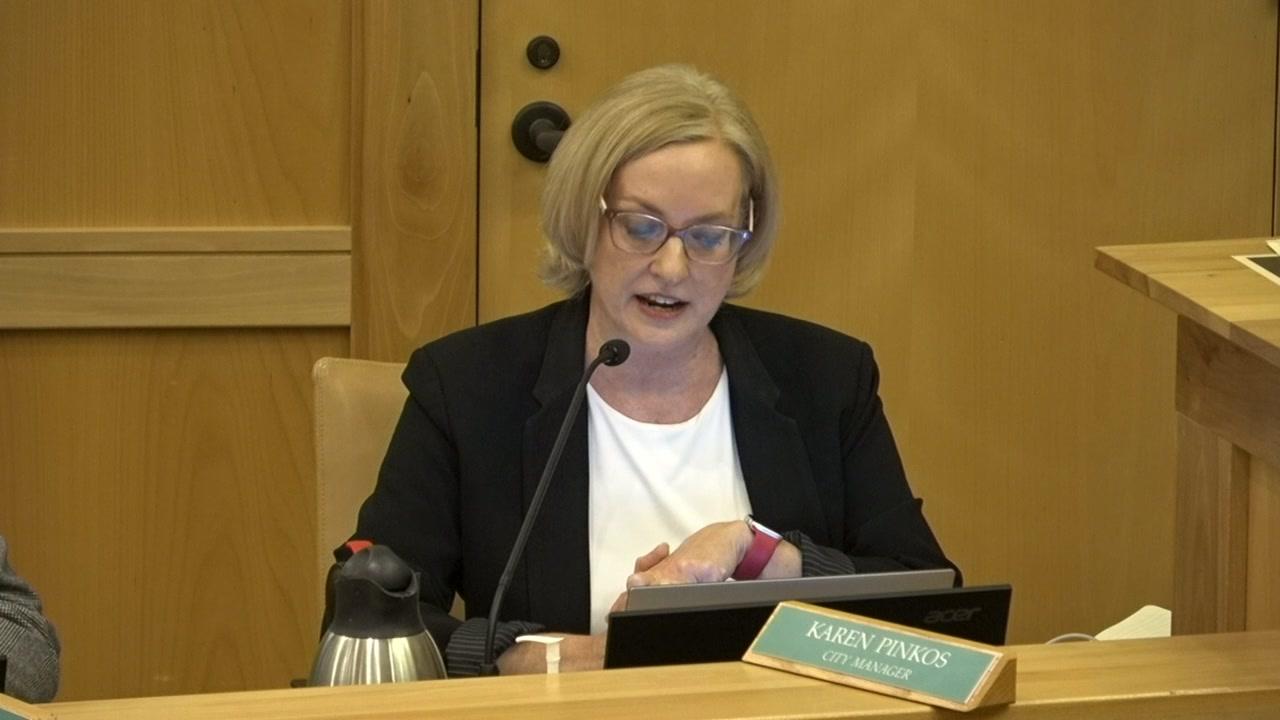
The city manager and city attorney explained why staff support is needed to keep meetings compliant with the Brown Act, California's open meetings law. On the idea of having members prepare their own agendas and minutes, the attorney was blunt. "I do not believe it has been successful," said the city attorney.
Volunteers keep their seats for now. Every proposal remains unresolved and will pass to the incoming council.
What's next: Staff will plan a town hall, likely after the new year. Ktsanes asked for a two-way format: "I do want communication to go both ways," he said. SB 707 required no formal action.
The Fight Over Financial Oversight
Why it matters: The Financial Advisory Board drew the sharpest defense of the night. Its members argue that voter-approved tax measures promised independent citizen oversight of city finances.
Where things stand: The ad hoc committee offered two options. The first would replace the board with a two-member council committee. The second would add one resident expert to that committee. Saltzman rejected claims that a council committee would meet out of public view. "It would be a Brown Act committee, we would have to do the meetings in public," said Saltzman.
Ktsanes, a former board member, pushed back on the options. "The Financial Advisory Board was instrumental in making sure we adhered to the State Auditor and her recommendations," said Ktsanes. He said he would support keeping the full board and adding two council liaisons.
The other side: Mike McDougall, a Financial Advisory Board member speaking for himself, cited oversight language in Measures A, R, V, H and G. He acknowledged the board needs to be more effective. "I think that it would be disingenuous to use flexibility to remove the core promise, which is that a dedicated group of citizens are tasked with keeping an eye on city finances…" said McDougall.
David Carvel, also a board member, said the board's recent missed meetings came at the city's direction, not from a lack of quorum. "In regards to the two options around FAB, I reject both," said Carvel.
Several other public commenters also urged the council to keep the board independent:
- Jean Liu called the board a cost-saving, expert volunteer body.
- Barbara Chan said keeping it would help rebuild trust.
- Richard Brooks said its expertise could not be bought at the costs staff presented.
- BJ Thorsness suggested expanding the board by two members and televising its meetings.
A few speakers, including Steffen, noted the board's inconsistent recommendations.
Decisions and stakeholder impacts: The council gave no direction on the board. That leaves its five members in place heading into what speakers described as tougher budget years.
Traffic Grant Approved, With a Pedestrian Caveat
Where things stand: Police Capt. Lauren Caputo presented a $43,000 grant from the National Highway Traffic Safety Administration, administered by the California Office of Traffic Safety. The grant runs through Sept. 30, 2027, and is reimbursable. It covers:
- Two DUI and license checkpoints.
- Four DUI patrols.
- Officer training.
- Six targeted operations, including distracted driving and pedestrian and bicycle safety.
- Community education.
Saltzman argued that drivers pose the greater danger and questioned what pedestrian enforcement would mean in practice. "So you're going to go ticket people for jaywalking?" she asked. "So it goes both ways for both pedestrians and vehicles," Caputo replied.
The other side: Public commenters split on the question. "The pedestrian thing seems like it should be more of an education than an enforcement," said Mitchell. Sue Duncan, a public commenter, disagreed: "Some pedestrians will walk against a red light. They should be cited."
Mitchell also asked whether the grant could target speeding. Caputo explained that speed enforcement requires engineering surveys and officer certification.
Decisions and stakeholder impacts: Saltzman moved approval "with the stipulation that we get a memo on what the pedestrian— if there is going to be pedestrian safety enforcement, what that will look like before it happens."
The motion carried on a roll call:
- For: Quinto, Saltzman, Ktsanes
- Absent: Wysinger
- Montoyama's vote was not recorded.
What's next: Staff owes the council a memo before any pedestrian enforcement begins.
Police Contract Locks In Raises Through 2029
Where things stand: The new memorandum of understanding with the El Cerrito Police Employees Association runs from July 2026 through June 2029. It covers 33 sworn and 10 non-sworn positions. Human Resources Manager Shannon Bassi outlined the terms:
- Base pay rises 3% each July in 2026, 2027 and 2028.
- Market adjustments add 1%, 0.5% and 0.5% in those years.
- The comp time bank grows from 175 to 180 hours.
- The meal allowance rises from $15 to $20.
- Bilingual pay changes to $50 per payroll.
The money: The resolution appropriates $75,131 from the FY26-27 general fund unassigned balance. An estimated $113,859 for FY27-28 will be handled at the mid-cycle budget.
The other side: Ktsanes supported the agreement but questioned the funding source. "It doesn't make sense to use a fixed amount of money to fund a cost that's not fixed," said Ktsanes. He floated a contingent amendment.
Finance Director Crystal Reams answered that the city would draw only on about $1.6M of discretionary balance. "So we're not actually dipping into our reserve target. We're dipping into that discretionary balance," said Reams. The city's reserve target is 17%. Ktsanes accepted the explanation.
Decisions and stakeholder impacts: The contract passed. For: 4 (Quinto, Saltzman, Ktsanes, Montoyama), Against: 0, Absent: 1 (Wysinger). Officers get predictable raises. The city takes on ongoing costs it is paying for with one-time fund balance for now.
Streaming Tax Could Plug Cable Losses
Where things stand: Budget and Financial Services Manager Claire Coleman said first-quarter revenues and spending are tracking as expected. She explained that early-year data looks uneven because revenue arrives late while costs come early in the year. For that reason, she recommended dropping the year-over-year percent-change column from first-quarter reports. Public safety personnel costs are running slightly high because the police department has fewer vacancies. Staff cited an anticipated year-end reserve of $22.7M.
Why it matters: At Montoyama's request, staff explained the city's 8% utility users tax on video services, which voters reaffirmed in 2004. The tax closely resembles Santa Barbara's, which an appellate court held applies to streaming. "We think we're in a very strong position to have that tax applied to video streaming services," said the city attorney.
Streaming providers appear to be agreeing to comply. Coleman cautioned that the money would make the city whole for declining cable revenue, not produce new revenue.
The other side: Carvel objected that the report left out the capital improvement fund. He opposed using that fund for tennis court repairs and asked for before-and-after balances at each update. Staff said an update on the capital improvement program is coming.
What's next: The report was received and filed, with no action. A mid-year review is expected around Jan. 19.
- Sgt. Sid Hubbs honored: The council approved a resolution for the retiring sergeant, who helped build the drone program and investigated more than 400 collisions. For: 5, Against: 0, Absent: 0.
- Consent calendar passed 5-0: Questions revealed $23,660 remains for council travel and that the Cerrito Vista Park tennis courts still need base repairs.
- Crosswalk complaints: Sarah Beth George urged quick fixes to missing markings at Potrero and Blake. "People should not have to risk being seriously injured just to cross the greenway and use the street," she said.
- School hate incidents: Wysinger described tar placed at Kensington Elementary and urged residents to talk with their children, saying "we do not stand for hate in this city."
- Air District appliance rule: Quinto said the board pushed its heat-pump rule to 2028; he had wanted 2029. His last Air Board meeting is Dec. 9.
Looking ahead: A community open house on Saturday, Nov. 21, will cover zoning changes near the El Cerrito Plaza and del Norte BART stations. The city must consider those changes to keep receiving transportation funding from the Metropolitan Transportation Commission (MTC). Sandbags are available at the recycling center, up to 10 per household, ahead of forecast heavy rain. The meeting adjourned in memory of former Fire Chief Mark Scott. The council meets next on Tuesday, Dec. 1, at 6 p.m.