
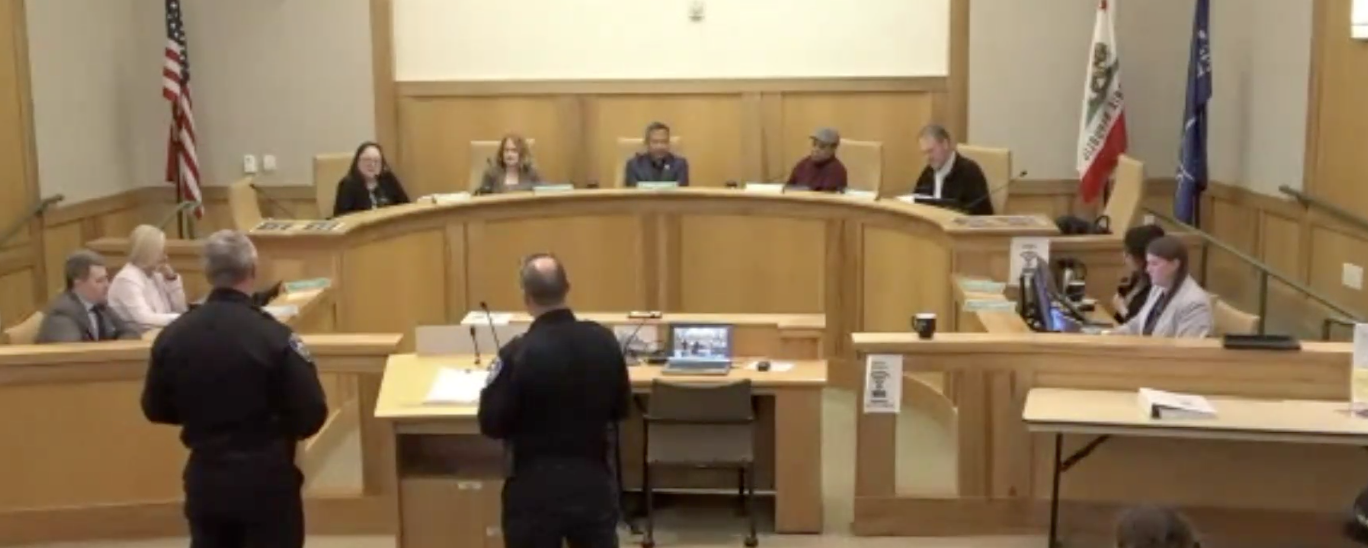
City Council - Apr 21, 2026 - Regular Meeting

City Council - Apr 21, 2026 - Regular Meeting

City CouncilEl CerritoApril 21, 2026

Sources:

Locunity is a independent informational service and is not an official government page for this commission.We use AI-assisted analysis and human editorial review to publish information.

Council Delays Flock Surveillance Contract After Massive Public Backlash

El Cerrito's City Council pumped the brakes on renewing a controversial license plate reader contract after 27 residents packed the chambers to oppose it, then reluctantly voted to begin converting to district-based elections under legal threat — all while staring down a biennial budget squeezed by soaring insurance costs and potential loss of a key revenue source.

  • Flock Safety camera contract punted to May 5 after 27 speakers overwhelmingly urged non-renewal; council demands shorter-term options and invites the ACLU to present
  • District elections forced by anonymous CVRA demand letter; council unanimously adopts resolution to transition by 2028 despite calling the process a "shakedown"
  • Budget study session flags 19% insurance spike, potential loss of 8–9% of general fund revenue if property transfer tax is banned statewide
  • Military equipment ordinance renewed; police seek one additional American-made drone at $15K premium over banned Chinese models
  • Measure C senior exemption broadened ahead of June 1 library tax vote, removing reverse-mortgage and equity requirements
  • Trail Trekkers press for $113K annually in path signage and maintenance funding, describing years of staff resistance to volunteer projects

Flock Cameras Hit a Wall: 27 Speakers, Zero Support for Renewal

The most contested item in years consumed nearly 90 minutes of public testimony and extensive council deliberation as El Cerrito weighed whether to renew its three-year contract with Flock Safety, the Atlanta-based company whose 40 license plate reader cameras dot the city's streets.

The basics: Flock Safety's automated license plate recognition (ALPR) cameras photograph every vehicle passing their location, storing plate data that can be searched by law enforcement. The system is shared across a network of more than 1,000 agencies nationwide.

Why it matters: In a city that has declared itself a sanctuary jurisdiction, residents fear the mass vehicle-tracking data could be exploited by federal immigration authorities — a concern amplified by the current political climate. The debate forced the council to weigh documented public safety gains against foundational civil liberties questions no local contract can fully resolve.

Where things stand: Police Chief Paul Keith presented three options: auto-renew the existing three-year deal, decline auto-renewal and enter a renegotiated agreement that includes a $34,500 penalty for unauthorized data sharing, or terminate entirely. Keith made the crime-reduction case forcefully: "We experienced the lowest burglary rate we've had in 40 years, the lowest car theft rate we'd had in 40 years, and the second lowest robbery rate we've had in 40 years." He also reported a 10% increase in violent crime clearance rates.

But Keith also disclosed a troubling finding from internal audits: "After we turned on our account controls, we had two unauthorized accesses by federal agents. One was the U.S. Postal Service Investigations Unit and the other was the Veterans Affairs Police Department." Both were discovered and addressed, he said, and the renegotiated contract adds multi-factor authentication and prevents California departments from opting into out-of-state data sharing.

Councilmember William Ktsanes set the tone for the dais, calling this "the most consequential item that's come before us" in his 18 months on council. He noted it "is asking people to agree to give up some of their civil liberties" and said no one had presented the civil liberties perspective to the body.

Vice Mayor Rebecca Saltzman zeroed in on the contract's enforceability: "The penalty does not apply to what are called lawful processes, emergencies, or regulatory compulsion. We know that our federal government currently is not to be trusted." She pushed for shorter-term options so the city isn't locked in for three years given federal legal uncertainty.

Councilmember Carolyn Wysinger noted she represents the neighborhood with the highest camera concentration: "I live right on the avenue in the place not only where the majority of the cameras are, but where we're going to be building more housing for low-income communities."

A Flood of Opposition

Not a single public speaker endorsed renewal. Twenty-seven residents — many identifying as tech industry professionals — argued that no contract or audit can protect data from federal compulsion. Brian Fogg, a public commenter, cited the CLOUD Act, FISA court powers, and National Security Letters as federal mechanisms that override any local contract protections. Bill Barish, describing himself as a 20-year tech industry veteran, warned that a code owner can share data without detection.

Talia Davido urged non-renewal as a sanctuary city obligation, citing disproportionate targeting of marginalized communities. Jiggy Geronimo, identifying as a parent of two young children, described mass surveillance as terrifying and reported gathering 150 signatures against renewal in under 24 hours.

Multiple speakers flagged Flock Safety's investor ties to Peter Thiel and Marc Andreessen, and noted that the company's own transparency portal shows data sharing with more than 1,000 law enforcement agencies.

Decisions: The council voted unanimously (5-0) to continue the item to May 5 and to invite the ACLU to present. Mayor Gabriel Quinto also directed staff to have Flock send a more senior representative and to negotiate shorter-term contract alternatives. The existing contract keeps the 40 cameras operational through at least June 6.

What's next: The May 5 meeting will feature an ACLU presentation and revised contract options. The council signaled it is unlikely to approve a three-year renewal without substantially stronger federal data protections.


District Elections: Council Votes Yes Under Protest

Every member of the El Cerrito City Council expressed frustration, but all five voted to begin converting from at-large to district-based elections after receiving a California Voting Rights Act demand letter from an anonymous resident.

The basics: The CVRA allows any resident to allege racially polarized voting and demand a city switch to district elections. If a city fails to act within a "safe harbor" timeline, it faces litigation — and no California city has ever won such a case.

Why it matters: The compressed 90-day timeline requires five public hearings and adoption of a final district map, fundamentally reshaping how El Cerrito's five council seats are elected beginning with the 2028 general election. Members warned the shift could reduce electoral competition in a city of roughly 25,000 people.

Where things stand: City Attorney Sky Woodruff explained the safe harbor process: adopt a resolution of intent within 45 days, then complete hearings and an ordinance within 90 days. Attorney fees are capped at $38,000–$40,000 if the city stays within the timeline. Litigation would cost far more. "Many cities across California have attempted to fight these similar demand letters. So far, none of them have won. None have won," Woodruff said.

He noted ranked choice voting as a theoretical alternative but said Contra Costa County would charge a prohibitive price: "The first jurisdiction that chooses to transition to ranked choice voting will have to pay $170,000 to pay for the cost of implementing that system. After that, they will have to pay $70,000 a year as an annual license cost" — plus $100,000–$120,000 per election.

The anonymous plaintiff refused the city's request for a timeline extension, adding to the frustration.

The other side: Every council member objected to the process while accepting its inevitability. Councilmember Lisa Montoyama described the council as being "held over a barrel." Vice Mayor Saltzman warned: "We're going to end up having probably less competitive elections. We're probably going to have a lot of elections that don't have any competition."

Councilmember Wysinger pointed to what she called a deep irony — the demand letter cited the 2022 election "that elected a out Asian American man to the council and elected the first Black lesbian" in the city's history.

Mayor Quinto called the process a "shakedown."

Public commenters acknowledged the bind. Jeffrey Wright, a former Chamber of Commerce president, urged compliance for risk mitigation but called for legislative reform to remove the financial incentives from CVRA demand letters. Michael McDougall, a Financial Advisory Board member, recommended compliance as a straightforward risk management decision and offered practical mapping advice.

Decisions: The resolution of intent passed unanimously (5-0). The city must complete all five public hearings and adopt a district map by approximately mid-July.

What's next: Public hearings on proposed district maps will begin in the coming weeks, with formal adoption targeted before the 90-day deadline expires.


Budget Preview: Rising Costs, Shrinking Cushion

Budget Manager Claire Coleman delivered the first of five scheduled study sessions for the FY 2026–28 biennial budget, painting a picture of a small city caught between escalating costs and revenue fragility.

Why it matters: Insurance premiums have risen from $500,000 to $3 million in eight years. A 19% insurance premium increase is projected for FY 2027, layered on top of 9% health benefit increases and new labor agreements carrying 3–3.5% cost-of-living adjustments plus market adjustments. Pension costs are projected to approach peak unfunded accrued liability around 2032.

The biggest wild card: the property transfer tax, which accounts for 8–9% of general fund revenue, faces potential elimination by statewide ballot measure. "If that happens, it would be 8 to 9% of our general fund," Coleman said. "If the real property transfer tax does go away, we would come back to the city council and do a very different budget process mid-year."

Where things stand: On the revenue side, staff projects 5% annual property tax growth, a 5% sales tax increase in FY 2027, and steady business license tax receipts. But tariff impacts, volatile natural gas markets, and international conflicts are adding uncertainty — including an estimated $85,000 in additional fuel costs. A community budget survey drew 173 responses, with parks and facility maintenance, fire safety and wildfire prevention, and economic development ranked as top priorities.

Capital improvement projects are funded through a patchwork of state grants, Measure A, Measure J, SB 1, and federal earmarks.

What's next: Budget scenarios will be presented at the May 5 meeting, with formal adoption targeted for June 2.


Drones In, Tear Gas Questioned: Military Equipment Ordinance Renewed

The council renewed the annual military equipment ordinance required by state law (AB 481), approving the police department's existing inventory and a request for one additional American-made drone pending budget approval.

Why it matters: The annual review is the only formal public transparency mechanism for police equipment. The shift to American-made drones — at roughly $15,000 more per unit than Chinese equivalents — reflects a federal ban on new Chinese drone imports.

Where things stand: Councilmember Montoyama pressed Chief Keith on why the department stocks tear gas that has never been deployed in 25 years. Keith explained it is retained for emergency preparedness: "In my 25-year career, we've never used tear gas in El Cerrito. The reason that we retain a stock of tear gas is — I'm an Eagle Scout. I spent a lot of years in Boy Scouts. The Boy Scout motto was to be prepared."

Montoyama also questioned the need for a seventh drone; Keith detailed that two are interior models, one is for training, one for investigations, and two for patrol, with redundancy critical for operational reliability. Vice Mayor Saltzman expressed support for drones as alternatives to lethal force. Jason Martins, a public commenter from Berkeley, objected to the tear gas stock, noting it is banned by the Geneva Convention for wartime use.

Decisions: Passed unanimously (5-0). The additional drone purchase is contingent on budget approval.


Measure C Exemption Clarified Ahead of June 1 Vote

A resolution on the consent calendar broadened the senior exemption for the proposed Measure C library parcel tax, removing two requirements that had become flashpoints for opponents.

Why it matters: Measure C goes before voters June 1. Under the revised language, qualifying seniors receive full elimination — not deferral — of the tax, with no 40% home equity requirement and no reverse mortgage restriction. City Attorney staff clarified that references to state programs in the eligibility criteria serve only as benchmarks; residents need not participate in those programs to qualify.

During oral communications earlier in the meeting, the Measure C debate previewed the intensity of the coming campaign. Michael Fisher, one of the measure's authors, detailed the three exemption improvements. James Silvi argued opponents offer no alternative funding proposals. On the other side, Bill Barish criticized the resolution's wording as unclear, and Ira Sharnell cited a 40% decline in countywide library visits since 2014 and questioned whether tax revenue could cover both construction bonds and operating costs.

The library presentation bolstered proponents' case: Senior Community Library Manager Heidi Goldstein reported a 10% increase in physical visits at El Cerrito's branch, 9% circulation growth across Contra Costa County, and 39% growth in digital circulation. The library celebrated its 76th year at the Stockton Avenue location with over 200 programs and nearly 5,000 attendees.

Decisions: The consent calendar, including the Measure C resolution, passed unanimously (5-0).


Minor Items

  • Education and Sharing Day proclaimed for March 29, 2026; Rabbi Yankee Bell of the Chabad Center El Cerrito accepted the proclamation. Passed 5-0.
  • Earth Day events Saturday, April 25: eight volunteer work parties from 9 a.m. to noon and a repair workshop at the community center from 1–4 p.m., with tabling by Recycle More, 350 Contra Costa, Citizens Climate Lobby, El Cerrito Garden Club, and others.
  • Trail Trekkers request CIP funding: Janet Byron asked for $38,000 one-time for path signage across 60 public paths, $50,000 per year for maintenance, and $25,000 per year for Hillside Natural Area management. Barbara Lass and Wade Huntley described repeated delays and denials of volunteer trail projects, including Eagle Scout proposals. Coleman acknowledged that staff capacity constraints limit project throughput.
  • Consent calendar also included: quarterly cash and investment report, SB 1383 organic waste MOU, Chevy Silverado EV purchase, and landscape and lighting assessment district renewal.
  • Eve Ma presented a petition to keep the ducks in Arlington Park.
  • Michael McDougall urged the council to agendize a Section 115 pension trust contribution from the prior year's $2.4 million surplus.
  • Ira Sharnell criticized Measure A pothole repair tax transparency, noting the pavement condition index dropped from 85 to 65 despite $26 million in dedicated tax revenue collected.
Council Delays Flock Surveillance Contract After Massive Public Backlash | City Council | Locunity