
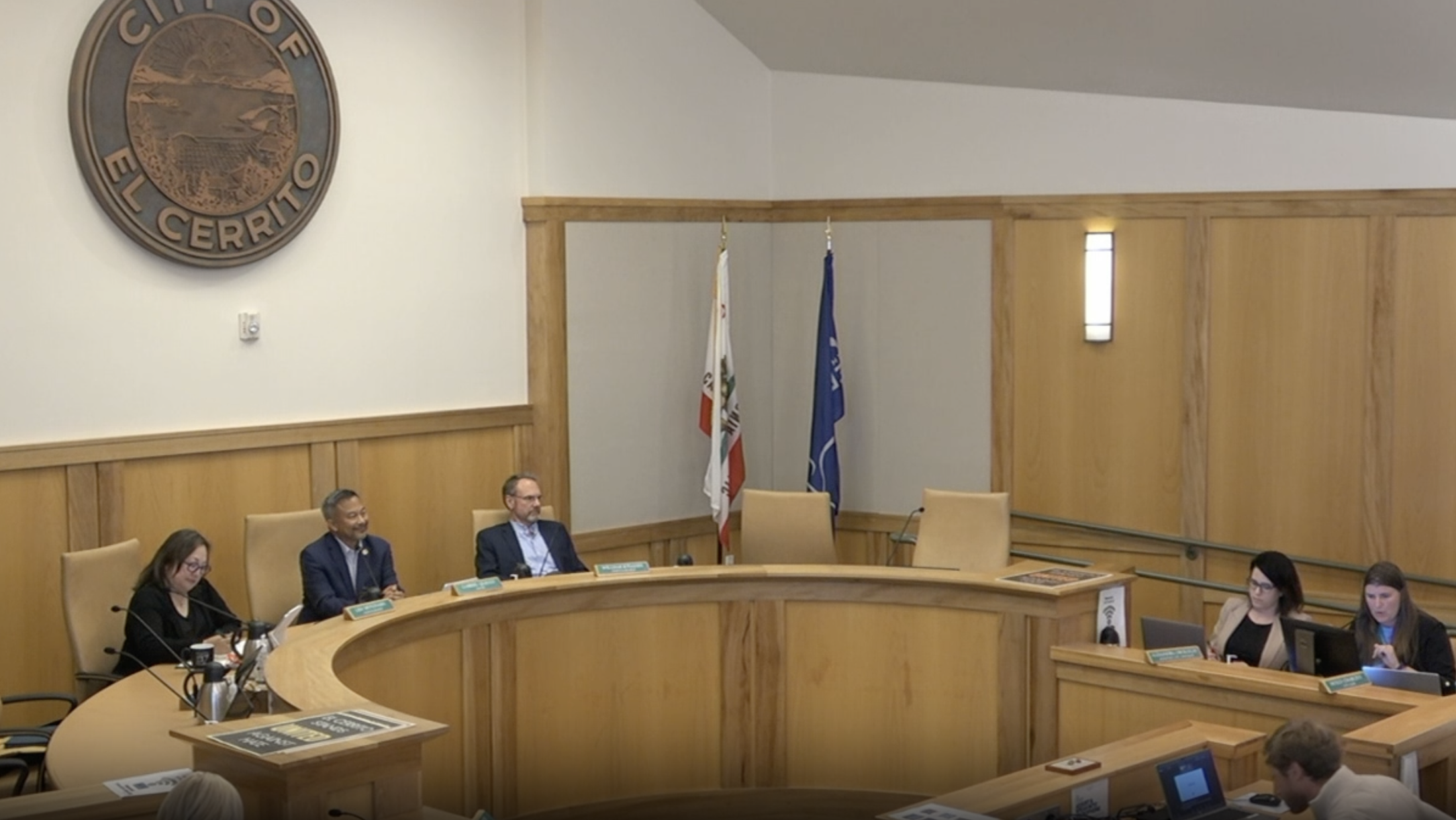
City Council - Jun 16, 2026 - Regular Meeting

City Council - Jun 16, 2026 - Regular Meeting

City CouncilEl CerritoJune 16, 2026

Sources:

Locunity is a independent informational service and is not an official government page for this commission.We use AI-assisted analysis and human editorial review to publish information.

Council Narrows District Maps, Adopts $96M Budget in Marathon Session

The El Cerrito City Council spent more than five hours Tuesday navigating two of the most consequential items on its near-term horizon: choosing which district election maps will reshape city politics for a generation, and adopting a biennial budget that threads the needle between deferred infrastructure needs and a punishing statewide fiscal climate. Both items drew sharp debate — and both passed with at least one dissent signaling unresolved tensions ahead.

  • Two finalist district maps advance unanimously ahead of a July 7 final vote, as CVRA deadline looms

  • $96M biennial budget adopted 4-1 after clash over pension liabilities, capital savings, and what "balanced" really means

  • Speed limits reaffirmed on eight streets despite collision rates 1.5x the state average on one corridor

  • Salary schedule with city manager merit raise approved 4-1 amid pointed public criticism of management pay

  • Flock surveillance cameras confirmed off and being removed citywide after contract ends


Two Maps, One Deadline: District Elections Take Shape

The basics: Under the California Voting Rights Act, an anonymous demand letter is forcing El Cerrito to transition from at-large to district-based council elections. The city has 90 days to adopt a map under "safe harbor" provisions that cap attorney fees at roughly $38,000–$40,000. Miss the window, and the city faces uncapped litigation costs. Tuesday's session was the fourth of five required public hearings.

Why it matters: The map the council ultimately adopts will determine which neighborhoods share a council representative for the foreseeable future — and which communities of interest get grouped together or split apart. The first district elections would be held in November 2028 for three seats, with the remaining two in 2030, ending El Cerrito's at-large system.

Where things stand: City Attorney Sky Woodruff set the stakes early, noting the city has no realistic legal alternative.

"Multiple cities in California have fought this. They have gone all the way to verdicts. And thus far, no city in California has been successful in one of those. And the result has been a very large legal bill," he said.

The plaintiff refused timeline extensions or alternative systems like ranked choice voting.

Demographer Paul Mitchell of Redistricting Partners presented five draft maps — A, A2, B, C, and C2 — organized around key communities of interest: the San Pablo Avenue renter corridor, hillside fire-danger zones, school attendance boundaries, and the growing student community near BART stations. Mitchell emphasized that the fourth hearing is the most consequential because maps must be publicly posted at least seven days before the fifth hearing vote.

Seven public speakers offered a range of perspectives. Michael Cohen questioned whether a narrow San Pablo corridor district could amount to gerrymandering. Chelsea Sparti pushed for diverse, integrated districts that include schools, parks, transit, and hazard zones, opposing maps that separate the hills. Sally Goodman, a former Title VI compliance professional, called for explicit racial equity framing on the city's redistricting website. Neil Tsutsui defended his community-drawn map 109, which unites BART station neighborhoods, fire-danger areas, and communities west of I-80. Richard Brooks urged district shapes that give less wealthy groups stronger representation. Grant Ricketts supported presenting multiple maps and favored map 109. Howdy Gowdy preferred C2 but suggested an alternative variant.

The other side: Council members split on which maps best served the city. Mayor Gabriel Quinto favored A2 but raised a sharp concern about the hillside fire-danger area.

"Why I do not like this map — because it gives the eastern part the burden of being the predominantly high fire danger neighborhood," he said, citing threats of insurance cancellations.

Mayor Pro Tem Rebecca Saltzman pushed back on A2, saying it distorted other districts:

"I think A2 is the one I could least live with. I think A is okay. And two, although it does bring in the renters district, it ends up distorting some of the other districts."

Councilmember Carolyn Wysinger defended the sometimes unusual-looking district shapes, noting the city's geography forces trade-offs.

"When we're looking at these maps and we're looking at some of the oblong shapes, you got to remember El Cerrito has a lot of just wonky space where there's just … there is nothing," she said, referencing parks, commercial zones, and golf courses.

Mitchell made live adjustments to C2 during the meeting, producing a cleaned-up variant labeled C3 (map 142) that addressed a two-lobed district.

Decisions: The council voted 5-0 to close the public hearing and 5-0 to advance maps A2 and modified C2 (C3/map 142) for the fifth and final public hearing. (For: Quinto, Saltzman, Ktsanes, Montoyama, Wysinger; Against: none; Absent: none)

What's next: Final map adoption is targeted for the July 7 meeting, with an implementing ordinance expected July 21 — both within the CVRA safe harbor window.


Budget Passes 4-1 as Ktsanes Breaks Ranks Over Fiscal Discipline

Why it matters: The FY 2026-27 and FY 2027-28 biennial budget — roughly $96 million — introduces target-based budgeting for the first time, starts rebuilding depleted internal service funds, and makes two major one-time purchases: a $1.18 million fire engine at end of life and $500,000 for federally mandated breathing apparatus (SCBA) replacement. But it does so by drawing down reserves, which triggered the sharpest political fault line of the night.

Where things stand: Budget Manager Claire Coleman walked the council through the city's new approach: departments received spending targets rather than simply rolling forward prior-year budgets with inflation adjustments. Major cost drivers include more than $2 million in insurance increases over six years, rising CalPERS pension costs peaking around 2031-32, and unfunded state mandates. The budget also reflects over $15–$20 million in Affordable Housing and Sustainable Communities (AHSC) grants flowing to the Plaza TOD affordable housing development. The city updated its cost allocation plan for the first time in more than a decade.

Service reductions include decreased council travel and training budgets, a cut in the Fourth of July contribution to $25,000, cancellation of the advisory board dinner and holiday lights, and recreation event changes. Library hours and the EC Stars internship program were retained.

Councilmember William Ktsanes emerged as the lone dissenter, framing the budget as a moral question about intergenerational fairness.

"Logistically we can push it off, we can have future generations take care of it. We don't have to deal with it right now. But I think it's just unfair and I think that we are compelled to address it now," he said of unfunded pension liabilities and deferred capital savings for a library, public safety building, and senior center.

He was blunt in his final assessment:

"I can't support this budget. And the reason I can't support it largely is because it's not balanced."

The other side: Mayor Pro Tem Rebecca Saltzman fired back forcefully, defending the budget's fiscal realism:

"I think it's incredibly dishonest to suggest that the council in the past or currently could set aside significant enough funds to build a new library or build a new public safety building. We cannot do that."

She argued that large capital projects inevitably require financing, not annual savings from a general fund budget of this size. Councilmember Wysinger seconded Saltzman's position.

Councilmember Edward Montoyama pressed staff on why prepaying pension obligations — an approach Ktsanes appeared to favor — is risky. Coleman explained the CalPERS amortization system using a layered mortgage analogy:

"If you think of them like a layered mortgage — every year with a mortgage, you say you're going to pay this much money over time, and every year you pay a chunk until it's paid off."

The complexity of CalPERS' amortization layers means discretionary prepayments do not always yield the savings cities expect.

Mayor Gabriel Quinto, serving as president of the League of California Cities, placed the budget in statewide context:

"We have the majority of cities up and down the state of California whose budgets are going sideways. Cities around us will be making rounds of cuts, hundreds of cuts, in our largest cities."

Public commenters sharpened the debate further. Ira Sharow cited 53% overtime growth, 64% pension debt growth, and $1.8 million in fire department overtime, and noted the budget included no recession or Howard Jarvis amendment scenarios. Richard Brooks criticized high salaries and excessive overtime. Grant Ricketts urged adoption of the Financial Advisory Board's service-level agreement proposal for greater transparency. Megan Steff called on council members who supported the budget to publicly explain and narrate it for residents.

Decisions: The budget was adopted 4-1. (For: Quinto, Saltzman, Montoyama, Wysinger; Against: Ktsanes; Absent: none) The Gann appropriations limit was set at $205 million, well above the $96 million budget. Reserves remain above 31% for the adopted year.

What's next: The tension between maintaining services, rebuilding internal funds, and saving for capital projects will carry directly into next year's mid-biennium review — and into a community still processing the failure of Measure C.


Saltzman Dissents on Speed Limits, Pushing for Safety Corridor

Why it matters: California law requires engineering and traffic surveys for police to use radar or lidar enforcement on arterial and collector streets. The surveys use the 85th percentile speed methodology, which often locks in speed limits that reflect how fast drivers actually travel — frustrating officials who want lower limits on dangerous roads.

Where things stand: Public Works Director Yvetteh Ortiz presented updated speed surveys for eight streets. Limits were set using the 85th percentile method, with additional 5 mph reductions applied where justified.

Mayor Pro Tem Rebecca Saltzman cast the sole no vote, pointing to data in the city's own survey.

"If you look at the study, the survey that they did, they looked at collision rates and especially the Cutting-Elm-Richmond street corridor, the collision rate was nearly one and a half times the state collision rate," she said, arguing the current limits clearly are not working.

Ortiz noted that a future local road safety plan could establish San Pablo Avenue as a safety corridor, which would unlock the legal authority to set limits below the 85th percentile.

Decisions: Approved 4-1. (For: Quinto, Ktsanes, Montoyama, Wysinger; Against: Saltzman; Absent: none)

What's next: The local road safety plan, once adopted, could enable the lower speed limits Saltzman is seeking — a potential flashpoint for traffic safety advocates.


Salary Schedule and City Manager Raise Draw Sharp Public Pushback

Why it matters: The annual salary schedule included two classification modifications and a 5% merit increase for City Manager Karen Pincus. The item drew the most emotionally charged public comment of the evening.

Where things stand: Ira Sharow called for management salary cuts and position eliminations, criticizing city management's performance over the past year. Lisa Martinengo urged the council to reject the schedule entirely, questioning management raises during service cuts. Richard Brooks called management salaries "disgusting" compared to the private sector and suggested forced retirements for the highest-paid legacy CalPERS employees.

Councilmember William Ktsanes dissented — though he clarified his objection was about process, citing a need for more community discussion time, rather than opposition to any specific salary.

Decisions: Approved 4-1. (For: Quinto, Saltzman, Montoyama, Wysinger; Against: Ktsanes; Absent: none)


Minor Items

  • Flock cameras decommissioned: Police Chief Paul Keith confirmed all Flock automated license plate reader cameras have been turned off and will be physically removed from city poles in coming weeks.

  • Consent calendar approved 5-0: Items included meeting minutes, a Juneteenth proclamation, disbursement reports, delegation of design review powers to the planning commission, consolidation of the November 2026 municipal election, a street sweeping contract with Sweeping Corporation of America (with reduced hillside frequency), a 2026 surface seal construction contract, Contra Costa County forensic services spending, an urgent drain pipe repair at Cerrito Vista Park, and the SB1 road repair project list.

  • Financial Advisory Board recommendation: The FAB was unable to reach consensus on the budget and recommended formal service-level agreements. FAB Chair David Carbell presented the proposal, but a motion by Councilmember Montoyama to agendize a study session failed for lack of a second.

  • Vendor spending authority for purchases exceeding $45,000 approved 5-0 without presentation.

  • Ruby Adachi Hiramoto, age 105, was recognized as El Cerrito's centenarian for Q2 2026.

  • General public comment: Residents called for town hall meetings, questioned a $70,000 public safety building consultant, raised transparency concerns about Richmond Street bike lane grant funding, and urged the city to revisit its strategic plan following Measure C's failure.

Council Narrows District Maps, Adopts $96M Budget in Marathon Session | City Council | Locunity