
City Council - Apr 07, 2026 - Regular Meeting

City Council - Apr 07, 2026 - Regular Meeting

City CouncilEl CerritoApril 7, 2026

Sources:

Locunity is a independent informational service and is not an official government page for this commission.We use AI-assisted analysis and human editorial review to publish information.

El Cerrito Eyes Zero Traffic Deaths by 2035 With Citywide Speed Cuts

The El Cerrito City Council dove deep into two policy-shaping study sessions Tuesday night — a road safety plan that would drop speed limits across the city and commit to eliminating fatal crashes within a decade, and a contested effort to clarify senior tax exemptions in the June library ballot measure before confusion hardens into opposition. The consent calendar, including a permanent outdoor dining ordinance, passed unanimously.

  • Council backs Vision Zero goal, 25 mph citywide speed limit, and a protected bikeway backbone after crash data reveal 72% of injuries occur on just 5% of roads

  • Staff directed to simplify Measure C senior exemption — stripping equity and reverse mortgage requirements while keeping age and income thresholds ahead of the June vote

  • Walk and Roll advocates and crash survivors urge faster action on pedestrian safety improvements at dangerous San Pablo Avenue and Carlson Boulevard crossings

  • Councilmember Ktsanes requests ACLU speaker for upcoming Flock surveillance camera study session, signaling civil liberties scrutiny

  • Permanent outdoor dining ordinance adopted, codifying pandemic-era flexibility for local restaurants


Vision Zero: A Road Safety Plan Built on Hard Data

The basics

Transportation Program Manager Jarrett Mullen presented El Cerrito's first Local Road Safety Plan, built on five years of crash data (2018–2022) and supplemental records through 2025. The plan proposes four major policy shifts: a Vision Zero commitment to zero fatal and severe injury crashes by 2035, a citywide 25 mph speed limit, designing streets for target speeds rather than for drivers going 10 mph over the posted limit, and readiness to pursue automated speed enforcement.

Why it matters

The numbers are stark. El Cerrito recorded 104 minor injury crashes and 10 fatal or severe injury crashes during the study period. San Pablo Avenue — a state route that is just 2% of city road miles — accounts for 30% of all injury crashes. Half of all fatal and severe crashes occur in disadvantaged communities. Most victims are pedestrians or bicyclists.

"This network is only 5% of the local road network. But it counts for 72% of all injury crashes and 18 of the 21 KSI crashes," said Mullen.

He pointed to Hoboken, N.J., as proof the goal is achievable.

"Hoboken has had zero traffic fatalities or serious injuries going on nine years now. The city's small, it's compact, it doesn't have wide roads. So they have this urban fabric that's very favorable to achieving Vision Zero," Mullen said, drawing a direct parallel to El Cerrito's own compact street grid.

Where things stand

The plan proposes a backbone bikeway network of Class 2 or Class 4 facilities on Richmond Street, Ashbury Avenue and a future East-West Bikeway — for which $10 million in grant funding has already been secured. On speed enforcement, staff noted that San Francisco's automated speed camera pilot has produced 72% reductions in speeding, and recommended the council add automated enforcement to its legislative platform.

Mayor Pro Tem Rebecca Saltzman pushed for even lower limits.

"I'd really like the default in El Cerrito to be 20. Anywhere we can do is safer. It's what a lot of European cities and other cities around the world are doing," she said.

She also reminded colleagues of strong public support for the plan's direction:

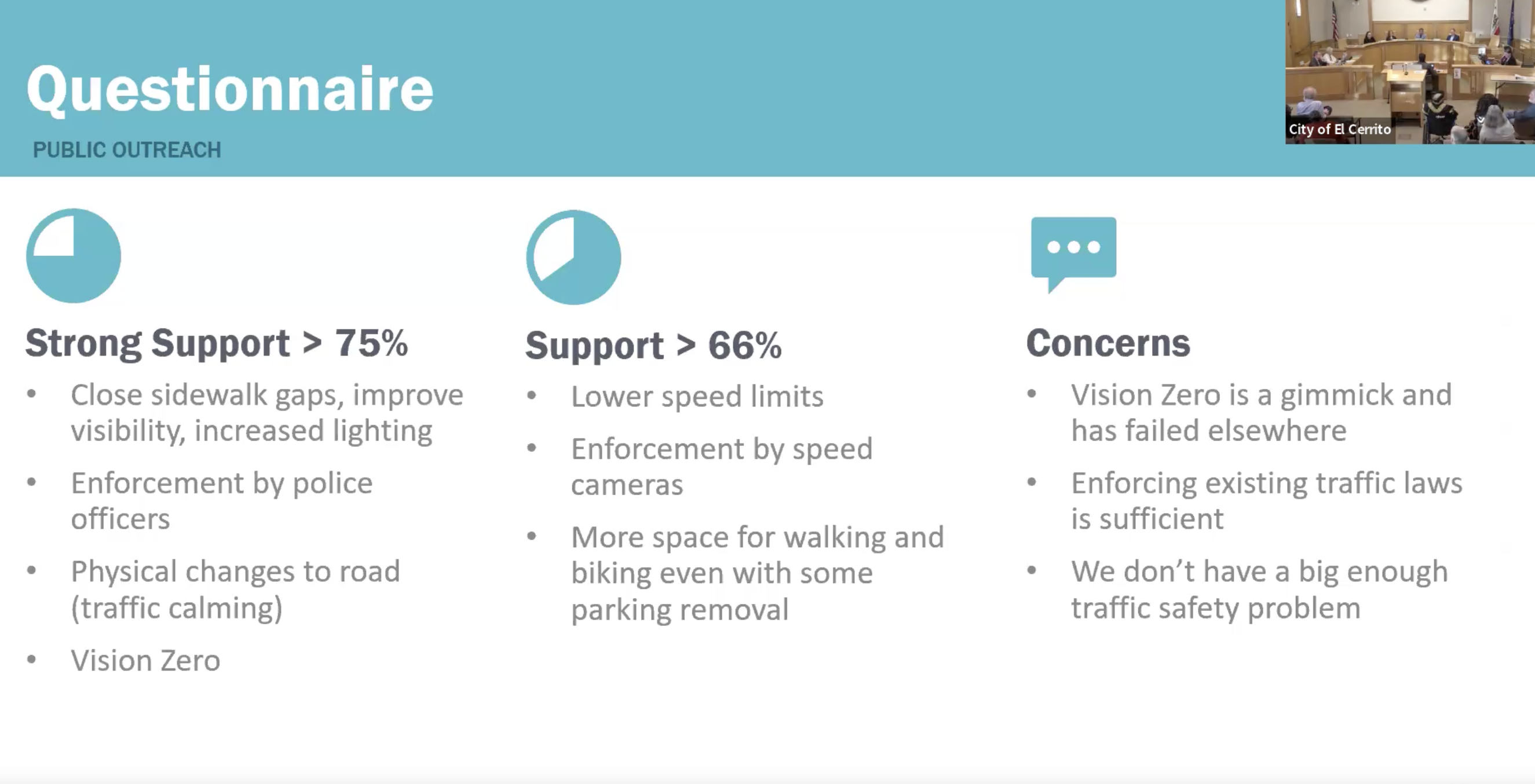
"We're getting 66% of people who are saying that it makes sense to have more space for walking and biking, even with some parking removal. We need to remember that as we move forward."

Councilmember William Ktsanes zeroed in on immediate dangers, asking what the city can do right now at intersections where children walk to school.

"How do we go about having that reactive response now, prior to all of this being sorted out and laid out into a plan and implemented later, when there are people being hit now on Carlson and San Pablo?" he asked.

Councilmember Carolyn Wysinger praised the plan's systems-design philosophy.

"What I appreciate most about this plan is that it does shift us from thinking about the individual behaviors of the folks on the street and really thinking about the way the system is designed," she said, adding that cross-boundary coordination with Richmond on San Pablo Avenue traffic is essential.

Councilmember Lisa Montoyama asked about east-west crossing safety and traffic enforcement staffing. Interim Field Operations Lieutenant David Wentworth of the El Cerrito Police Department confirmed the city has one dedicated traffic officer but would ideally need three.

The other side

Public commenters largely supported the plan but pushed for speed. Janet Byron, coordinating committee member of El Cerrito Richmond Annex Walk and Roll, told the council the group's 500-plus newsletter subscribers are tired of planning without action. She called for a comprehensive traffic-calming strategy including speed bumps, crosswalks, pedestrian beacons, protected bike lanes, bollards and quick-build projects.

Barbara Chan described being struck in a crosswalk at Euclid and Richmond in 2008, suffering lasting injuries. She reported drivers clocked at 30–35 mph despite speed bumps and urged more radar enforcement on Arlington Boulevard, where she said she has been passed on double yellow lines at 45 mph.

Steven Price warned that heavier electric vehicles will increase crash severity and argued that a future San Pablo Avenue redesign with transit and bike lanes would fundamentally change the corridor's safety profile.

What's next

Staff confirmed they received sufficient direction without a formal vote. A public draft of the Local Road Safety Plan will be released for a 30-day review period in May, with council adoption targeted for July.


Measure C: Untangling the Senior Exemption Before June

The basics

Measure C is a proposed parcel tax on the June ballot to fund construction of a new El Cerrito library and 10 years of operations. The measure includes a senior exemption tied to two state programs — but one program has been unfunded since 2010, and the other comes with stringent requirements including 40% home equity and no reverse mortgage. Months of community confusion and mistrust about whether the exemption is real prompted the council to schedule a study session with City Attorney Sky Woodruff of Redwood Public Law.

Why it matters

The exemption question has become a flashpoint. Public commenter Bill Barish presented a statistical analysis of Measure C comments across nine council meetings: 95 comments from 54 speakers — 41% in support, 48.4% opposed or preferring a November ballot, and 10.5% taking alternative positions. The resolution the council is now pursuing could determine whether skeptical seniors support or oppose the measure.

Where things stand

Woodruff explained that the city interprets the ordinance's phrase "qualify for participation" as meeting the criteria of the referenced state programs — not actually enrolling in them. He noted no one has ever applied for the exemption under existing analogous taxes for the swim center and parks.

The key state program criteria are: homeowner aged 62 or older (or blind or disabled), household income of $55,181 or less, and principal residence. But the Postponement Law also requires 40% equity and no reverse mortgage — conditions the council found too restrictive.

Woodruff presented revenue-impact scenarios. An age-only exemption for residents 60 and older could cost more than $1 million — roughly 32% of projected revenue. An income-only exemption under $50,000 would affect 673 households and cost about $222,000. A combined age-65-plus and income-under-$50,000 threshold would affect fewer than 673 households.

He clarified the council's legal authority:

"The city council may enact any other amendments, including but not limited to amendments necessary to implement or administer the special tax."

But any resolution cannot frustrate the measure's core purpose of funding library construction or raise taxes beyond rate caps.

Councilmember William Ktsanes pressed on whether exemptions would shift the burden to remaining taxpayers.

"Say it's a pie and you have 100 participants in the pie, everyone's going to have equal share. And suddenly you have 95 people in the pie. Everyone's piece of the pie that they have to contribute does go up," he said.

Woodruff responded that the council has flexibility to set rates below caps and could supplement library services with general fund dollars rather than raising the per-parcel rate on others.

Mayor Pro Tem Rebecca Saltzman pushed for clarity above all.

"I think we should clarify the included exemption because there is a lot of mistrust and misinformation out there. And I think we should just clarify that whatever is going on with these state programs, it doesn't matter," she said, supporting the removal of the equity and reverse mortgage requirements.

Councilmember Lisa Motoyama supported using the Postponement Law criteria as a template, noting the qualifications seemed reasonable and already vetted. City Manager Karen Pinkos said the application process would be manageable with technology and is not entirely new to staff.

The other side

Public commenters were split. Susan Obayashi called the current exemption wording misleading because one referenced program is unfunded and the other is a tax postponement with a lien — not forgiveness. She asked how long a council resolution clarifying exemptions would remain in effect.

Michael Fisher, who identified himself as a Measure C drafter and AARP volunteer, affirmed the intent was always to include an appropriate senior exemption and said the complex balancing between relief and sufficient revenue is why the council and staff are entrusted with the decision.

Ira Sharenow questioned the reliability of census data used for revenue estimates, urged the council to consider the West Contra Costa Unified School District parcel tax exemptions as a more generous model, and called for a public forum. Michelle suggested a graduated exemption rather than a hard income cutoff and noted eight upcoming Q&A sessions on the campaign website.

Decisions

Council reached consensus directing staff to bring back a resolution that: (1) clarifies the exemption does not require actual enrollment in state programs; (2) retains the age 62-plus (or blind/disabled), income ($55,181 or less), and principal-residence criteria; and (3) strikes the 40% equity and reverse mortgage requirements. Mayor Gabriel Quinto confirmed agreement. Woodruff summarized the final direction:

"The only criteria that council would be using from that program are that one of the owners must be at least 62 years of age, blind or disabled, that they own the property as their principal place of residence and that they have a total household income of $55,181 or less."

What's next

Staff will return with a draft resolution for formal adoption. The June election timeline means the clarification must be finalized quickly to inform voters.


Flock Cameras: Ktsanes Wants Civil Liberties Voice at the Table

During liaison reports, Councilmember William Ktsanes disclosed he has been reading extensively and speaking with residents about the city's Flock automated license plate reader cameras. He asked that the upcoming police chief presentation be restructured as a full study session — and that a representative from the American Civil Liberties Union be invited alongside the police chief and the Flock company representative to provide a civil liberties perspective.

"I would like someone to be invited from the American Civil Liberties Union who could also speak from their perspective," Ktsanes said.

Mayor Pro Tem Rebecca Saltzman seconded the concept. The request signals potential council scrutiny of surveillance technology before any expansion of the program.


Minor Items

  • Consent calendar passed 5-0 by roll call (For: Quinto, Saltzman, Ktsanes, Motoyama, Wysinger; Against: none; Absent: none). Items included approval of prior meeting minutes, a permanent outdoor dining and retail sales ordinance, the landscape and lighting assessment district annual report, an Earth Day proclamation, and an Economic Development Committee appointment. Roll call was required because Councilmember Wysinger participated remotely under a just-cause illness exemption.

  • Landscape and lighting assessment district faces structural shortfall. Councilmember Motoyama flagged the declining fund balance of the 1980s-era district. Budget Manager Claire Coleman confirmed the district no longer generates enough revenue, with the general fund and SB1/Measure J transportation funds already subsidizing operations. When the balance is exhausted, the council will decide whether to maintain services with general fund dollars or cut back.

  • Prescribed burns planned for April 13, 15 and 17. Fire Chief Eric Saylors announced debris-pile burns in the hillside natural area to reduce wildfire fuel before fire season. Trails will be partially closed with public notification.

  • Council members reported on intergovernmental work. Wysinger described representing El Cerrito on the National League of Cities Public Safety Committee, including work on sanctuary city protections. Councilmember Ktsanes reported on Sacramento lobbying and e-bike regulation. Mayor Pro Tem Saltzman provided updates from ABAG and WCCTA meetings. Motoyama noted her WCTAC participation.

El Cerrito Eyes Zero Traffic Deaths by 2035 With Citywide Speed Cuts | City Council | Locunity