
City Council - Jul 07, 2026 - Special Meeting

City Council - Jul 07, 2026 - Special Meeting

City CouncilEl CerritoJuly 7, 2026

Sources:

Locunity is a independent informational service and is not an official government page for this commission.We use AI-assisted analysis and human editorial review to publish information.

El Cerrito Picks District Map in Split Vote, Faces Stalled Housing Pipeline

The El Cerrito City Council chose its political future Monday night, selecting Map A2 to carve the city into five council districts for the first time — a decision driven by a California Voting Rights Act threat and shaped by a passionate debate over who best represents the city's renters. In the same meeting, staff delivered a sobering report: the San Pablo Avenue housing pipeline that once promised thousands of units has frozen as construction costs outpace achievable rents, and the city's main affordable housing tools have produced nothing.

  • Map A2 selected 3-2 for El Cerrito's first-ever district elections, with renter representation as the decisive argument

  • Map C3 motion fails 2-2 after most public commenters backed it for fire-risk grouping and compactness

  • District sequencing pits two incumbents against each other: Mayor Gabe Quinto and Councilmember William Ktsanes land in the same brown district, both eligible for 2028

  • San Pablo Avenue housing pipeline stalled: construction costs exceed rents, freezing entitled projects; inclusionary zoning has produced zero affordable units

  • City's affordable housing fund down to $95,000, with no new revenue in sight

  • Council unanimously honors retiring Community Development Director Melanie Mintz after 22 years; successor Claudia Garcia starts July 20


The Map That Will Reshape El Cerrito Politics

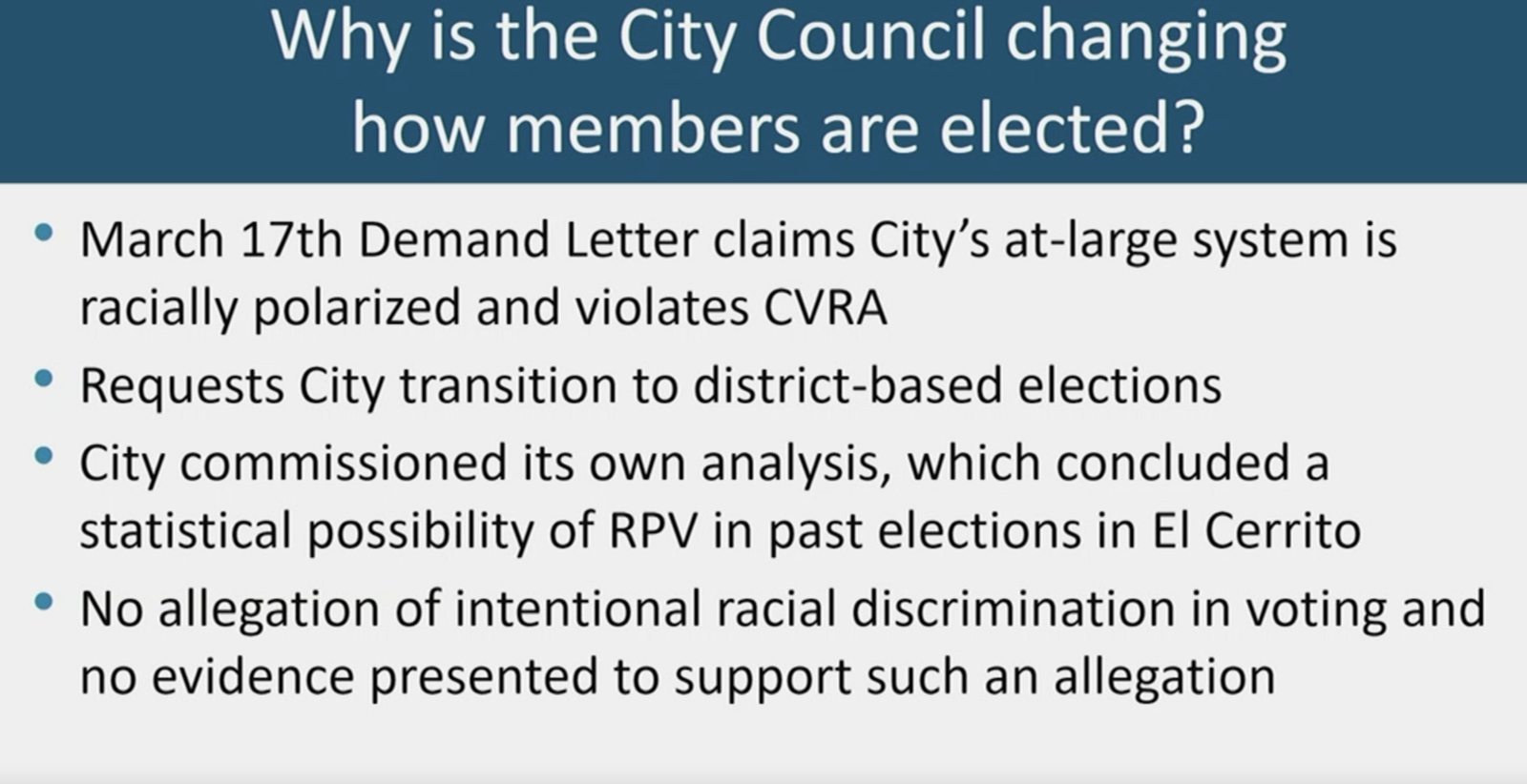
The basics: Under the California Voting Rights Act, any voter can challenge a city's at-large election system by alleging racially polarized voting. An anonymous plaintiff sent El Cerrito a demand letter on March 17, triggering a 90-day "safe harbor" window: if the city adopts a district election ordinance by July 21, it caps its legal exposure at roughly $40,000 in attorney's fees. Cities that have fought CVRA claims in court have universally lost and paid far more.

Why it matters: Monday's votes will fundamentally change how El Cerrito residents choose their council members starting in 2028 — shifting from citywide races to neighborhood-based contests that could amplify the political voice of renter-heavy and minority communities.

The Legal Clock

City Attorney Sky Woodruff told the council the plaintiff's attorney refused to grant any timeline extensions. "

The potential plaintiff in this case has declined to agree to such extensions. My office met with the attorney representing the plaintiff. We spoke at length about the possibility of extending the timelines, and the attorney communicated that his client was simply not agreeable to granting any of those extensions," said Woodruff.

She confirmed that a July 21 adoption date remains within the safe harbor window.

Two Maps, Two Visions

Demographer Paul Mitchell owner of Redistricting Partners and the Vice President of Political Data, Inc. (PDI) presented the two finalist maps, both refined over five public hearings. Map A2, with a 2% population deviation, was originally built around school district attendance areas and adjusted to capture the renter community of interest. Map C3, with a 3.3% deviation, followed major streets and produced more compact district shapes.

Public comment split along neighborhood lines. Maureen Dixon, a 22-year resident, favored C3 for grouping mid-elevation residents together, away from hillside fire-risk areas. Rebecca Kenny agreed, calling school district boundaries a "red herring" because West County Unified lines cross city borders. Mike McDougall, who attended all six hearings, backed C3 for its compactness and fire-community logic. On the other side, Grant Ricketts, a resident since the 1980s, urged adoption of A2 as best reflecting neighborhood character.

Richard Brooks raised pointed legal concerns: he warned that splitting the Northwest minority opportunity district or burying it in a low-turnout 2030 off-year cycle could expose the city to a second CVRA lawsuit.

The Decisive Argument: Renters

Councilmember Carolyn Wysinger delivered the most forceful case for Map A2, speaking as the first renter ever elected to the El Cerrito City Council.

"I'm the first renter to ever be on this council," she said, describing how she zoomed into 400% on the map to examine what was actually in each district.

Wysinger argued that A2 properly captures "the renter community — everything from Ohlone Greenway on down, point blank, period." She stressed that she wants future representatives from renter districts to actually live in those communities, not represent personal interests from elsewhere.

Mayor Pro Tem Rebecca Saltzman preferred C3, noting that "the vast majority of people" have supported it, but acknowledged the limited volume of public comment made it hard to gauge citywide sentiment. Councilmember William Ktsanes leaned toward C3 but accepted trade-offs in both maps.

The Votes

The C3 motion, moved by Saltzman and seconded by Ktsanes, failed 2-2 (For: Saltzman, Ktsanes; Against: Wysinger, Quinto; Absent: Montoyama). Wysinger then moved Map A2, seconded by Mayor Gabriel Quinto, and it passed 3-2 (For: Quinto, Wysinger, Montoyama; Against: Saltzman, Ktsanes).

Sequencing: Two Incumbents, One District

With the map settled, the council turned to which districts vote first. Mitchell framed the core question bluntly:

"Do you want to make the brown district up in 2028 so that the two council members who live there would have the option to run against each other, or make it up in 2030 so that the council member whose term expires in 2028 won't have anything to run for for two years?"

Ktsanes argued that renter districts should align with presidential election years for higher turnout:

"Because that's a slightly lower income area, I'm inclined to believe that their turnout is significantly higher during a presidential election year."

The council voted 3-2 to assign the brown, purple, and green districts to 2028 and the red and orange districts to 2030 (For: Saltzman, Wysinger, Montoyama; Against: Quinto, Ktsanes). The result means Quinto and Ktsanes, who both reside in the brown district, could face each other in a 2028 race — a political dynamic neither voted for.

The ordinance introduction then passed unanimously, 5-0.

What's next: Final adoption is scheduled for July 21. November 2026 will be El Cerrito's last at-large election. District-based voting begins in 2028.


San Pablo Avenue's Frozen Pipeline

Why it matters: El Cerrito must produce roughly 1,400 housing units — including 500 affordable — to meet its current RHNA cycle targets. The city's primary development corridor and its main affordable housing tool have both stalled, forcing a fundamental policy rethink at the worst possible time.

A Success Story Hitting a Wall

Community Development Director Melanie Mintz reported that the San Pablo Avenue Specific Plan, adopted in 2014 with an MTC planning grant, has entitled projects totaling over 1,700 housing units and completed approximately 400 — a 20% increase in the city's multifamily rental inventory. Every completed project maintains above 90% occupancy.

But the pipeline has frozen. Construction costs now substantially exceed achievable rents, halting projects in their tracks. One entitled mixed-use property is being marketed for different uses. The Fairmont project, originally a six-story multifamily development, is being re-entitled as a 16-unit townhome project. A nearly permit-ready Hampton Inn has also stalled.

Zero Affordable Units

The city's inclusionary zoning ordinance — 10% for rental, 12% for ownership — was adopted in 2018 and has produced zero affordable housing units. Housing and Economic Development Program Manager Aissia Ashoori reported that the city's Low to Moderate Income Housing Asset Fund is nearly empty:

"We do have about $95,000 left in our low to moderate income housing asset fund. Unfortunately we don't have any projects coming in with inclusionary."

An additional $800,000 could materialize only if Project Kickstart, a city council-approved initiative to revive stalled, multi-family housing developments by reducing or waiving various city fees and regulations, projects break ground.

Bright spots include full recovery of inflation-adjusted sales tax revenue since 2020, strong restaurant performance along the corridor, and the Cerrito Vista property sale as a positive market signal. Retail vacancy sits at about 10%, mostly driven by large vacancies like Marshalls and Joann's.

Council Pushes for a New Approach

Mayor Gabriel Quinto expressed frustration with property owners sitting on entitled land:

"In the future I want to look at what we can do to incentivize them to sell their properties. This is not acceptable to have your staff work so hard day and night for how many years now and to see all these empty lots."

Mayor Pro Tem Rebecca Saltzman called for multiple study sessions. She said Project Kickstart, which reduced fees for four pipeline projects, was "a Band-Aid solution" and proposed replacing the inclusionary policy with a mechanism tying tax revenue from new development to affordable housing funding. She also pointed to Berkeley's missing middle ordinance as a model:

"What is getting built there are these duplexes, quadplexes, things like that because they passed this new missing middle ordinance a couple years back."

Councilmember William Ktsanes asked about certificates of participation as a potential financing tool. Councilmember Montoyama raised concerns about naturally occurring affordable housing being precarious and asked about the costs of implementing a tenant opportunity-to-purchase (TOPA) policy.

What's next: No formal action was taken. Saltzman requested study sessions on affordable housing policy, overall housing strategy beyond San Pablo Avenue, and transportation improvements to make the corridor more walkable.


Minor Items

  • Resolution honoring Melanie Mintz: Council unanimously (4-0, Councilmember Wysinger absent) approved a resolution recognizing Community Development Director Melanie Mintz upon her retirement after 22 years with the city. Council members praised her work on Baxter Creek restoration, the recycling center, San Pablo Avenue streetscape improvements, and BART station area development. Claudia Garcia was introduced as her successor, beginning July 20.

El Cerrito Picks District Map in Split Vote, Faces Stalled Housing Pipeline | City Council | Locunity