Coalition Rallies Behind Haiti Security Force as Deployment Bottleneck Widens
Economic and Social Council • United NationsSeptember 24, 2026
Locunity is an independent informational service and is not an official government page for this commission. All information is sourced from public footage and an analysis of official agendas with the aid of responsible, fact-checked AI. to report an error or omission.
The ECOSOC Ad Hoc Advisory Group on Haiti convened a high-stakes ministerial session with over a dozen delegations demanding renewal of the Gang Suppression Force mandate — and confronting an uncomfortable math problem: more than 17,000 troops have been pledged for 5,500 authorized positions, yet only 1,200 are on the ground. Canada announced $25.4 million CAD in new funding, Haiti's prime minister called for a fundamental shift from aid to investment, and a diplomatic flare-up over Taiwan underscored the geopolitical fault lines threatening to complicate the mandate vote.
- Over 17,000 troops pledged for Haiti's Gang Suppression Force, but only 1,200 deployed — airlift and logistics identified as the critical bottleneck
- Canada announces $25.4 million CAD in new funding for youth, policing, judicial accountability, and gender-based violence services
- Haiti PM calls for paradigm shift from emergency aid to productive investment in industry, tourism, and renewable energy
- Elections set for Dec. 13, 2026, but gang-controlled highways imperil voter registration and candidate movement
- China objects after Canada names Taiwan as a GSF financial pledger; chair corrects the record
- CARICOM reports 490% increase in violations against children amid gang recruitment surge
The Deployment Gap: 17,000 Pledged, 1,200 on the Ground
Why it matters: The Gang Suppression Force, authorized under Security Council Resolution 2793 at 5,500 personnel, is the linchpin of Haiti's fragile security gains. With 29 of roughly 50 key areas now under government control and 21 still confronting armed groups, any lapse in the mandate or deployment pace risks reversing ground-level progress and enabling gangs to regroup.
Where things stand: Mike Waltz, the U.S. representative, delivered the session's most detailed operational picture. "We've received more than 17,000 personnel pledges for the 5,500 authorized billets. Think about that for a moment. We have more than three times as many personnel pledged as positions available," he said. Yet only 1,200 troops are currently deployed, with 2,500 slated within months. Waltz praised ongoing GSF operations: "They are focused, they're planning, and they are moving forward with clearing roads that are blocked and used as toll collection mechanisms by the gangs. They're dismantling their revenue sources, and they're securing once again critical infrastructure."
Minister Ito Bisono Haza, the Dominican Republic's foreign minister, put a finer point on the gap: as of July 8, the military component had just 1,083 personnel against the 5,550 authorization.
Minister Kamina Johnson-Smith, Jamaica's minister of foreign affairs and foreign trade, identified specific actionable bottlenecks. "There are countries willing to deploy but which don't have airlift. There are countries with personnel able to provide intelligence support, but do not have the software. They require equipment on the ground, and there are countries with naval and Coast Guard personnel who could be deployed but would require vessels," she said. She warned bluntly: "A gap in GSF operations at this time will redound only to the benefit of the gangs and should absolutely not be allowed."
The other side: Troop-contributing nations — Chad, El Salvador, Guatemala, Jamaica, Mongolia, and Sri Lanka — were recognized for their commitments. Secretary of State Randeep Sarai of Canada, chairing the session, urged every country to increase financial and in-kind contributions. Deputy Secretary-General Amina Mohammed of the United Nations offered an alternative path for nations that cannot deploy personnel: "If your country is not in a position to contribute directly to the Gang Suppression Force, you can make a decisive difference through the Peace Dividend Fund and related stabilization efforts."
What's next: The UN Security Council is expected to vote on renewing the GSF mandate before the end of the month. Nearly every speaker called for swift renewal. Waltz warned that the council should not allow the vote to be jeopardized by unrelated geopolitical disputes — a remark that proved prescient by the session's end.
Haiti's Force-Building Ambition: 15,000 Soldiers Over Three Years
Why it matters: Haiti's long-term strategy hinges on building sovereign security capacity so the country can end recurring cycles of international security missions. Without a credible national force, any withdrawal of foreign troops risks a return to gang dominance.
Where things stand: Minister of Defense Mario Andresol provided a detailed operational briefing. "Among these, 29 of these areas, about 58%, are actually controlled by our security forces," he said, referring to the approximately 50 key zones across Haiti's 10 departments. He announced that more than 2,000 police officers have been trained this year, with a new class set to graduate from the police academy in November, and that 1,500 soldiers have completed training. The centerpiece: a new program targeting 15,000 soldiers over three years — roughly 5,000 per year — alongside an overhaul of military doctrine through the P4000 program.
Andresol framed the effort in terms of sovereignty, calling for international support to "further enhance the capabilities of our forces, our security services to ensure that Haiti can stand alone, support its own defense."
What's next: Training timelines and equipment needs will be a recurring ask from Haiti at upcoming international forums.
From Aid to Investment: PM Demands a Paradigm Shift
Why it matters: Billions in humanitarian aid have flowed to Haiti over decades without breaking cycles of instability or building durable institutions. The prime minister's call signals a shift in how Haiti's government wants the international community to engage.
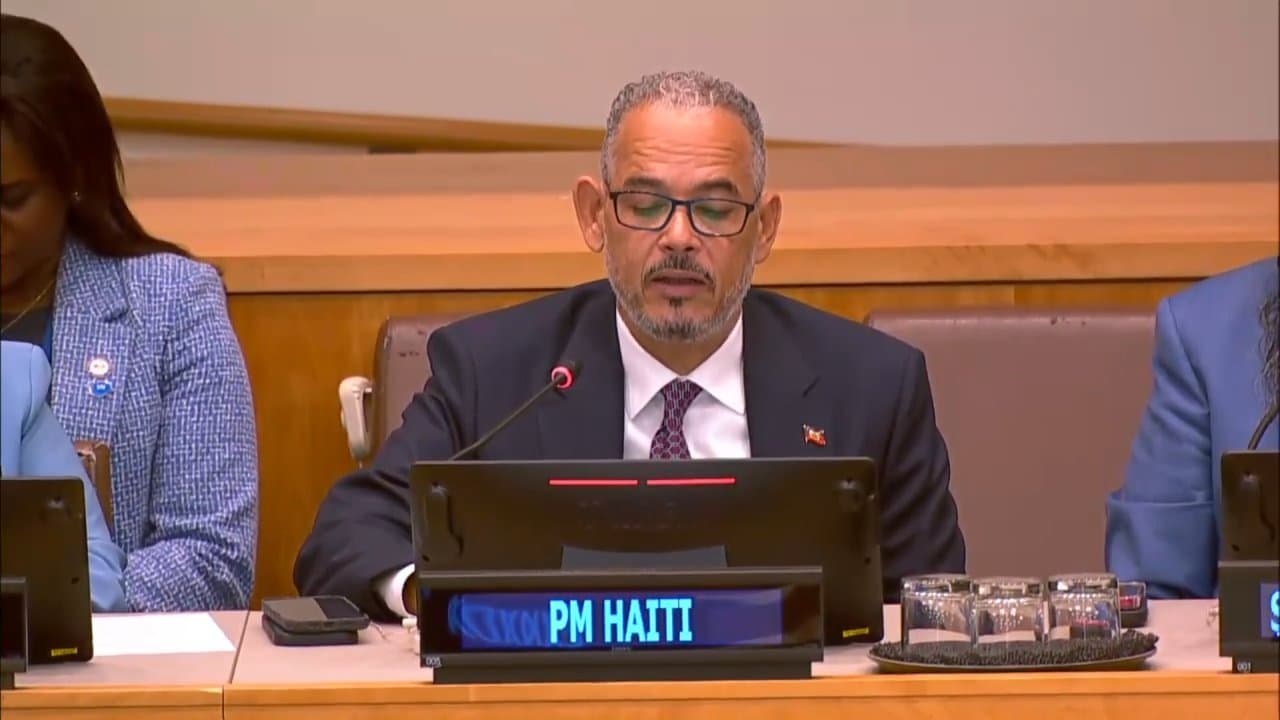
Where things stand: Prime Minister Alix Didier Fils-Aime delivered a forceful keynote, arguing that while emergency aid saved lives, lasting well-being cannot remain indefinitely dependent on charity. "We must change the paradigm, move from aid to investment, from assistance to production, dependency to partnership and gradually transform the resources mobilized to manage the crisis into investments capable of creating jobs, production, businesses, and opportunities," he said.
He pointed to potential across Haiti's north and south — in industry, agro-industry, textiles, tourism, renewable energy, the blue economy, and services — and called for attracting foreign direct investment, technology transfer, and support for small and medium enterprises. The Dominican Republic's Minister Bisono Haza cited the textile sector and free zones as evidence that productive investment can work even under difficult security conditions.
Fils-Aime framed disarmament and reintegration (DDR) through the same lens: "We must also take away violence, to hire, to recruit. We must be able to offer young people credible alternatives and real opportunities. This is where security and development meet."
Haiti's Foreign Minister Raina Forbin echoed the prime minister's vision in her closing statement, calling on partners to convert solidarity into concrete partnerships.
Elections Set for December 2026 — but Security Is the Precondition
Why it matters: Haiti has not held democratic elections in years, cycling through successive transitional governments. The announcement of a concrete electoral calendar creates both a benchmark for accountability and a pressure point: if security conditions do not improve, the dates could slip.
Where things stand: The Provisional Electoral Council has set Dec. 13, 2026, for the first round of national elections and Feb. 21, 2027, for the second round. Citizen registration is underway and political organizations are being certified. Prime Minister Fils-Aime declared that "transitions cannot become a mode of governance. Haiti's next government must come through the ballot box."
The other side: The practical barriers are enormous. CARICOM Secretary-General Carla Barnett noted it remains very difficult for persons and candidates to safely move around the country because highways remain controlled by gangs. SRSG Carlos Ruiz Massieu, head of BINUH, warned that adjustments to the timeline may be required and that maintaining momentum is essential to avoid uncertainty becoming a source of instability. Secretary of State Sarai called on Haitian authorities to be laser-focused on progress, insisting "elections should be carried out in a way that enables people from all regions of Haiti to cast their vote."
What's next: International electoral observation missions are expected. The security trajectory in the coming months will largely determine whether the December date holds.
DDR Cannot Wait: Parallel Tracks for Security, Justice, and Reintegration
SRSG Carlos Ruiz Massieu was emphatic that disarmament, demobilization, and reintegration must run alongside security operations — not wait until after stability is achieved. "Without credible pathways out of violence, security gains will remain fragile. Without justice, DDR risks being perceived as a pathway to impunity. And without political progress, none of these gains will ultimately endure," he said.
He urged the operationalization of Special Judicial Units and highlighted the recently launched Multi-Partner Trust Fund as a vehicle for coordinated DDR financing: "We now need to ensure it is fully utilized as a vehicle for continued and coordinated support to Haiti."
DSG Mohammed reinforced the stakes: "Containing the rampant violence is just the first step. Preventing its return is far more difficult, and it demands investment in communities, rebuilding trust in institutions, strengthening the rule of law, and giving young people real alternatives to life inside a gang."
CARICOM's representative, Minister Miles LaRoda of the Bahamas, reported a staggering 490% increase in violations against children, per the Secretary-General's most recent report. "We call on all armed gangs to release children from their ranks without delay," he said. Several delegations linked DDR directly to preventing the recruitment of children, with the EU emphasizing that children recruited by gangs are victims requiring protection, not targets.
Geopolitical Flare-Up: China Objects to Taiwan Mention
A diplomatic incident punctuated the session when Secretary of State Sarai listed Taiwan among financial pledgers for the GSF alongside the Dominican Republic, Germany, and Qatar. Chair David Lametti, Canada's permanent representative, subsequently corrected the record, stating the secretary of state "misspoke when he called pledging — he should have said pledgers instead of countries."
The delegate from China took the floor at the close of the meeting to express "strong dissatisfaction," invoking the One China principle and General Assembly Resolution 2758. China also reiterated its position that military means alone cannot resolve Haiti's crisis and stressed the Haitian government's primary responsibility.
The exchange validated the earlier warning from the U.S. representative, Mike Waltz: "We cannot allow Haiti's security and the region's stability to become leverage in some unrelated geopolitical fights or conflicts or disputes that have nothing to do with the security of the Haitian people."
Minor Items
- Canada's $25.4 million CAD covers six initiatives: at-risk youth programs, the Pôle judiciaire for serious human rights violations, gender-based violence service centers, community peace-building, combating online gang recruitment, and a polygraph unit for the Haitian National Police.
- Qatar pledged $30 million to the UN Trust Fund for Haiti.
- Spain contributed €1 million to OAS peace and stabilization programs and €12 million in humanitarian assistance.
- The EU reported close to €600 million in humanitarian aid since 1994, €23 million this year, and €10 million earmarked for police and GSF support.
- Cuba noted its ongoing health cooperation brigade of more than 50 personnel in Haiti.
- CARICOM welcomed the school meals program targeting 1.5 million children with a goal of 100% nationwide coverage by 2030.
- Saint Vincent and the Grenadines warned the humanitarian response plan has received less than 20% of required funding, leaving millions without essential assistance.
- ECOSOC President Amar Bendjama noted Haiti's upcoming Voluntary National Review at the High-Level Political Forum in July 2027.
- El Salvador called for an adequate privileges regime for GSF personnel.
- Türkiye expressed support and was among the inscribed speakers.
- Haiti's Foreign Minister Forbin closed by framing security, democratic governance, DDR, and economic recovery as interdependent: "None of these pillars can be successful alone. If we neglect one pillar, we weaken the others."