
Oct. 7 Remembrance Proclamation Fails on 2-1 Vote Under Three-Vote Rule
City Council • East Palo AltoOctober 6, 2026
Locunity is an independent informational service and is not an official government page for this commission. All information is sourced from public footage and an analysis of official agendas with the aid of responsible, fact-checked AI. to report an error or omission.
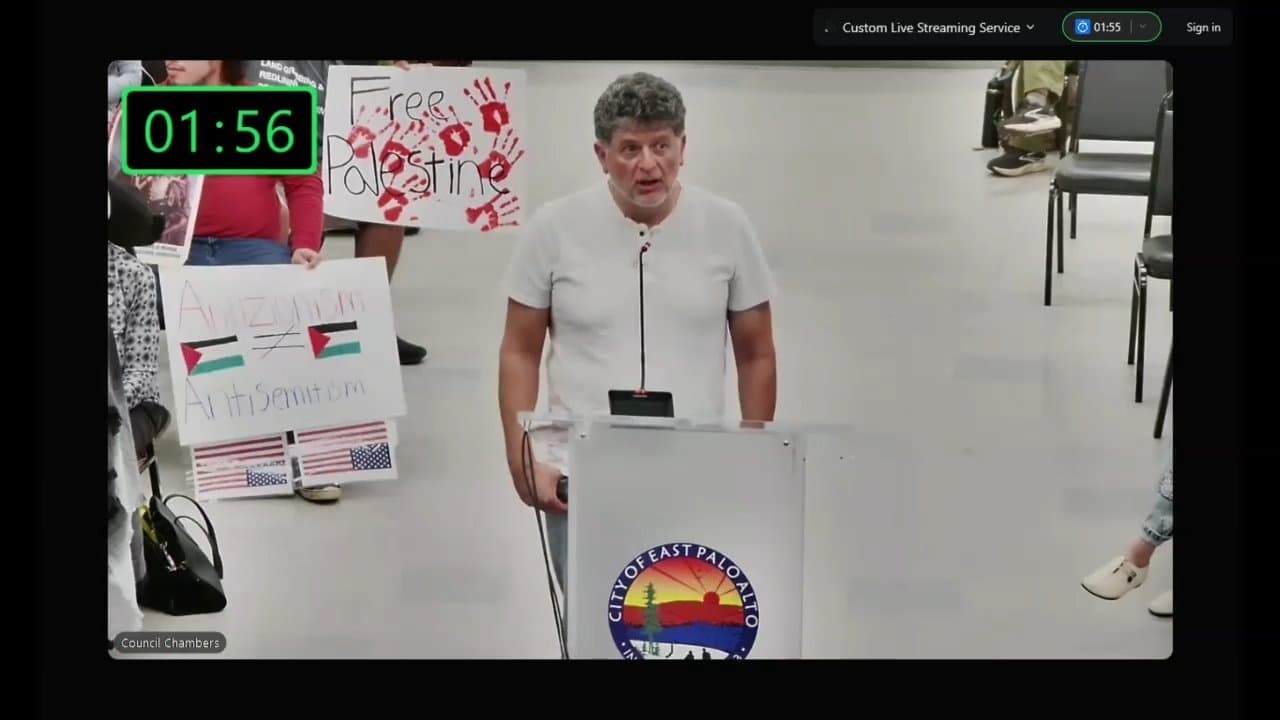
A proclamation marking the anniversary of the Oct. 7, 2023, attack on Israel drew about 20 speakers and a sharply divided room to the East Palo Alto City Council on Oct. 6, 2026. Mayor Webster Lincoln first declared the item passed on a 2-1 voice vote. Staff then ruled that it failed, because the city's municipal code requires three votes and only three of five members were present. The meeting ended early after a family emergency, pushing seven items to a tentative Oct. 20 date.
- Oct. 7 Day of Remembrance proclamation fails after a 2-1 vote misses the three-vote threshold.
- Roughly 20 speakers split sharply over Israel, Gaza and the mayor's Israel trip.
- Municipal Code Chapter 2.08 rule lets a single "no" vote block action at short-handed meetings.
- Seven items, including Rent Stabilization Board appointments and Safer Bay, are continued to a tentative Oct. 20 meeting.
Remembrance Proclamation Fills the Room, Then Falls Short
The basics: Lincoln authored a proclamation that would designate Oct. 7, 2026, a day of remembrance for victims of the 2023 attack by Hamas and Palestinian Islamic Jihad. The text also rejects antisemitism, hate and violence. Councilmember Carlos Romero pulled it from the consent calendar so audience members could speak.
Why it matters: A ceremonial item became the longest debate of the night, at roughly 40 minutes of comment and deliberation. Critics linked it to the mayor's trip to Israel and to the council's earlier adoption of the IHRA definition of antisemitism, a working definition from the International Holocaust Remembrance Alliance.
Where things stand: Supporters described the proclamation as a way to honor the dead. Anna Stepanenko, a public commenter, compared Oct. 7 to 9/11 for Jews. She said many supporters stayed home because of hate and intimidation. Speakers named Adit, Igal Furuman and Moran told personal stories, including the killing of a young woman named Libby after the Nova Music Festival attack. A speaker named Yuval said the day honors the dead, is not about politics, and that hate in any direction is unacceptable.
Lincoln defended the item as respect for victims and compared it to Sept. 11 remembrance.
"You can't justify any sort of terrorism," said Mayor Webster Lincoln.
The other side: Opponents called the proclamation one-sided. They said it ignored Palestinian suffering and Islamophobia. One of the most pointed objections came from a city employee speaking during public comment.
"The only time Palestinians and Muslims are mentioned is through naming terrorist organizations," said Batool Zaro, a senior engineer for the City of East Palo Alto who identified herself as a Palestinian Muslim.
Several local Jewish speakers also opposed the item. Ayelet, a public commenter who described herself as a local Jewish mother and clinician, invoked "never again for anyone" and criticized the IHRA definition and the Israel trips. East Palo Alto native Luis Rosas criticized the mayor's paid trip to Israel. Liban Sheikh tied the proclamation to the council majority's positions on Flock license plate readers and the IHRA definition. Rovniel argued the council had recognized antisemitism but not anti-Palestinian hate. He also said the city enforces its sign rule unevenly.
Resident Gail Dixon said she had "no dog in the fight." She urged the council to prioritize local African American history and reparations.
Decisions and stakeholder impacts: Councilmember Mark Dinan backed the item with reservations about bringing global issues to the dais.
"They're really a distraction from the mission of our city, which is to serve the people of East Palo Alto," said Dinan, who added, "I will support this motion."
Romero voted no.
"We should be focusing on the issues that are municipal and local in nature," said Councilmember Carlos Romero.
The vote: For: 2 (Lincoln, Dinan), Against: 1 (Romero), Absent: 2 (Vice Mayor Ruben Abrica, Councilmember Martha Barragan). The proclamation failed.
What's next: Lincoln said the item could be reconsidered later. Debate over it carried into general public comment, where more speakers spoke for and against.
Three-Vote Rule Turns a 2-1 Win Into a Loss
The basics: Before the vote, a council member asked what approval would take. The city attorney cited Municipal Code Chapter 2.08, which states: "No action of the council shall be valid or binding unless a majority of all members concur therein." On a five-member council, that means three votes, regardless of how many members are present.
Where things stand: After the voice vote, Lincoln declared the motion carried. Staff corrected him: "The motion did not pass because Councilmember Romero voted no." Lincoln said he was hearing about the rule for the first time.
During general comment, Lincoln asked whether the rule applies to proclamations. Staff said state law sets a floor that covers only resolutions, ordinances and payments of money. They added that the council has chosen to regulate beyond that floor.
The other side: Rebecca Eisenberg, a public commenter speaking personally, asked the council to double-check state law on whether the 2-1 vote should count.
Why it matters: With Abrica and Barragan absent, every item effectively needed unanimity among the three members present. Any one member could block any action, ceremonial or substantive. The rule could decide outcomes again at any short-handed meeting. That is also why the proclamation's fate may turn on attendance as much as on votes.
What's next: No council direction to revisit the rule was recorded. Residents who want clarity on how Chapter 2.08 applies to proclamations can raise the issue with the city attorney or at a future meeting.
Seven Items Pushed to Oct. 20 After Early Exit
Where things stand: The council started with three members. Abrica was absent following his brother's death, and Barragan was also absent. Later, one of the three remaining members had a family emergency.
"We wouldn't have a quorum if one of us leaves," said Lincoln, who ended the meeting.
Decisions and stakeholder impacts: Staff listed seven continued items:
- two EPASD items (7.1 and 8.1)
- Youth Commission introductions (11.1)
- Rent Stabilization Board appointments (12.1)
- the citywide lighting assessment (13.1)
- a code enforcement update (13.2)
- a Safer Bay flood-protection update (13.3)
None were public hearings. Tenants and landlords waiting on rent board seats, residents tracking flood protection, and neighborhoods with code enforcement concerns all face a delay. Earlier in the meeting, the agenda and consent calendar (minus the two pulled proclamations) passed by voice vote, 3-0.
What's next: The items are tentatively set for Oct. 20, pending confirmation through the Agenda Committee. The meeting adjourned at 7:39 p.m.
Minor Items
- Domestic Violence Awareness Month: The council approved the proclamation 3-0, honoring CORE's 18,380 services, 5,193 shelter nights, over $1.34M in rental assistance and legal services to 925 survivors. "We are now co-locating with JobTrain," said Robin Jensen, manager of prevention and community engagement, CORE. CORE will hold an open house at the new office on Oct. 28.
- License plate reader audit: A resident named Ravneel asked the council to publicly agendize San Mateo County Civil Grand Jury findings F5, F7 and F8. The findings cover the city's automated license plate reader (ALPR) audits, data-sharing records and approval criteria. The council took no action.
- Signs and ethics: Gail Dixon said three of her signs were removed within 24 hours. She also said a commissioner called her a "village idiot" on Facebook, and she asked for equal ethics enforcement.
- Street racing: A resident named Mario said cars race on city streets, asked where police are, and urged the council to act.
- Parkrun proposal: Resident Aisha Raymond said she is working with Parkrun and Dinan to bring free community runs to the city.
Looking Ahead
The Oct. 7 proclamation could return if the chair brings it back. The next likely session, tentatively Oct. 20, already carries seven continued items, from rent board appointments to Safer Bay. With the three-vote rule now on the record, attendance may decide outcomes as much as debate.