
Council Punts Woodland Park Affordability Deal to Nov. 17 as Clock Ticks
City Council • East Palo AltoOctober 20, 2026
Locunity is an independent informational service and is not an official government page for this commission. All information is sourced from public footage and an analysis of official agendas with the aid of responsible, fact-checked AI. to report an error or omission.
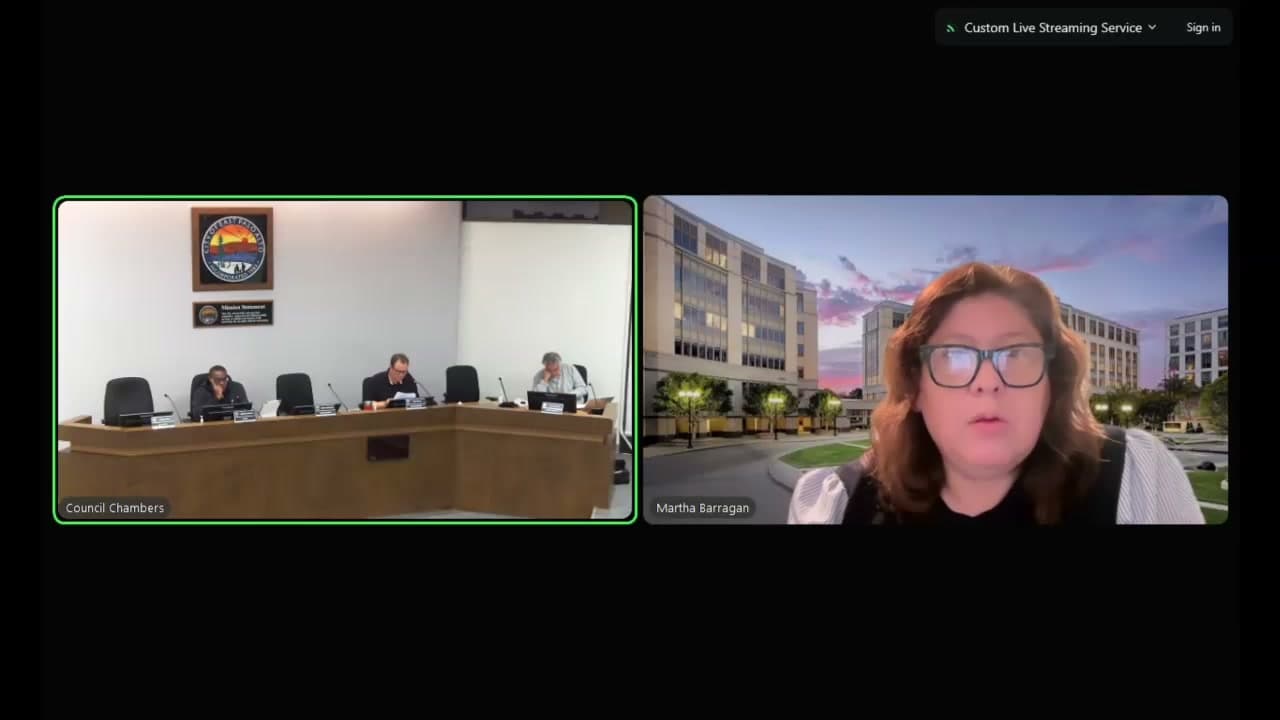
East Palo Alto's biggest housing decision of the year, how to replace 144 rent-stabilized apartments at Woodland Park, is still unresolved. On Oct. 20, 2026, the City Council voted 4-0 to continue the hearing to Nov. 17 after nearly two hours of testimony and debate. Under state law the city has roughly one continuance left before a Jan. 7, 2027 deadline. The council also approved a contested surveillance-camera response 3-1 and got its first look at how Measure JJ anti-displacement money is being spent.
- Woodland Park hearing continued 4-0 to Nov. 17 after tenants and the mayor objected to dropping deeper affordability and for-sale homes.
- Companion O'Keefe-Manhattan hearing never started because the council lacked a quorum. It slips to Nov. 17.
- Council approves ALPR grand jury response 3-1. Councilmember Carlos Romero pushed for a public discussion.
- First Measure JJ report shows the pre-eviction fund only about 13% spent. The mayor pressed staff on slow contracts.
- Sanitary district approves its share of a $31M Palo Alto plant credit line, about $2.37M for East Palo Alto.
- SamTrans pitches a 5-mile Dumbarton busway and trail, with construction possible in the early 2030s.
Woodland Park: One Hearing Down, Few Left
The basics: Sand Hill Property Company wants to meet the city's Inclusionary Housing Ordinance (IHO) through an "alternative compliance" plan for its 13.5-acre Woodland Park site. The plan calls for 766 total units, 307 of them net new. Of those, 124 rental units would be deed-restricted for households earning up to 80% of area median income (AMI) but priced at 60% AMI. The proposal includes no affordable ownership units.
"Households making up to 80% of AMI will be able to rent them, but the rent price will be based on 60% of AMI," said Alex Wagner, a consultant to the city's Housing Division.
Why it matters: The plan would replace the city's tiered 35%, 50% and 60% AMI requirements with a single 60% AMI tier. Under the state Housing Crisis Act (SB 330), all 144 demolished rent-stabilized units must be replaced. Low-income units must carry 55-year deed restrictions, and the council chooses between deed restriction or rent stabilization for the rest. The council must approve or deny by Jan. 7, 2027, within five hearings.
Where things stand: Councilmember Mark Dinan backed the deal. He cited $614,000 to $818,000 in annual city revenue and the substandard condition of the existing housing.
"If we want housing built in this community, our existing IHO does not work," Dinan said.
Councilmember Martha Barragan asked about unit sizes, which staff put at 480 to 1,050 square feet. She also asked about legacy businesses such as laundromats and 7-Eleven, saying neighborhood retail "is a necessity, not a luxury."
The other side: Most public commenters opposed the plan. Tenant association member Angelica said 80% AMI is out of reach for her neighbors. Donna said dropping the 35% and 50% tiers fails the lowest-income residents. Luis Rosas asked how displaced tenants would return. Francisca Guzman cited Sand Hill's record on the Euclid project, and Rovneel urged the council to reject or postpone the plan until it gets answers on ownership and tenant protections.
Not every commenter opposed it. Elidio Lombera Pulido, a representative of the Woodland Park renters committee, said the proposals were acceptable to the committee. Veronica Reyes backed renovating the apartments for current residents.
On the dais, Romero called the staff report incomplete and the plan a bad deal.
"This is not a compromise with a developer. This is a sellout of our community if we don't truly think about their implications," Romero said.
Mayor Webster Lincoln objected to eliminating for-sale homes and neighborhood retail without a public-benefit analysis. "I can't support this as proposed," Lincoln said, adding that "we need ground floor neighborhood-serving retail."
Decisions and stakeholder impacts: Romero moved to continue the hearing and require the missing developer information. Barragan seconded. The vote was For: 4 (Lincoln, Dinan, Barragan, Romero), Against: 0, Absent: 1 (Vice Mayor Ruben Abrica).
The companion hearing on the 172-unit O'Keefe-Manhattan project (Item 14.2) could not proceed for lack of a quorum, since Lincoln had said he would recuse himself. Speakers who waited hours left with no decision. The council had reordered its agenda specifically to protect a quorum for these hearings.
What's next: Both items return Nov. 17. Tenants face a choice between deeper affordability and ownership on one side and renovated replacement housing on the other. Sand Hill now has to fill in the data gaps the council flagged.
Measure JJ: Money In, Slow Out
Why it matters: This was the first public accounting of the anti-displacement funds voters approved in 2024. Council had earmarked 45% of Measure JJ revenue for rental assistance.
Where things stand: WeHOPE, Community Legal Services in East Palo Alto (CLSEPA) with the Legal Aid Society of San Mateo County, Samaritan House and EPACANDO all presented.
"Measure JJ funds 3 connected services with one goal, which is to keep East Palo Alto residents housed," said Katrina Logan, executive director of Community Legal Services in East Palo Alto.
CLSEPA said only about 13% of the pre-eviction fund has been spent. It proposed shifting funds, replacing the $5,000 assistance cap with up to three months' rent, and revisiting income eligibility rules.
The other side: Lincoln wanted answers on timing. "I'm just wanting to know an explanation from staff why it took so long to get this funding out," he said.
Staff blamed limited capacity: 2.5 housing employees managing five contracts, with Samaritan House signing last. Karen Camacho, housing and economic development manager, said the shift to the housing division was a factor: "in the past, the contracts were managed through the Rent Stabilization Program and funded in part through rent stabilization funds."
Decisions and stakeholder impacts: No vote was taken. Tenants facing eviction stand to benefit most if the council loosens the cap and moves unspent money. Two public commenters weighed in. Mario raised concerns about fraud in aid programs, and Gail Dixon asked agencies to provide tenant pamphlets.
ALPR Response Passes, Debate Deferred
Why it matters: The city's response to the San Mateo County Civil Grand Jury report on automated license plate reader (ALPR) cameras partly or wholly disagrees with findings on audits (F5) and data-sharing safeguards (F7).
Where things stand: Romero pulled the item from the consent calendar, saying the community is split on surveillance.
"So this is more than anything a request to have this agendized as a discussion item, given its importance," Romero said.
The other side: Public commenter Rovneel urged the council to reconsider its F5 and F7 answers. He cited about 300 data-sharing relationships and corrective actions not scheduled until 2027.
Decisions and stakeholder impacts: The response passed For: 3 (Lincoln, Dinan, Barragan), Against: 1 (Romero), Absent: 1 (Abrica). The city's positions now go to the grand jury. Privacy advocates did not get the public discussion Romero sought.
Dumbarton Busway Takes Shape
The basics: SamTrans' Reimagine Dumbarton project envisions "a vision to transform the former freight line known as the Dumbarton Rail Corridor into a 5-mile-long busway and walking and bicycling trail," said Millie Tolleson, SamTrans director of planning.
Where things stand: The concept includes bus rapid transit-style lanes, a 20-foot path, nine stations, 15 access points and a new U.S. 101 crossing. A preferred alternative is due this winter, and construction could start in the early 2030s. Construction funding is not yet secured.
Why it matters: The bus lanes end at University Avenue, so East Palo Alto service would continue on city streets. Councilmembers backed the bus rapid transit approach. They asked about last-mile connections, environmental review under the California Environmental Quality Act (CEQA) and a bridge design that could accommodate rail later. One councilmember argued a line carrying perhaps 5,000 riders does not justify a $3 billion to $4 billion rail investment.
What's next: Public survey input runs through Oct. 30.
Sanitary District Signs on to Plant Financing
Where things stand: Sitting as the East Palo Alto Sanitary District (EPASD) board, with Lincoln chairing as vice president, members approved Addendum 2 to the Palo Alto Regional Water Quality Control Plant partner agreement. The addendum covers a $31M, five-year line of credit. EPASD holds a 7.64% share of plant capital upgrades, about $2.37M.
Utility Manager Matt Vining put the annual partner cost at "approximately $800,000 to $1 million, and this is lower than the originally estimated $1.3 million to $1.5 million."
The other side: Romero asked why the district would finance rather than pay cash. Karen North of Palo Alto said Mountain View had asked to be pulled out of the arrangement and called the credit line interim financing.
Decisions and stakeholder impacts: The addendum passed For: 4 (Lincoln, Dinan, Barragan, Romero), Against: 0, Absent: 1 (Abrica). The board also approved the August 2026 cash disbursement report by the same 4-0 vote. Vining said a full-time assistant starts Oct. 26 and that temporary staffing funds will go toward digitizing files.
- Rent Stabilization Board: Jose Sanchez (YMCA) won the regular seat 3-1 on written ballots, with Lincoln, Dinan and Barragan voting for him and Romero voting for Ariana Aranda. Aranda (Compass Family Services) took the alternate seat by consent.
- Agenda reorder: Approved 3-1 over Romero's objection that board applicants were told to arrive around 7:30. Youth Commission introductions were postponed.
- Consent calendar: Street sweeping, minutes and IT consulting items passed 4-0.
- Proclamation: East Palo Alto joined America the Entrepreneurial, 4-0. A commenter asked whether the mayor had committed the city before council approval.
- General public comment: Speakers raised stolen campaign signs, Dinan's statements about ICE activity in the city and a proposed citizens' oversight committee.
Looking ahead: The clerk announced a Planning Commission vacancy. Both Woodland Park hearings return Nov. 17.