Board of Directors - Sep 08, 2026 - Meeting
Board of Directors • East Bay Municipal Utility DistrictSeptember 8, 2026
Locunity is a independent informational service and is not an official government page for this commission.We use AI-assisted analysis and human editorial review to publish information.
Board Cuts $1M From Dump Truck Contract, Demands New Outsourcing Rules
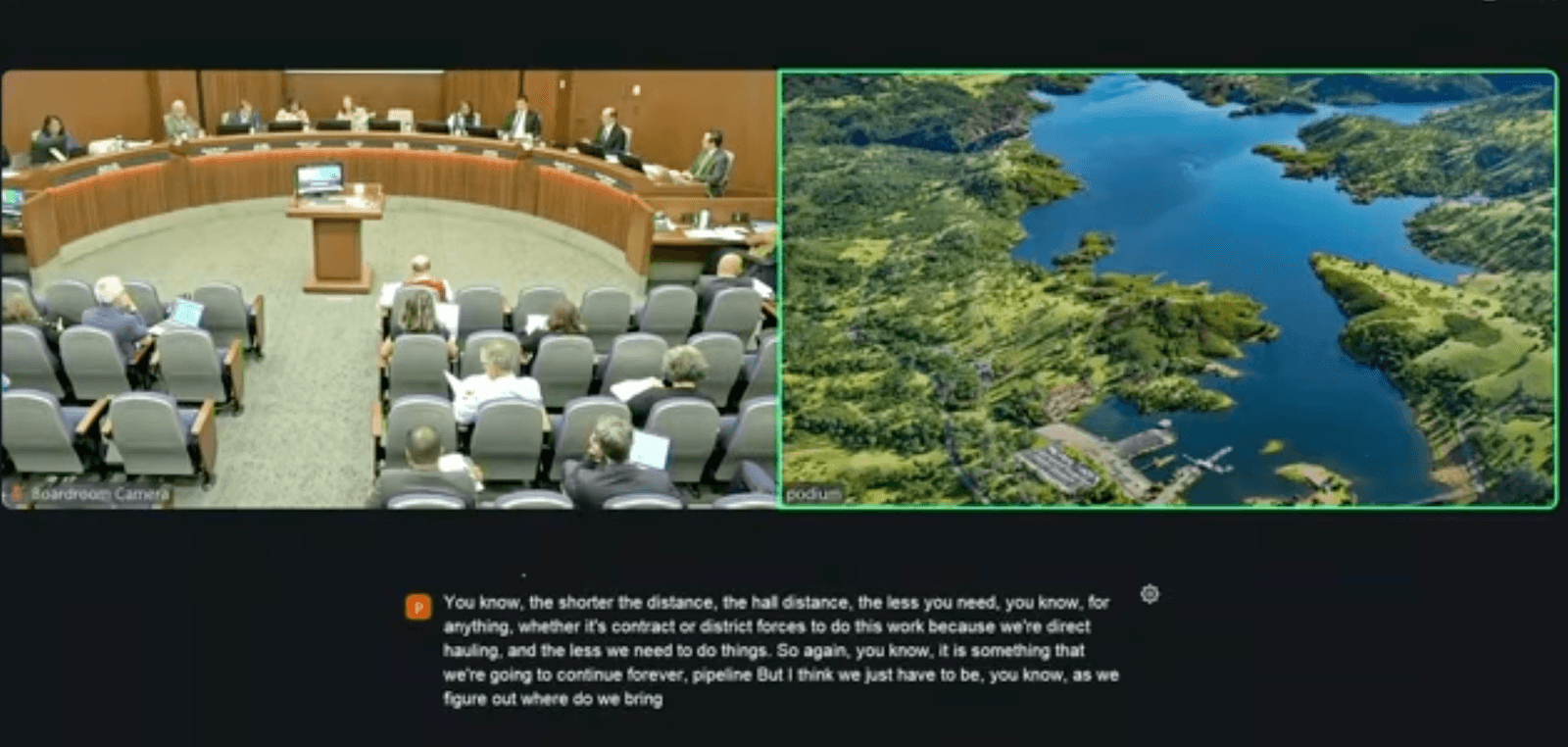
East Bay MUD's board sliced $1 million from a dump truck contracting authorization and — for the first time — required staff to develop formal criteria governing when outside contractors can replace union workers on the district's massive pipeline rebuild program. The 5-1 vote capped a lengthy debate that pitted cost control on a $1.9 billion infrastructure project against organized labor's demand that the board stop outsourcing bargaining unit work without negotiation.
- Board reduces FMNO dump truck contract from $7.8M to $6.8M, conditions future outsourcing funds on formal board-adopted criteria
- AFSCME Local 444 president challenges $1M increase as contracting out union work without proper meet-and-confer
- GM warns pipeline rebuild will cost $1.9 billion over 13 years, crowding out all other capital projects at current spending rates
- Resident demands district publish decades of rate data, revealing 6% annual increases with no public explanation
- Board unanimously adopts updated governance manual after months of revisions
The Fight Over Who Hauls the Dirt
Item 15 — a consent calendar item that Director Odie pulled for full debate — proposed increasing the authorization for fully maintained and operated (FMNO) dump truck services to $7.8 million. The contract covers trucks used to direct-haul trench soils from the district's pipeline rebuild program, a method that eliminates the intermediate step of stockpiling dirt before disposal.
The basics: FMNO contracts provide heavy equipment with operators on a per-hour basis. The district currently uses the FMNO contract for dump trucks on its pipeline rebuild, which is replacing aging water mains across the East Bay. Last year the district spent $6.1 million on these services; staff requested authorization for $7.8 million — a 28% increase.
Why it matters: The pipeline rebuild is East Bay MUD's single largest capital program, and how the district allocates labor between its own union workforce and outside contractors will shape costs — and rates — for 1.4 million customers for the next decade-plus.
Labor's Case
Eric Larson, President of AFSCME Local 444, came to the board with a blunt message: the increase contracts out bargaining unit work, and the union wasn't notified until a July 2026 contracting-out notice.
"We object to the $1 million increase in fully maintained and operated dump trucks contracts for direct haul of trench soils," said Larson. "We request that you amend the motion and reduce the award from $7.3 million, down to last year's spending, plus inflation of $6.3 million, allowing us time to meet and confer over the decision, the effects, and the impact."
Larson later challenged the cost comparison staff used to justify the contract, arguing FMNO trucks look cheaper only because the district avoids paying benefits. "The numbers that Clifford used, the differential that Clifford used for FMNO trucks is much cheaper because we don't have to pay their pension. They're not union jobs," he said. "We don't pay for their benefits. We don't pay for their health care. We don't pay for anything except for prevailing wage."
Management's Math
General Manager Chan defended the increase on pure cost grounds. He told the board that overall dirt-handling costs had dropped from $16 million to $10 million through direct haul — and that the hourly rates are significantly different.
"The hourly cost for district forces is $231. The hourly cost for FMNO is $161 per hour," GM Chan said. "So there's a big difference between contracting out and district forces."
Staff member Crystal added a logistical wrinkle: the prior subcontractor, Pacific States, had an eight-hour minimum that the district was unable to negotiate down, while the FMNO dump truck contract carries only a four-hour minimum — making it more cost-effective for shorter hauls.
But GM Chan used the moment to deliver a broader warning about the pipeline rebuild's trajectory. "If we project forward 13 years, the last 13 years of pipeline rebuild, pipeline rebuild by itself, the total 13 years is going to cost close to $1.9 billion," he said. "And that doesn't fit very well into the rate models that we have."
He noted that cost per mile for pipeline installation has risen from $2.9 million to $4.4 million since FY20, and cautioned the board against locking in permanent hires before the district fully understands long-term cost dynamics. "I just suggest that we moderate decisions that you really can't go back on, which is especially hiring people before we figure all this out."
The Board Weighs In
Director Odie had been asking for a contracting-out workshop for 18 months. He framed the 28% increase as part of a pattern and pushed back on the idea that perpetual work should be outsourced on cost alone.
"From my understanding of the answer to Director Smith's question is this is going to happen in perpetuity," Director Odie said. "So we're basically using the cost rationale to contract out work that's probably never going to end. So that's where I have a little discomfort."
Director Katz pressed for a formal evaluation framework. "I do want to make sure that we have before our next budget cycle, a process to clearly evaluate the need for district forces to fully utilize those types of forces to be consistent and compliant with the MUD Act," he said — a reference to the Municipal Utility District Act, which governs contracting standards for the district.
Director Smith asked about pipeline rebuild timelines and future staffing needs, while Director Young probed whether the contract could be split between work that should stay in-house and work suited for contractors.
Decisions
Director Young crafted the final motion: approve $6.8 million — effectively last year's spending plus inflation, matching a compromise Larson himself had floated — and condition any additional funding on the board first adopting formal criteria governing FMNO heavy equipment contracting. "We've been asking criteria to agree on something forever," Director Young said. "It predates Director Odie's tenure."
The motion passed 5-1. Director Lewis voted no, citing the motion's complexity. Director Chan was absent.
What's next: Staff must present contracting-out criteria to a board committee before requesting any funding above the $6.8 million threshold. The outcome could establish a precedent for how East Bay MUD manages all outsourcing decisions on the pipeline rebuild — a program that has already added 57 positions since FY20, including 37 in Local 444.
A Ratepayer's Challenge: Where's the Data?
Public commenter Joseph Gurkar used his time at the microphone to present the board with something the district doesn't publish: a compiled historical rate sheet showing water rates have climbed roughly 6% per year since the start of the century.
Why it matters: Gurkar noted that while water production has been highly variable — declining due to conservation and droughts — rate increases have been remarkably uniform, with no public explanation of what drives them.
"Bottom line is that your water rates are going up 6% a year," Gurkar said. "What's unexplainable is why do the rates rise that much?"
He pointed out that the district removes financial publications from its website after about 10 years, making pre-2005 data essentially inaccessible. He thanked Secretary Cole for providing some early rate sheets that enabled his compilation and called on the board to disclose more historical data online.
Minor Items
- Consent calendar (Items 1–14, 16–17) approved unanimously by voice vote with no discussion. Director Chan absent and excused. (For: 6, Against: 0, Absent: 1)
- California Clean Air Day resolution declaring Oct. 7 adopted unanimously. The annual resolution reaffirms the district's clean action plan and employee sustainability activities, including bike-to-work programs. (For: 6, Against: 0, Absent: 1)
- Board of Directors Governance Manual adopted unanimously after months of committee and full-board revisions. The updated manual codifies agreements from the board's retreat and incorporates minor grammatical changes to Sections 3.04 and 4.03. Director Katz flagged rendering errors ("bookmark not defined") for the record, clarifying the adoption covers the corrected version. (For: 6, Against: 0, Absent: 1)
- Hispanic Heritage Month recognition celebrated Fuerza Latina's 30th anniversary, with a month of cultural programming including a Dia de los Muertos altar. The board observed a moment of silence for earthquake victims in Colombia and Venezuela.
- National Disability Employment Awareness Month recognized DART, the district's newest employee affinity group (founded 2022), with October activities including guest speakers and therapy dogs from Canine Companions.
- Art exhibit by Mario Navacero, "De Manera Amorosa" (In A Loving Way), featuring visual experiences from growing up in East Oakland's Fruitvale neighborhood.
- Committee reports: Planning Committee accepted water quality and pipeline rebuild updates. Legislative HR Committee received the district's inaugural economic impact report. Finance & Administration Committee covered monthly investments, FY2027 insurance summary, KPIs, greenhouse gas reduction options, internal audit, and held a "robust discussion" on Policy 4.29 governing artificial intelligence use.
- General Manager's report: GM Chan reported July and August water production is trailing last year. He cautioned against reading too much into revenue figures, noting they lag production data and several more months are needed for a clear assessment.
- Director Young called for a moment of remembrance for the Nepal earthquake, noting 5,000 missing and 1,500 dead. Multiple directors reported attending the Water Reuse Conference, signaling growing board interest in recycled water as a long-term supply strategy. Other community engagements included Oakland Pride, the Contra Costa Mayors Conference, the Alameda Labor Council Unity Dinner, and a KTVU Channel 2 interview about the Oakland Oakport project.