
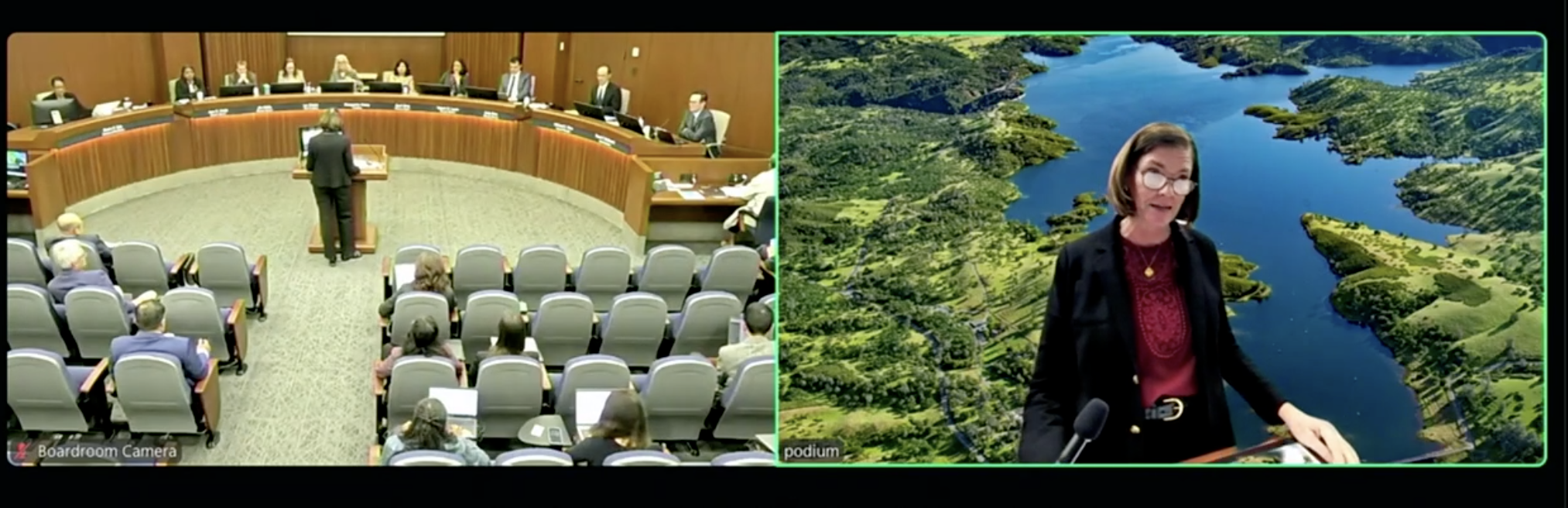
East Bay Municipal Utility District, CA – Board of Directors – Jan 13, 2026

East Bay Municipal Utility District, CA – Board of Directors – Jan 13, 2026

Board of DirectorsEast Bay Municipal Utility DistrictJanuary 13, 2026

Sources:

Locunity is a independent informational service and is not an official government page for this commission.We use AI-assisted analysis and human editorial review to publish information.

EBMUD Elects New Leadership, Approves Board Pay Hike in Split Vote

The East Bay Municipal Utility District rang in 2026 with a leadership shuffle, a detailed primer on new state transparency rules, and a 7.23% pay raise for board members that drew the meeting's only contested vote. With reservoirs sitting at 114% of average storage despite a dry start to winter, the utility enters the year in solid operational shape—but will need more rain and snow to stay there.

  • Luz Gómez elected Board President; Director Lewis named Vice President for 2026.

  • Board approves prospective 7.23% salary increase in 5–1–1 roll call; Director April Chan votes no, Director Odie abstains.

  • Legal counsel walks board through sweeping SB 707 Brown Act changes, including mandatory remote access, multilingual agenda translations, and social media restrictions.

  • Federal lobbyist warns of "unprecedented" political dynamics in Washington; PFAS liability protections top district's DC wishlist.

  • Water supply remains healthy at 83% of capacity, but recent storms only partially offset below-average precipitation; more rain needed.


New Officers Take the Gavel

The board opened the year by electing new leadership, elevating Luz Gómez to President and Director Lewis to Vice President for 2026.

Why it matters: The annual leadership rotation shapes meeting agendas, committee assignments, and the district's public voice for the coming year. Gómez, who had served as a board member, now presides over a utility serving 1.4 million East Bay customers.

Director Marguerite Young nominated Gómez, with Director Andy Katz seconding. The vote was unanimous. Young then nominated Lewis for Vice President, with Director Odie seconding.

"The next item on the agenda would be to open the floor for nominations for Vice President of the board for 2026," said President Luz Gómez, taking the gavel moments after her election.


Brown Act Overhaul: What SB 707 Means for EBMUD

The bulk of the meeting was devoted to an annual ethics and transparency briefing—this year dominated by SB 707, a new state law reshaping how public agencies conduct meetings, handle disruptions, and communicate with constituents.

Why it matters: The law expands public access requirements and places new constraints on how board members interact on social media—rules that will require policy changes and staff attention before a July 1, 2026 deadline.

State of play: The General Counsel and Assistant General Counsel walked the board through four major changes:

  1. Remote access: Agencies must now provide two-way audiovisual access to all public meetings. If internet or phone service is disrupted, the board must recess for up to one hour before continuing.

  2. Disruption removal: Existing authority to remove disruptive in-person attendees now extends to remote participants.

  3. Translation and interpretation: Agencies must post agendas translated into "applicable languages"—for Alameda County, that means Spanish, Chinese, Vietnamese, and Tagalog. Interpretation at meetings remains discretionary.

  4. Social media limits: Board members may not interact with each other's posts on district business, even to "like" innocuous content.

"The board will be required to adopt a policy addressing disruptions of service. And that has to be done by July 1, 2026," said the General Counsel.

Director Marguerite Young raised a practical concern: what happens if an earthquake knocks out internet and phone service across the region?

"Maybe this is a little bit too specific, but in the event of an earthquake where there's a broad disruption of Internet service and potentially telephone service of the type that's required by the Brown Act," she said, as staff acknowledged the law doesn't carve out exceptions for natural disasters.

Director Odie pressed on the social media rule, noting its breadth.

"I was not allowed to like your post where you threw out the first pitch," Odie quipped to a colleague, illustrating how even celebratory, non-policy content now falls under the restriction.

The Assistant General Counsel clarified the translation requirements, noting that the district must identify applicable languages based on census data.

"In Alameda County, Alameda County recognizes four languages that would fit within the definition of applicable language. And they are Spanish, Chinese, Vietnamese, and Tagalog," the Assistant General Counsel said.

Staff noted that Zoom already supports closed captioning in multiple languages, offering one avenue for compliance. The Secretary explained, "Zoom allows—we have closed captioning here in English, but Zoom allows you to change the language for the closed caption."

What's next: Staff will return with a draft disruption policy before the July 1 deadline.


Board Pay Raise Passes With Dissent

The board approved a prospective salary adjustment mirroring recent staff increases—but not without pushback.

Why it matters: Board compensation decisions are perennial lightning rods for public agencies. EBMUD's approach—tying director pay to general employee increases—aims for political cover, but the 7.23% cumulative bump still drew a split vote.

State of play: The General Manager presented three options: a 3.4% increase for 2025 (matching last year's staff raise), a 3.7% increase for 2026, or both compounded for a 7.23% total. Under the MUD Act, the board can increase its own salary by up to 5% annually.

"The MUD Act allows an annual increase, as President Gomez just mentioned, of up to 5% in the Board of Directors salary," the General Manager said.

The other side: Director April Chan voted no; Director Odie abstained. Neither offered detailed objections during the meeting, but the dissent signals ongoing sensitivity around board compensation.

Decisions: The motion to adopt the compounded 7.23% increase (Option C) passed 5–1–1.


Federal Priorities: PFAS, Funding, and a "Wild" Washington

The district's Washington lobbyist, Eric Saperstein, delivered a blunt assessment of the federal landscape—and outlined priorities for the year ahead.

Why it matters: EBMUD, like water utilities nationwide, faces mounting costs to address PFAS contamination. Federal liability protections and infrastructure funding could significantly shape the district's long-term finances.

State of play: Saperstein framed the political outlook with characteristic candor:

"I thought about telling you that nothing is going on in Washington. And that's my presentation," he joked, before diving into a detailed briefing on budget reconciliation, WRDA/WIN reauthorization, and PFAS litigation exposure.

Top priorities for 2026 include securing PFAS liability protections for water utilities, advancing Western water infrastructure, and maintaining access to federal funding programs.

Decisions: The board accepted the legislative report without objection.


Water Supply: Strong Storage, But More Rain Needed

The Water Operations Manager reported that system storage stands at 83% of capacity and 114% of historical average—a healthy position, but one built largely on prior wet years rather than this winter's precipitation.

"Our rain totals and our snow totals were below average. Our runoff was below average as well. But despite that, we did end up with just about a full system at the end of September," the manager said.

Recent storms have boosted Sierra snowpack, but staff cautioned that additional precipitation is needed to reach median runoff projections for the year.


Minor Items

  • Consent calendar: Items 2 and 4–9 approved together. Item 1 (minutes) amended to include Director Chan's filed questions on the district's captive insurance company. Item 3 (hydrant replacements contract) approved after brief discussion.

  • Community recognition: A public commenter named Frances noted Pete's Hardware in Castro Valley is celebrating its 100th anniversary and requested district recognition. Staff said they would consider a note of appreciation but cautioned about setting precedents.

  • General Manager's report: Monthly financial and program updates; applications for the Community Water Academy are now open.


What to Watch

Brown Act compliance: Staff must bring a new disruption policy to the board before July 1. Multilingual agenda translation logistics will also require attention.

Water supply trajectory: The district enters 2026 in good shape, but another dry winter could trigger conservation conversations. The next few months of precipitation will be decisive.

Federal wildcard: With Washington in flux, the district's DC priorities—especially PFAS liability—face uncertain prospects. The lobbyist's briefing suggests staff are bracing for a bumpy year.