
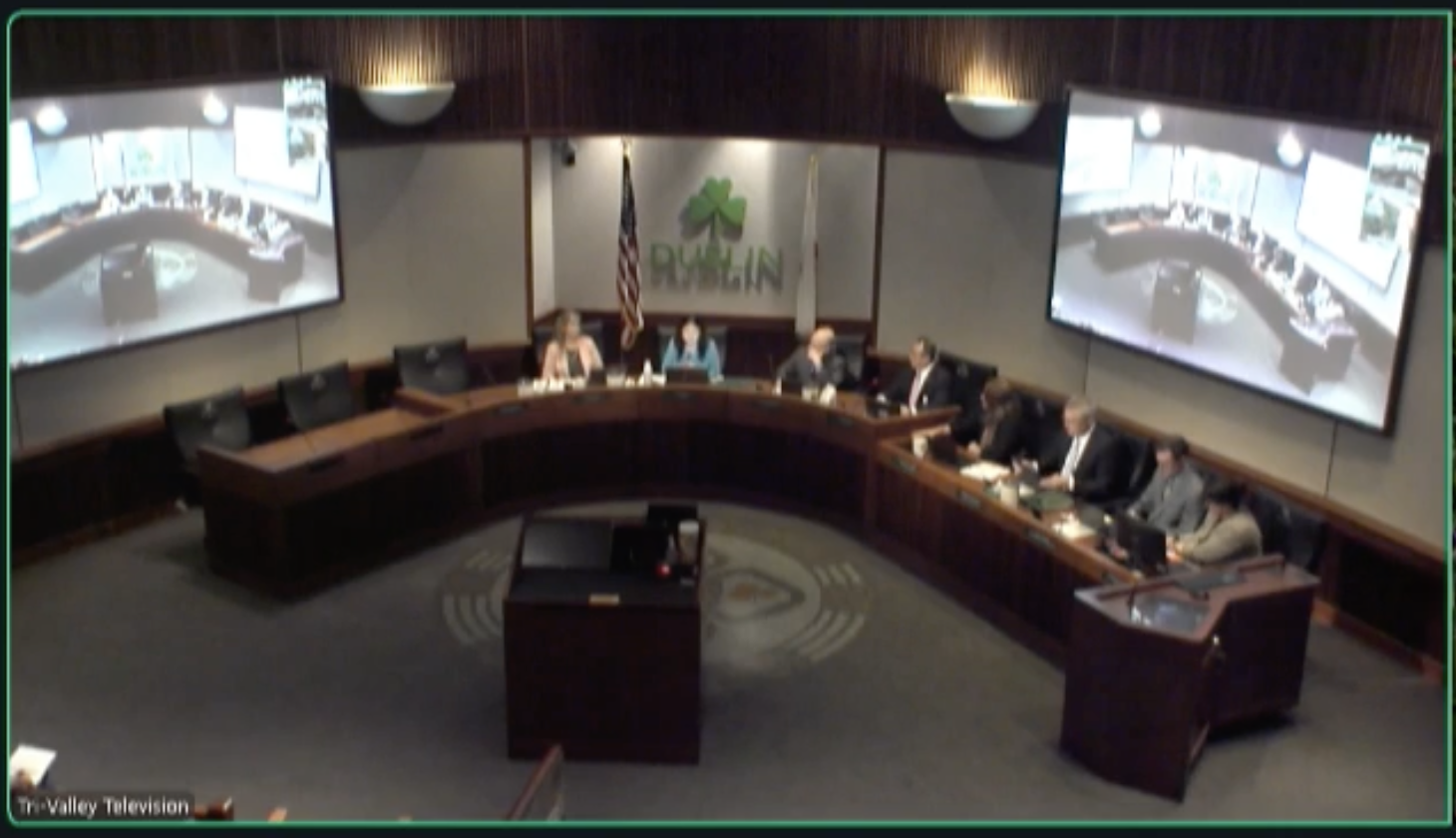
Dublin, CA – City Council – Mar 24, 2026
City Council • DublinMarch 24, 2026
Locunity is a independent informational service and is not an official government page for this commission.We use AI-assisted analysis and human editorial review to publish information.
Dublin Raises Parking Minimums Over State Objection Risk, Adds Fireworks Crackdown
The Dublin City Council tackled a full docket March 24, introducing two ordinances that will shape housing development standards and public safety enforcement heading into summer — while also green-lighting a long-awaited cell tower to close a wireless dead zone in the city's eastern neighborhoods.
Council sets market-rate parking above staff proposal, risking state pushback on Housing Element compliance
New social host liability lets city cite property owners for illegal fireworks ahead of July 4th
50-year cell tower lease at Fallon Sports Park targets eastern Dublin's wireless dead zone
Dublin hits halfway mark on housing permits with 1,035 of 3,719 RHNA units issued
Meals on Wheels program served 76,000 Tri-Valley meals last year but is scrambling to fill 9 of 15 Dublin volunteer routes
Parking Fight: Council Overrides Staff Numbers, State May Push Back
Dublin introduced zoning code amendments required by its Housing Element — but the headline was a debate over how much parking new apartment buildings should provide, and whether the council's instincts would survive scrutiny from Sacramento.
The basics: The ordinance implements two state-mandated Housing Element programs: replacement housing requirements (new Chapter 8.51) and the removal of development constraints, including reducing and consolidating parking minimums for multifamily housing. A W-Trans parking study backed the proposed reductions. The Planning Commission unanimously recommended approval on Feb. 24.
Why it matters: Staff proposed setting market-rate parking at 1 space per studio or one-bedroom unit and 2 spaces per two-plus-bedroom unit — numbers calibrated to ITE peak parking demand data and designed to avoid triggering objections from the California Department of Housing and Community Development. Guest parking requirements would be eliminated entirely. The council's decision to go higher could invite state scrutiny at the next HCD compliance check.
Where things stand: Vice Mayor Jean Josey led the push to raise minimums, questioning whether the parking study reflected Dublin's suburban reality.
"For market rate, I would like to see us go a little bit higher, like for studios and one bedrooms, 1.1 or 1.2. So that if you've got 100 unit building, you're getting a little bit more of that shared parking as a minimum. And for two plus bedrooms, maybe 2.25 or 2.5," she said.
Councilmember Michael McCorriston echoed the concern, citing his own experience visiting multifamily developments in other parts of the Bay Area.
"There's no parking. There's just not enough parking. And we might have it different here, I don't know. But I want to make sure that we're taking that into consideration," he said.
The other side: Brian Canepa of W-Trans pushed back, explaining that ITE peak demand data already accounts for all on-site users including guests, and that parking minimums, actual demand, and supply are three different things.
"Developers want to provide parking at the end of the day. Obviously they base it on market conditions and the location where it's at. But if you were locating in a suburban part of Dublin, developers would inevitably want to provide parking regardless of whether there were parking requirements or not," he said.
Canepa also noted that resident parking permit districts — not higher minimums — are the most common California tool for managing neighborhood spillover. Councilmember Kashef Qaadri pressed on whether reduced standards would burden affordable housing residents, and whether spillover would affect adjacent neighborhoods. Canepa reiterated that developers calibrate supply to market conditions beyond any minimum.
Special Projects Manager walked through additional ordinance changes including cleanup items correcting inadvertent errors in the land use table for SROs and low-barrier navigation centers.
Decisions: The council voted 5-0 to introduce the ordinance with modifications: studio and one-bedroom market-rate units set at 1.1 spaces, two-plus-bedroom market-rate units at 2.25 spaces. A new footnote provides that affordable senior housing uses whichever standard is lower between the senior housing and affordable housing categories. Staff explicitly warned that HCD may object to the 2.25 ratio.
What's next: The ordinance returns for a second reading at an upcoming meeting. Staff indicated the city may have to revisit the 2.25 figure if HCD flags it during the next compliance review.
Fireworks Crackdown: Social Host Rules and Calls for Even Tougher Penalties
Dublin introduced a fireworks ordinance rewrite that gives the city a tool it has never had: the ability to hold property owners responsible when illegal fireworks are set off on their property.
Why it matters: Illegal fireworks have long frustrated Dublin residents and law enforcement alike. Under the current code, officers have limited ability to hold anyone accountable unless they catch a person in the act. The new "social host" provision shifts liability to the property owner — modeled after ordinances in Newark and Livermore.
Where things stand: Staff member Jordan Foss presented the amendments, which also establish administrative citation authority ($100/$200/$500 per the state schedule), replace a fixed $200 fireworks booth deposit with the city's master fee schedule, and require prior-year revenue and expenditure reporting from booth operators.
Vice Mayor Jean Josey praised the social host language and pushed for more aggressive enforcement.
"I think that adding the social host language helps tremendously. We do have drones. We could be looking for where they're coming from," she said, noting that people have set off illegal fireworks directly in front of officers without consequences.
Councilmember Michael McCorriston advocated for penalties that match the risk.
"With regard to the use and storage of illegal fireworks, I think in the city of Dublin, we should have penalties that influence behavior and we shouldn't have to wonder or pursue county rules and laws or state rules and laws as a fallback," he said.
Councilmember John Morada shared it was good progres.
"I think there's a nice fair balance here. So I'm certainly in support of the progress that we're making here."
Morada also raised First Amendment considerations, urging staff to frame public education around safety rather than restriction.
Chief Victor Fox addressed response times, noting police can reach priority-two calls in 5–7 minutes, with faster responses on July 4th. The city attorney indicated some legal authority may support higher fines specifically for dangerous fireworks and that staff will return with additional research.
Decisions: The ordinance was introduced unanimously, 5-0. The 2026 fireworks booth application is already live with the new reporting requirements.
What's next: Staff will return at a future meeting with research on whether the city can set penalties for illegal fireworks above the state-set $100/$200/$500 schedule.
Cell Tower Deal Targets Eastern Dublin's Wireless Dead Zone
The council approved a 50-year site lease with Wireless Edge Towers III, LLC for a 95-foot monopine wireless tower at Fallon Sports Park, aimed at filling persistent coverage gaps in eastern Dublin.
Why it matters: Residents in eastern Dublin have dealt with weak or nonexistent wireless service — a problem that extends to 911 reliability. The tower, disguised as a faux pine tree, will accommodate up to four carrier mounts plus one municipal mount, sited behind Field C near Fire Station 18.
Deal math: Minimum annual colocation rent of $40,000, a one-time $100,000 community benefit payment, $5,000 bonuses per new sublease, and $10,000 renewal bonuses. Wireless Edge bears all construction, operation, maintenance, insurance, and removal costs.
John Arthur of Wireless Edge Towers described the tower's coverage range as approximately half a mile due to the area's bowl-like terrain, with carrier equipment enclosed in a fenced, landscaped pavilion shed.
Councilmember Michael McCorriston asked about the city's plan beyond this single site. Staff member Jordan Foss confirmed Dublin has an agreement with Horizon Tower covering 14 potential sites across the city for future wireless assessment. Councilmember Kashef Qaadri asked about decommissioning and technology evolution; Arthur said carriers regularly swap antennas and anticipate 5G deployment continuing for about 10 years.
Decisions: Approved 4-0. Councilmember John Morada recused himself due to the facility's proximity to his home. Construction is estimated at 10–12 months.
Dublin Halfway to RHNA Goal, Very-Low-Income Permits Surge
Councilmember John Morada pulled the Housing Element Annual Progress Report from the consent calendar to walk through the numbers publicly.
Why it matters: Dublin's total RHNA allocation for the 2023–2031 cycle is 3,719 units. Through 2025, the city has issued 1,035 building permits — putting it at roughly 28% of the cycle total at the midpoint.
Senior Planner Gaspare Annibale broke down the permits by year: 370 above-moderate in 2023, 90 in 2024, and 575 in 2025 (including 404 above-moderate, 19 moderate, 40 low, and 112 very-low-income). The 112 very-low-income permits came from the Regional Street Senior Affordable Housing Project — a notable breakthrough given zero permits in that category in prior years.
Decisions: Approved 5-0. Staff was directed to forward the report to HCD and the Governor's Office of Land Use and Climate Innovation.
Meals on Wheels Serving 76,000 Meals but Running on Fumes
The council proclaimed March for Meals Month, but the presentation from Spectrum Community Services underscored a real operational crisis.
A representative from Spectrum Community Services reported that the program served 76,000 hot meals across the Tri-Valley last year and remains one of the few agencies nationally still delivering hot — not chilled — meals to seniors 60 and older who struggle to shop, cook, or afford food.
The problem: volunteers.
"There is 15 routes in Dublin weekly. Currently, I have nine routes that do not have a committed person. And so we just scramble. I've been here for seven and a half years. We have not missed a day of service," the representative said.
Residents interested in volunteering can contact Spectrum Community Services directly.
Minor Items
Closed session: Council voted 5-0 to cross-appeal in Kingswood Owners Association v. City of Dublin (Case No. A175808), an active case before the First District Court of Appeal.
Consent calendar (Items 5.1–5.4, 5.6): Approved 5-0, covering Feb. 18 meeting minutes, a Zone 7 stormwater license agreement, a recyclables processing contract with Alameda County Industries, $19.6 million in February 2026 expenditures, and management position retitling.
American Red Cross Month: Council proclaimed March as American Red Cross Month, marking the organization's 145th anniversary. Teresa Deloach Reed of the American Red Cross accepted the proclamation.
Public comment: Mike Grant praised security and logistics at the St. Patrick's Day events, thanking Alameda County deputies, DPS, and parks staff. Liz Schmidt spoke in defense of Dublin's diversity, responding to a previous meeting's criticism of a Ramadan proclamation.
H Mart grand opening: March 26 at 7884 Dublin Blvd., ribbon cutting at 9 a.m., doors open at 10 a.m.
Doherty Road overpass: Paving repairs on the 580 overpass at Dougherty Road are scheduled for April.
Red Cross blood drive: April 3 at the Dublin Civic Center.