
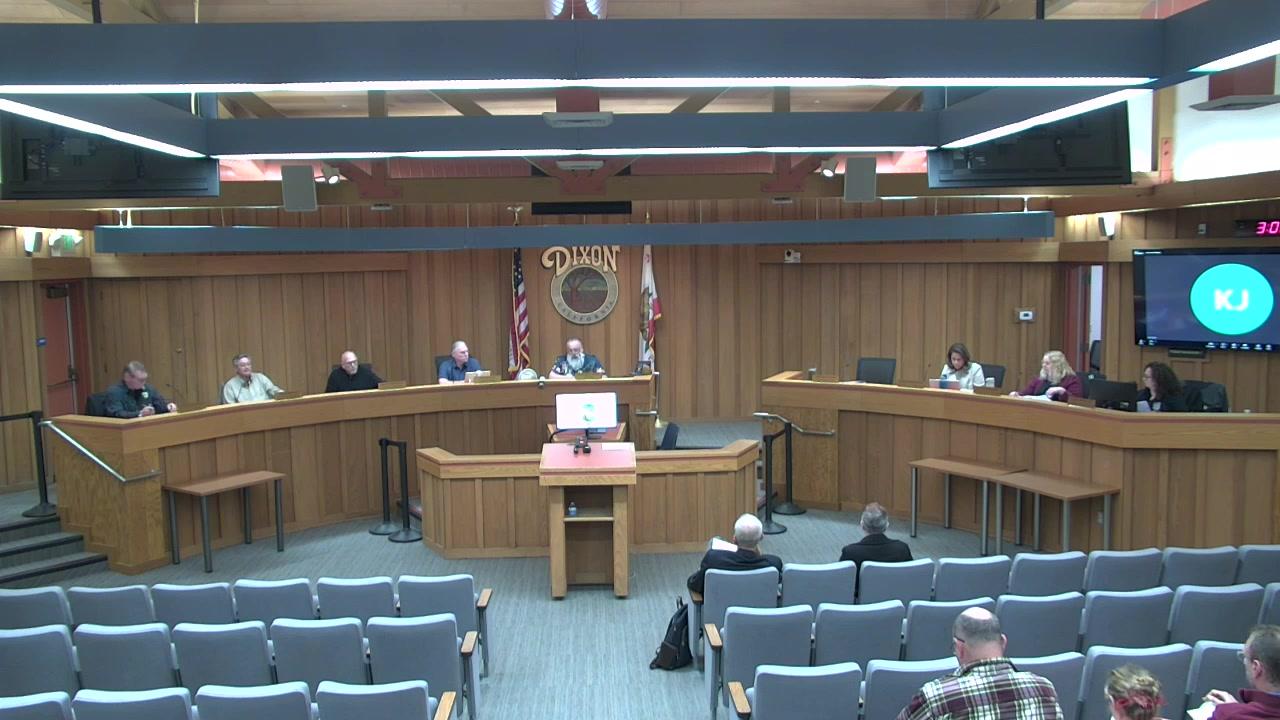
Divided Dixon Council Advances Club 420 Sale, Adds Penalty Teeth
City Council • DixonNovember 17, 2026
Locunity is an independent informational service and is not an official government page for this commission. All information is sourced from public footage and an analysis of official agendas with the aid of responsible, fact-checked AI. to report an error or omission.
Dixon's City Council on Nov. 17, 2026, voted 3-2 to let the Club 420 cannabis dispensary change hands to The Artistry, after a pointed debate over years of unbuilt promises. The council inserted a fine schedule for missed construction deadlines, then turned to more than $60 million in infrastructure financing and a budget update that projects a deficit.
- Club 420 sale to The Artistry advances 3-2 on first reading, with a fine schedule for missed construction milestones
- Cannabis public benefit payment projected to rise about 40% under new 7%-of-gross terms
- Council backs state loan path for $48M wastewater plant expansion, 5-0, as a resident questions cost and sizing
- Projected $2.5M deficit for FY 2026-27, with four businesses generating 80% of sales tax
- Up to $15M in Homestead special tax bonds approved, 5-0, with no city obligation
Club 420 Sale Clears Split Council, With Strings
The basics: A development agreement (DA) is a contract that locks in a project's rules in exchange for public benefits. Club 420, formerly Highway 80, has operated at 240 Dorset Court since 2021 in four modular buildings. It operates under a 2019 DA that has been extended seven times. The permanent Phase 2 building was never built, and the current extension expires Dec. 31, 2026.
Why it matters: The deal raises Dixon's cannabis revenue. It also ties the dispensary's permit to enforceable building deadlines after years of missed ones.
Where things stand: Raffi Boloyan, Community Development Director, presented a three-party DA among the city, property owners the Reed brothers, and operator TAT Dixon (The Artistry). The term runs up to eight years: a three-year development term with up to two six-month extensions, followed by a four-year operations term.
"The revised public benefit is proposed to be 7% of gross receipts or $15,000 a month, whichever is greater," said Boloyan. Current terms are 5% or $30,000. The percentage rises, but the monthly floor is cut in half.
Staff projected about $102,000 more this fiscal year and $189,826 more next year. Milestones run from a planning application within two months to final occupancy at 30 months. Enforcement tools include a 15-day default notice and an optional suspension of up to 240 days. The Planning Commission recommended approval Sept. 8.
The other side: Kevin Johnson, Councilmember, District 3, said he was a no on the extension. "I have zero confidence in that you would find a way, if you fell behind, to potentially pay a $500 or $700 fee," he said. Another councilmember pressed for concrete penalties, citing past unkept promises.
Rob Reed, Owner, Davisville Business Enterprises, said the owners lacked capital and described an 18.5% loan. "We didn't have the money," he said. He called the city's cuts to dispensary caps "kind of a bait and switch." He added: "If we don't build the building, then the business will get shut down."
The City Attorney said, "The fines delineated in that ordinance would not apply to a default situation under the development agreement." The attorney added that the council could write fines into the DA, which would require the applicant's agreement.
Mayor Steve Bird reminded colleagues that "we've always prided ourselves on being business-friendly." Councilmember Johnson replied, "I have done nothing for 18 years than support business."
Decisions and stakeholder impacts: The ordinance and DA, with a fine schedule, passed 3-2. For: 3 (Bird, Vice Mayor Jim Ernest, Councilmember Thom Bogue). Against: 2 (Councilmember Don Hendershot, Johnson). Absent: 0.
The conditional use permit passed 3-1-1. For: 3 (Bird, Ernest, Bogue). Against: 1 (Hendershot). Abstain: 1 (Johnson).
Philip Del Rio, Vice President of Operations, The Artistry, pitched a high-end model with no youth marketing. He said the company keeps "no live cannabis on the sales floor" and has "been able to contribute over $2 million to local communities." No members of the public commented.
What's next: The ordinance was introduced on first reading and must return for final adoption.
$48M Wastewater Expansion Moves Toward State Loan
Why it matters: A roughly 2%, 30-year state loan beats bond rates near 5.69%. Staff warned that delay could drop Dixon to the bottom of an oversubscribed funding list.
Where things stand: The council reauthorized resolutions committing to repay a Clean Water State Revolving Fund (CWSRF) loan. Dan Rich, an engineer with NextGen Utility Management, called the vote "essentially a housekeeping exercise to commit to funding the SRF loan, not to commit to the loan itself."
The plant runs at about 70% of capacity, nearing the 80% threshold that draws regulatory attention. The project would take about five years.
"If we were to push this plant beyond 80% towards 100%, it becomes very difficult to take a train out of service for maintenance," Rich said.
The $48M estimate covers plant-wide upgrades, including grit removal, electrical replacement and a pump station. A $50,000 mock bid refined the figure.
Rich said a $45M loan at 2% over 30 years would cost about $2M a year. About $20M in reserves, roughly $5M in Homestead fees and about $20M in campus fees could cover many years. In a worst case, ratepayers would need to cover about $1M a year, or $10 to $15 a month.
The other side: Public commenter Mike asked why one new treatment train costs about $48M, versus $38M in today's dollars for the original two. He questioned whether the expansion is sized correctly and urged that development, not current ratepayers, cover the costs. He said he accepts applying for the loan but not building until his questions are answered.
Decisions and stakeholder impacts: Approved 5-0. Councilmembers Hendershot and Johnson both referenced their recent tour of the plant. Ratepayers' exposure depends on whether developer fees arrive as projected.
What's next: Staff said the loan terms and the construction award will return to the council.
Budget Update Flags Deficit, Sales Tax Concentration
Why it matters: Dixon's general fund depends on a few large taxpayers while pension and debt costs climb.
Where things stand: Kate Zawadzki, Assistant City Manager, reported that FY 2025-26 closed with $35.1M in revenue and $33.7M in spending. However, $1.2M of the $1.4M surplus was carried-forward spending.
FY 2026-27 projects $35.7M in revenue against $38.2M in expenditures. That is a deficit of about $2.5M, or about $1.3M excluding carryovers.
The new sales tax measure is projected at $5.3M and funds 23 public safety positions. The cannabis public benefit fee funds three positions totaling $531,000.
"So 80% of our total sales tax revenue is generated by 4 businesses in town," Zawadzki said. She also cited $656,000 a year in debt service on police and fire bonds for the next 30 years.
Other risks include:
- Deferred maintenance
- Average CalPERS cost increases of 12.1% for miscellaneous, 15.5% for fire and 11.82% for police employees
- Possible diversion of excess water rate revenue to chromium-6 remediation
The other side: A public commenter praised the finance team but asked that the new sales tax be shown separately. The commenter opposed residential units on commercially zoned land and said the city's projected deficits rarely materialize.
Decisions and stakeholder impacts: The council approved the adjustments 5-0:
- Transferring $175,000 in vacancy savings to cover the interim Public Works Director's contract
- Adding $30,200 for an Esri GIS subscription
- Shifting engineering vacancy savings to consultants
Homestead Bonds Approved, Without City Liability
Why it matters: The bonds finance Homestead infrastructure. Property owners and builders repay them, not the general fund.
Where things stand: Ken Dieker, municipal advisor with Del Rio Advisors, outlined the 2026 bonds for Improvement Area No. 2 of Community Facilities District No. 2019-1. This is a Mello-Roos district, which levies special taxes on properties within it. Earlier series totaled $13.8M and $8.4M.
The estimated issuance is $13.2M, capped at $15M, with about $446,000 in issuance costs. The true interest cost was about 5.69% as of Oct. 26. About 63% of properties are developed, and Dieker said the district has "a 10.3 times value to lien." The bonds can be called in year seven at 103.
Vice Mayor Ernest asked about the 110% debt-service coverage. Mayor Bird asked about refinancing; Dieker said any savings would go to property owners. Asked who bears default risk, Dieker said no one pays until building permits are pulled. "No, these are not an obligation of the city whatsoever," he said.
Decisions and stakeholder impacts: Approved 5-0. No members of the public commented.
Minor Items
- Consent calendar passed 5-0, including a Geocon contract for Fire Station No. 82 (not to exceed $99,700 plus 10%) and a $27,000 Bob Murray & Associates Public Works Director search.
- Homestead Phase 4 backbone improvements accepted from JEN California 6 LLC; Tripepi Smith outreach contract extended at no cost through Dec. 31, 2027.
- Traffic signal and streetlight maintenance solicitation approved 5-0 after Vice Mayor Ernest asked about synchronization; staff said synchronization is a separate matter.
- Solar monitoring approved 5-0: $27,361 in sole-source Power Track data loggers and $11,100 for Element Electrical installation.
- A resident thanked outgoing Councilmember Bogue as his term ends; Dixon also won two Solano Transportation Authority awards.
Looking Ahead
The council meets next on Dec. 1 and Dec. 15, 2026. The Club 420 agreement must still return for final adoption. The Nov. 17 meeting was dedicated to, and adjourned in memory of, Officer James Caputo.