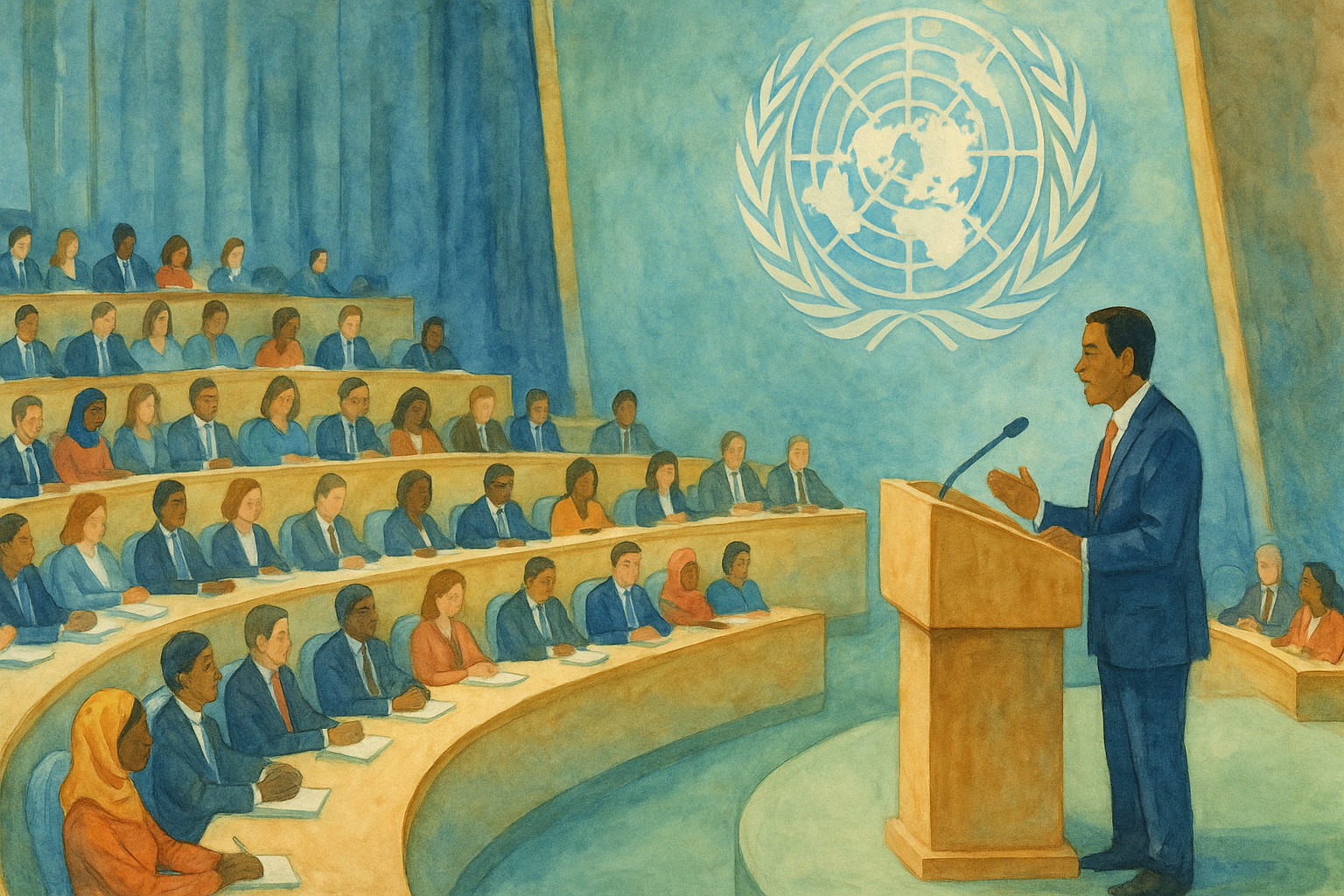
A platform for digital cooperation and innovation held during the UN General Assembly. It brings together governments, international organizations, technology companies and civil society to discuss inclusive digital transformation and build partnerships that expand access and opportunity.
Location not listed
Schedule not listed
Locunity is an independent informational service and is not an official government page for this commission. All information is sourced from public footage and an analysis of official agendas with the aid of responsible, fact-checked AI. to report an error or omission.
Hosts close with four words: ambition, partnerships, empowerment, action
Co-hosts Doreen Bogdan-Martin and Haoliang Xu summarize the evening's themes and urge attendees to translate momentum into cross-sector partnerships and concrete action.
United Nations
Big OceanDigital@UNGA26d agoSeptember 22, 2026
World's first deaf K-pop group Big Ocean urges 'begin with accessibility'
Big Ocean demonstrates how vibrating metronomes, AI tuning, and sign language choreography enable deaf performers to create music, urging leaders to design for disability from the start.
Why it matters: 400 million people live with disabling hearing loss, projected to reach 700 million by 2050; accessibility must be built in, not added on.
Dr. Chaudhry launches $10M foundation to professionalize AI evaluation
Humane Intelligence founder announces a $10 million philanthropic effort to create independent AI evaluation infrastructure, starting with education.
Why it matters: Without independent, professional AI testing, there is no systematic way to ensure AI systems serve vulnerable populations, especially children.
United Nations
WMODigital@UNGA26d agoSeptember 22, 2026
WMO chief says AI could bring early warnings to the 'last meter'
WMO Secretary-General Celeste Saulo argues digital and AI tools can personalize climate early warnings, but only if deployed with inclusivity and equality.
Why it matters: 90% of excess heat goes to oceans, driving record temperatures; AI-powered personalized early warnings could save lives in climate-vulnerable communities.
United Nations
Joseph Gordon-LevittDigital@UNGA26d agoSeptember 22, 2026
Calls intensify for global AI regulation as Africa's productivity stalls despite leapfrogging
Joseph Gordon-Levitt, Gabon's minister, and UN Envoy Amandeep Singh Gill converge on the urgency of global AI coordination to prevent repeating past governance failures.
Why it matters: Africa's productivity has been only 0.25% since 1991 despite technology leapfrogging, and most Americans want AI regulation but fear global coordination is impossible.
United Nations
Fatima NissaDigital@UNGA26d agoSeptember 22, 2026
ITU launches Gender Champions Program to empower girls in AI globally
Pakistani youth leader Fatima Nissa shares how the ITU Gender Champions program enabled her to bring robotics and AI training to girls, as the program officially launches with support from Australia.
Why it matters: Girls lacking access to AI will have their lives deeply shaped by it; targeted empowerment programs can create multiplier effects through peer-led mentoring.
United Nations
Current AIDigital@UNGA26d agoSeptember 22, 2026
Current AI launches framework to close cultural and linguistic gaps in AI
CEO Aya Badr describes how AI models fail to understand non-Western cultures and announces a UNDP paper mapping the data-to-AI pipeline for underrepresented communities.
Why it matters: Oral histories, ancestral knowledge, and non-digitized cultural content are invisible to current AI models, risking the erasure of entire cultures.
United Nations
GSMADigital@UNGA26d agoSeptember 22, 2026
Global memory crisis pushes smartphone costs to 76% of income in Africa
GSMA's Vivek Badrinath warns a global memory crisis is disproportionately raising entry-level smartphone costs, potentially excluding millions from AI benefits.
Why it matters: 3.1 billion people live within mobile coverage but don't use mobile internet; without collective action on handset affordability, the AI revolution will bypass them.
United Nations
Published Reports
Track this commission to get the latest reports in your inbox