Experts Push Africa to Adopt Proven U.S.-Style Mosquito Management
Devex • United NationsSeptember 24, 2026
Locunity is an independent informational service and is not an official government page for this commission. All information is sourced from public footage and an analysis of official agendas with the aid of responsible, fact-checked AI. to report an error or omission.
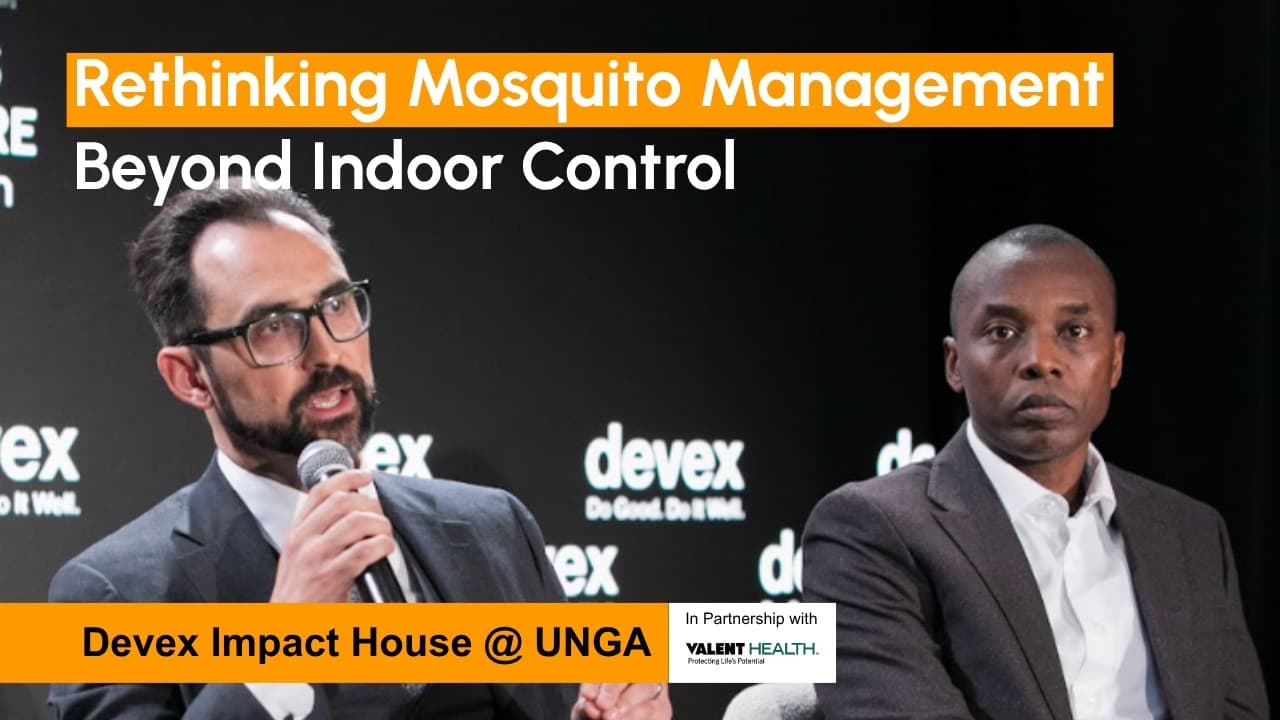
A Devex panel challenged the global health establishment's commodity-driven approach to malaria, arguing that the same systems-based mosquito management that eliminated the disease in the United States over 70 years ago could work in Africa — if donors and governments shift priorities. With a child dying from malaria every minute and an invasive outdoor-biting mosquito species spreading across the continent, the panelists said the window for a course correction is narrowing.
- Valant Health executives argue $4 billion in annual malaria spending is failing because it funds commodities, not systems
- Invasive mosquito species from Asia bites outdoors in Africa, undermining bed nets and indoor spraying
- Panelists outline creative financing: tourism taxes, rice farming cooperatives, existing government workforces
- Benin and Nigeria cited as countries now building integrated mosquito management programs
- Outdoor mosquito control framed as a job creation engine for Africa's young, unemployed population
A Priorities Problem, Not a Money Problem
The basics: Integrated mosquito management, or IMM, is the approach used across the United States and Europe that combines outdoor larviciding, habitat reduction, surveillance, and targeted indoor treatments into a coordinated system. It eliminated malaria in the U.S. in 1951. In Africa, where 90% of the global malaria burden sits, the dominant strategy relies instead on distributing bed nets and indoor residual spraying — products aimed at protecting individuals inside their homes.
Why it matters: The global health community spends roughly $4 billion per year on malaria without eliminating it. The U.S., by comparison, spends about $1 billion annually on government mosquito management programs that keep malaria — and a suite of other mosquito-borne diseases — at bay. Panelists called this gap a failure of philosophy, not financing.
Where things stand: Jason Clark, Vice President of Public Health and Forest Health at Valant Health, laid out the core argument: the problem is that the global health community treats vector control as a collection of products rather than a system. "Oftentimes, particularly in the context of malaria, which 90% of that burden is in Africa, is framing it around technology … focusing on the technology and vector control around the product and the technology, failing to recognize that vector control is a system," he said.
Clark drove the point home with dollar figures. "Probably in the United States, it's anywhere in the realm of $900 million to about $1 billion for government programs to manage mosquitoes in the United States, which eliminated malaria, by the way, in 1951. So, if you overlay that expense to what is spent on malaria year over year per annum, which is $4 billion — this is the conundrum that we're talking about. It is actually, and I know this is controversial, it's actually not a money issue," he said.
The other side: Dr. Silas Majambele, Business Manager for Africa, Europe, and the Middle East at Valant Health, acknowledged the painful logic that keeps the commodity cycle going. "Where we started is the wrong place. We started by just using the commodities, and because there is a lot of problems and people are dying, there's more money into commodities rather than building the systems that allow you to integrate outdoor mosquito management, indoor mosquito management where it works, so that you have all the tools together," he said.
The Devex moderator put a finer point on the accountability dynamic: "It's easy to write a donor report about how many bed nets you distributed, harder to demonstrate changes into the system."
What's next: Both panelists argued that donor funding must follow country-led system design rather than drive commodity distribution from the outside. "The conversation needs to reverse where the genesis of that conversation needs to come from the country out," Clark said.
An Invasive Species Changes the Calculus
Why it matters: The dominant malaria interventions in Africa — bed nets and indoor residual spraying — assume mosquitoes bite people indoors. A mosquito species that originated in Asia has now entered Africa and bites outdoors, fundamentally undermining that assumption.
Where things stand: Clark described the ecological shift as a direct challenge to current strategy. "What we thought the mosquito used to do in Africa, which was it likes to bite people indoors … there's an invasive species that has now come from Asia and into Africa and likes to bite people outdoors," he said.
Combined with rapid urbanization — Clark noted that "by 2050, over two-thirds of the population, 60, 65%, are gonna be living in urban areas" — the expansion of mosquito habitats into new geographies makes outdoor management not just beneficial but essential. Clark also emphasized that a vector-focused approach addresses far more than malaria: "We got to focus on the vector, which also spreads Zika, yellow fever, West Nile virus, filariasis, and you name it."
Financing the Shift: Tourism, Rice, and Street Sweepers
Why it matters: If the barrier is priorities rather than money, the question becomes how African governments can fund mosquito management systems using existing resources — without waiting for donors to redesign their programs.
Where things stand: Dr. Majambele outlined several practical mechanisms. He pointed to rice farming cooperatives, noting that "there's data that clearly shows a correlation between rice fields and the proliferation of mosquitoes, which also means proliferation of malaria. And the rice farmers, if they are organized usually in cooperatives, they do have economic income that could help also control mosquitoes."
Tourism revenues offer another pathway. Using Zanzibar as an example, Majambele explained how protecting tourist destinations creates benefits that ripple outward: "Even if you limit yourself to thinking, I make Zanzibar better … that money, as he said, you protect people from malaria, the country develops, that money trickles back to the rural area."
Clark cited Rwanda's capital as a model for repurposing existing government infrastructure: "Kigali is considered the cleanest city in Africa. And so they have government-paid employees who are wandering the streets of Kigali picking up trash. That's a government program." The implication: a workforce already managing urban sanitation could incorporate mosquito habitat reduction.
Decisions: Majambele described concrete progress. "In Benin, for example, the thinking is to start around the coast, which is where most people will live, which is where most development will happen, which is more where the tourism will happen. And then start a national program that works on mosquito management, outdoor, indoors, and then develop into the city." Nigeria is also developing an integrated program.
Jobs, Schools, and Measuring What Matters
Outdoor mosquito management carries a secondary benefit that both panelists emphasized: employment. "Outdoor mosquito management, it's a job creation opportunity which not only reduces the disease and increases the economy, but also people are working and generating money," Majambele said — a significant consideration on a continent with high youth unemployment.
Clark argued that long-term success requires embedding mosquito ecology into education, saying "the other way that we're really going to need to get involved is in the schools at a very early stage with kids and teaching them where malaria is actually coming from because that's a huge gap."
On measurement, Majambele pushed back against the notion that systems approaches are harder to evaluate than commodity distribution. He pointed to existing infrastructure: "There are surveillance systems that are there on the mosquito itself, on the disease, on human feedback, on community feedback." Beyond epidemiological data, he cited economic proxies: "How many people are not absent at school? How many children are attending school. All those economics are there, and it's just plug in and play."
The moderator closed the session by drawing a contrast with the rest of the week's programming: "I think we spent a lot of this week talking about problems that feel very hard to solve or you don't know where to start." This one, the moderator suggested, has a known playbook.