Devex - Sep 23, 2026 - Meeting
Devex • United NationsSeptember 23, 2026
Locunity is an independent informational service and is not an official government page for this commission. All information is sourced from public footage and an analysis of official agendas with the aid of responsible, fact-checked AI. to report an error or omission.
Vision Action Fund Launches to Deliver $1 Reading Glasses to 800 Million People
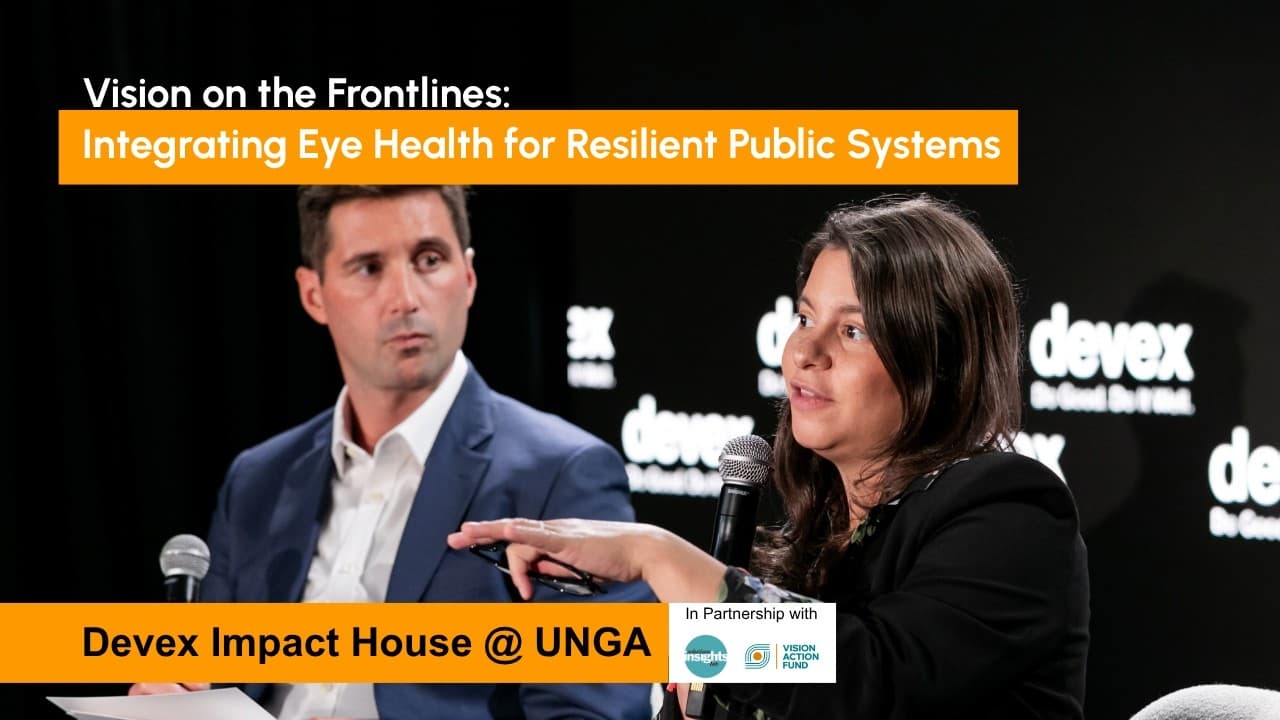
The Livelihood Impact Fund used a Devex panel to formally launch the Vision Action Fund, an ambitious new initiative aiming to put low-cost reading glasses into the hands of 800 million people worldwide who can't access them — a gap the fund says costs the global economy more than $50 billion a year in lost productivity.
- New Vision Action Fund targets 40 million people in three years with reading glasses costing as little as $1 per pair
- $28 return for every $1 invested, with delivery models tested across roughly 20 countries over four years
- Ethiopia leads integration push: 20,000 of 40,000 health workers trained to distribute glasses at the last mile
- Factory workers in Bangladesh with glasses earn $14–$15 more than those without, illustrating the economic stakes
A $50 Billion Problem Hiding in Plain Sight
The basics: Presbyopia — the gradual loss of near vision that typically begins around age 40 — affects 1.8 billion people globally. Reading glasses are a simple, well-understood fix. But 800 million people, overwhelmingly in low- and middle-income countries, cannot access them due to a combination of market failure, weak policy, and a widespread assumption that declining vision is just a normal part of aging.
Why it matters: The productivity loss is staggering. Workers who can't see up close lose earnings, make errors, and in some cases lose their livelihoods entirely — all for want of a product that can cost less than a dollar to manufacture.
"Every year, these 800 million individuals who cannot access them, we're losing about $50+ billion in productivity," said Abigail, Livelihood Impact Fund and Vision Action Fund. She drove the point home with a concrete example: "In factories in Bangladesh, you could be sitting right next to someone who has near-vision glasses, and you don't have them, and they could be earning $14, $15 more than you, just because of a $1 pair of glasses."
The Vision Action Fund is the successor to the four-year Eyeglasses Initiative, which tested scalable delivery models to determine the fastest, cheapest path from factory to face. "Over the last four years, we wanted to understand the magnitude of the problem, why it persists, and what is the fastest way to get glasses from a factory to a face," Abigail said.
The Delivery Model: $3, Factory to Face
The fund's strategy bypasses traditional eye-care clinics in favor of existing public-sector infrastructure — community health workers, primary care facilities, postal workers, self-help groups, and India's network of ASHA workers. The target is to deliver a pair of glasses for $3 or less, all-in, from manufacturing to the recipient's hands.
Partners executing this work include the Clinton Health Access Initiative (CHAI), Evidence Action, Last Mile Health, VisionSpring, Restoring Vision, and the World Health Organization. A pilot with the WHO and the Postal Union is exploring whether postal workers can serve as a distribution channel in India. GiveWell is conducting a randomized control trial to independently evaluate impact.
The return on investment, Abigail said, is substantial: "For every dollar you invest, you get upwards of $28 in return. And that's a conservative estimate."
Sustainability Beyond the First Pair
One of the most striking claims from the panel concerned long-term adoption. Abigail reported that "80%, really upwards of 90% of people are wearing them 3 to 5 years later," and that 60% go on to purchase their next pair independently — a signal that the intervention creates lasting market demand rather than permanent aid dependency.
Ethiopia as the Leading Case
Ethiopia emerged as the fund's most advanced country example. Abigail noted that "about 20,000 of the 40,000 health workers in the countries have been trained, and many are now deploying glasses at the last mile." Near-vision screening has been integrated into Ethiopia's noncommunicable disease (NCD) curriculum, embedding glasses distribution into the routine work of the health system rather than treating it as a standalone program.
She shared the story of Marta, a photocopy center operator who was confusing papers and clients and feared going bankrupt — until a health worker provided her with glasses, saving her business.
Scaling Amid Shrinking Development Finance
A Devex co-moderator acknowledged the difficult funding environment, noting that "there is a decrease in development finance or global health financing." That backdrop makes the fund's investment pitch — high ROI, proven delivery channels, and demonstrated sustainability — particularly relevant for philanthropists and impact investors looking for cost-effective interventions.
The fund is now operating across approximately 20 countries, including Ethiopia, Nigeria, Kenya, Uganda, India, Bangladesh, and countries in Southeast Asia and Latin America.
What's next: The Vision Action Fund website (visionactionfund.org) is live, and the fund has set a three-year goal of reaching 40 million additional people with reading glasses. "We hope in three years to reach another 40 million people with glasses," Abigail said. The fund is seeking philanthropic co-investment alongside Livelihood Impact Fund capital to hit that target.