
Buffett Foundation Crosses $1.5 Billion in Ukraine as Investors, Banks Make the Case to Deploy Capital Now
Devex • United NationsSeptember 24, 2026
Locunity is an independent informational service and is not an official government page for this commission. All information is sourced from public footage and an analysis of official agendas with the aid of responsible, fact-checked AI. to report an error or omission.
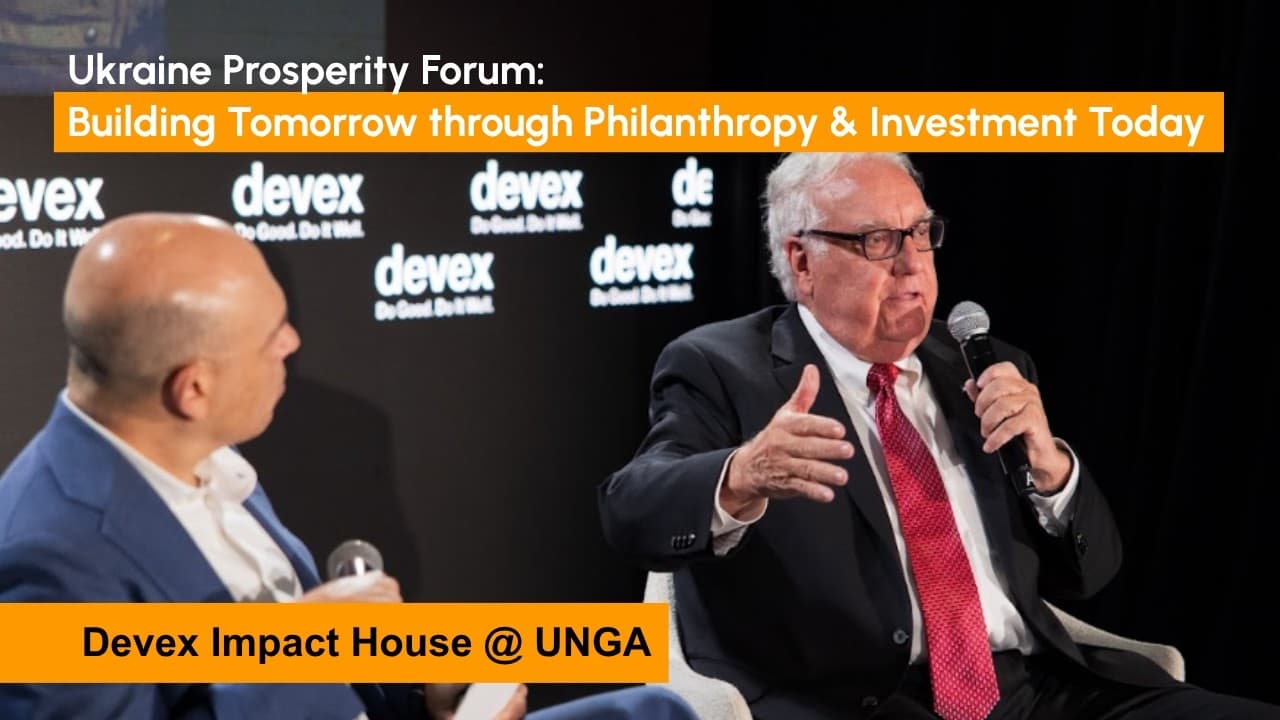
At the Devex Impact House during UN General Assembly week, philanthropists, private equity leaders, multilateral bankers, and Ukrainian officials delivered a unified message: Ukraine is investable now — not after a ceasefire. From Howard Buffett's $1.5 billion humanitarian commitment to Andrew Forrest's $500 million smart grid proposal to Horizon Capital's 30%-plus wartime returns, speaker after speaker challenged the assumption that capital must wait for peace.
- Buffett Foundation surpasses $1.5 billion in Ukraine spending, with $400 million planned this year alone, covering demining, 650 million meals, and the Superhumans prosthetics network
- Ukraine faces a $20–25 billion budget gap in 2026 — the first year without US direct budget support — as Ambassador Makarova calls for full confiscation of $300 billion in frozen Russian sovereign assets
- Andrew Forrest commits $500 million for a national distributed smart grid with AI-managed batteries too small to target, designed to neutralize Russia's energy destruction strategy
- Global food insecurity reaches 350 million people, driven by the war, fertilizer disruption, and shipping lane closures, former WFP chief David Beasley warns
- Superhumans prosthetics network loses nearly all Ukrainian donors in two weeks as Russian attacks destroy businesses funding its $50 million annual operation
- World Bank and EIB mobilize billions in de-risking tools, including a new Ramp Up mechanism targeting 1 GW of renewable energy for Ukraine
- Horizon Capital's wartime portfolio grows 30%+ annually, proving Ukraine can deliver top-5% global fund returns during full-scale war
$1.5 Billion and Counting: Buffett Foundation's All-In Ukraine Bet
Why it matters: The Howard G. Buffett Foundation is the largest private humanitarian funder in Ukraine, and its scale exposes the near-total absence of comparable commitments from other American private foundations.
Where things stand: Howard Buffett, Chairman of the Howard G. Buffett Foundation and Non-Executive Chairman of Berkshire Hathaway, told Raj Kumar, President and Editor-in-Chief of Devex, that the foundation doubled its spending after Russia's 2022 full-scale invasion and will exceed $1.5 billion in total Ukraine commitments by year-end.
"We'll go past $1.5 billion at the end of this year. We'll go a little over $400 million this year. But to me, again, it just wasn't a choice," said Buffett.
The foundation's portfolio spans humanitarian demining using autonomous Caterpillar and John Deere machines in partnership with Halo Trust, delivery of 650 million meals through Joint Aid Management to frontline areas, conversion to cash vouchers for internally displaced persons, support for the Victory Harvest agricultural program, and investment of nearly $100 million total in the Superhumans prosthetics center. A partnership with the McCain Institute supports leadership development.
Buffett described a proof-of-concept philosophy — a willingness to take risks and absorb failures. He recounted purchasing 48 bulldozers only to discover incompatible serial numbers. "The mistakes we make, we either find a way to benefit from them or we learn from them. We leverage it for the next thing that we do. And that's the best thing you can do is not be afraid to fail because that's how you learn," he said.
He emphasized that physical presence is essential. "Showing up is the number one thing I tell people. You have to show up. You can't understand the circumstances," Buffett said.
A Challenge to American Philanthropy
Buffett issued a pointed challenge to the broader philanthropic sector, questioning why other foundations have not mobilized at scale:
"How is it that we don't have a groundswell of private foundations saying, we believe in America, and because we believe in America, we believe in freedom and we believe in sovereignty and we believe in democracy," he said.
He framed the conflict in stark moral terms, describing Russia's systematic targeting of Ukrainian civilians, culture, and infrastructure — including the destruction of Factor House Publishing, which produced 50% of Ukraine's children's books, the kidnapping of Ukrainian children, and the use of drones against farm equipment.
"He has stated, I'm going to destroy the country, I'm going to destroy the people, I'm going to destroy their culture. Destroy their language, and destroy their history. That is a textbook description of genocide," Buffett said of Putin, drawing parallels to Rwanda.
The $140 Billion Question
Kumar pressed Buffett on the logistics of distributing Warren Buffett's remaining fortune — estimated at more than $140 billion — by a 2034 deadline. Buffett confirmed the three siblings speak weekly and have a few large ideas in development, noting they will need to make individual grants of $500 million. He said the larger Susan Thompson Buffett Foundation will receive proportionally more, but his own foundation's share will enable much bigger risks, potentially including government-scale grants and new institution-building. Buffett credited his mother's influence for the siblings' unity.
What's next: Buffett signaled Ukraine will remain a long-term priority, and the compressed giving timeline — roughly $22–23 billion annually across the three siblings — will reshape philanthropic capacity for large-scale global giving.
Ukraine's $25 Billion Budget Hole and the Fight Over Frozen Russian Assets
The basics: 2026 is the first year Ukraine will operate without US direct budget support, which the ERA instrument provided from 2022 through 2025.
Why it matters: The loss of American funding creates the most acute fiscal crisis of the war, forcing Ukraine to seek alternative sources — primarily the confiscation of approximately $300 billion in frozen Russian sovereign assets held largely in Belgium — to keep the government functioning.
Where things stand: Ambassador Oksana Makarova, Advisor on Reconstruction Investment in the Office of the President of Ukraine, laid out the shortfall plainly:
"If we listen to the Finance Ministry of Ukraine, we're about 20 to 25 billion short of funding, and it's very important to find it. Therefore, I believe it's very important to actually move ahead and confiscate Russian sovereign funds and provide them to Ukraine," she said.
Makarova argued the legal basis already exists, citing a UN General Assembly vote where 145 countries declared Russia's invasion illegal, a binding International Court of Justice decision from March 2022, and World Bank damage assessments exceeding $300 billion. She framed confiscation as a question of collective political will — not a unilateral decision by Belgium.
On corruption, she pushed back forcefully: "I don't think a lot of countries have the anti-corruption infrastructure that we have and dealing with it on a daily basis like we do," Makarova said.
She closed with an unequivocal message: "Regardless of how difficult it is, Ukraine will not surrender and will not give up."
The other side: Davide Le Cecilia, Special Envoy for Reconstruction in Ukraine at the Italian Foreign Ministry, confirmed Europe's total support at €220 billion — €90 billion military, €107 billion civil — including a €50 billion Ukraine Recovery Facility and a €10 billion investment facility with 3-to-4x leverage. He noted the European budget renews in January 2028 with additional resources planned.
What's next: The confiscation debate will intensify as Ukraine's fiscal pressure mounts heading into 2026. Whether Western allies move from freezing to seizing Russian assets will likely be a defining diplomatic question at upcoming international summits.
350 Million People Marching Toward Starvation
Why it matters: With 40% of the world's fertilizer base and food for 400 million people tied to the Ukraine-Russia region, the war's disruption of agricultural exports has become a cascading global security threat.
Where things stand: David Beasley, Former Executive Director of the World Food Programme, traced the escalation over nearly a decade:
"When I took over the World Food Programme in 2017, there were 80 million people in what we would call marching to starvation. Today, you're talking about 350 million people out there," he said, attributing the rise to COVID, the Ukraine war, fertilizer disruptions, and the Strait of Hormuz closure.
Beasley described WFP sourcing nearly a million metric tons of food from Ukraine before the invasion. He recounted personally pressuring Russia to open Black Sea ports, including tweeting at Putin, which led to the Black Sea Grain Initiative. Under his leadership, WFP raised $14.2 billion and reached 160 million people; he noted funding has since dropped below $6 billion.
He criticized US foreign aid cuts bluntly: "America's great when America's good. And when America ceases to be good, we cease to be great. And right now, we're not being good to a lot of our neighbors," Beasley said.
Superhumans Scales Up, but Its Donor Base Collapses
Why it matters: The most successful prosthetics and rehabilitation model in wartime Ukraine is losing domestic funding at exactly the moment demand is accelerating — a pattern that signals broader crisis for Ukrainian civil society as businesses are systematically destroyed.
Where things stand: Olga Rudnieva, CEO of the Superhuman Center, described the organization's growth from a pitch deck four years ago to three centers in Lviv, Dnipro, and Odesa, more than 5,000 patients discharged, 650 staff, and a $50 million annual budget. The organization has evolved from prosthetics into frontline evacuations by air, car, and train, limb-saving surgeries, and innovative procedures including toe-to-finger transplants.
Rudnieva noted that trauma patterns have shifted. Early in the war, injuries were predominantly lower-body mine blasts. Now, drone warfare is causing upper-body and brain injuries, with evacuation times extending from hours to days or weeks.
The financial picture is dire. "During the last two weeks, we lost almost all Ukrainian donors. All of them exited during the last two weeks. We lost an enormous amount of money because of the situation in Ukraine," Rudnieva said.
She reframed the narrative of Ukrainian resilience: "I don't think that we are just resilient. I think that we are very ambitious. Resilience is not, you know, like, it's a survival mode. And survival is not our destination," she said.
And she shared how soldiers view the center's work: "Olga, thank you for Superhumans and what you do. I'm not afraid to fight now because I know if something happens with me, you will put me together."
What's next: With domestic funding collapsing, Superhumans will pivot aggressively to international fundraising while managing rising demand. The loss of Ukrainian business donors may foreshadow a broader funding crisis across Ukrainian civil society organizations.
The 20% Problem: Veteran Reintegration at National Scale
Why it matters: If Ukraine fails to systematically reintegrate its enormous veteran population, it risks social instability and economic stagnation; if it succeeds, veteran entrepreneurship could become an engine of recovery.
Where things stand: Maksym Studolko, Founder of Mandry in UA, described his personal journey from IT sales director to combat platoon commander to veteran entrepreneur, founding a camper rental business that employs veterans and people with disabilities. He identified information access, mentoring, and financing as the three key needs for veteran entrepreneurs.
Alex Dardelli, CEO of IREX, scaled the challenge: "By the end of the war, Ukraine will likely have about 20% of its population consisting of veterans or their families. And I worry very much about that," he said.
Dardelli called for a national bridge between military service and full reintegration — including simplified regulatory processes, reformed vocational education with business sector involvement, greater institutional transparency, and fewer personnel rotations at the top. He emphasized that reintegration must be anchored in broader economic recovery, not treated as charity, and that veterans' skills in leadership and crisis management should be assets, not liabilities.
Forrest's $500 Million Grid: Making Energy Attacks Futile
Why it matters: Russia's systematic destruction of centralized power plants has damaged 80% of Ukraine's energy infrastructure and cut GDP by an estimated 2.5%. A distributed smart grid could make that strategy militarily pointless.
Where things stand: Dr. Andrew Forrest, Founder and Executive Chairman of Fortescue and Founder of the Minderoo Foundation, described building a 5 GWh self-healing smart grid for Fortescue's Australian mining operations, where AI switches electrons to where they are needed within milliseconds of disruption. He proposed scaling this to a 21 GWh national distributed grid for Ukraine.
"These are batteries the size of a shipping container, and you stick them everywhere and they're just — you just can't hit them," Forrest said.
He committed $500 million through the Ukraine Green Growth Initiative and said he is investing approximately $200 million on spec to begin deployment, working with Norway, IFC, and EBRD — though he noted bureaucratic processes are slowing progress. He drew parallels between Putin's potential for a Holodomor-style freeze genocide and argued his system could prevent it.
Forrest forcefully urged institutional investors to act now: "I'm saying to all institutions, all investors, do all the work now. People like me are prepared to go first, we're prepared to invest in a distributed smart grid, self-healing energy system."
He compared Ukraine's postwar potential to the golden eras of Japan, Germany, and South Korea: "Please accept the logic that Russia will not win this war. The best they can hope for is in front of the current front line of Ukraine."
What's next: Forrest's smart grid deployment will depend on clearing IFC and EBRD processes. If realized, tens of thousands of distributed batteries could fundamentally change the energy calculus of the war.
World Bank and EIB: De-Risking the Reconstruction Pipeline
Why it matters: With 60% of Ukraine's budget going to defense and blackouts cutting GDP by 2.5%, multilateral de-risking is the critical catalyst for private capital that could keep the economy functioning.
Where things stand: Anna Bjerde, Managing Director of Operations at the World Bank, outlined a three-part approach: government policy reform and institutional strengthening as the foundation of de-risking; IFC mobilization of $8 billion, with $3.2 billion already committed including trade finance and direct energy investment; and a new price stabilization mechanism.
"Together with EBRD and IFC and ourselves on the public sector side, we're setting up something called Ramp Up, which is a price stabilization mechanism which will enable about 1 gigawatt of large-scale renewable energy," Bjerde said.
She raised a concern that may prove more consequential than funding alone: "I actually worry about not having enough bankable projects, and bankable takes both good projects, but it also takes all the instruments it takes to take them off the ground."
Ambroise Fayolle, Vice President of the European Investment Bank, confirmed €4 billion disbursed, with Ukraine becoming EIB's largest country of operation outside the EU. He described making exceptions to climate bank policies to finance gas during winter and supporting rail gauge conversion to European standards.
Tom O'Shaughnessy, Head of North American Business at Amber Infrastructure, identified three prerequisites for private capital: risk-sharing mechanisms for country and war risk, policy consistency over decades, and multilateral development bank quality assurance on projects. Amber already manages a Ukrainian infrastructure fund and was awarded the EU Flagship Fund mandate for $500 million.
What's next: The Ramp Up mechanism and MDB de-risking tools will be tested heading into what may be Ukraine's most difficult winter for energy. Whether sufficient bankable projects can be developed fast enough to absorb available capital remains the binding constraint.
Minor Items
- Demining scale: Darren Cormack, CEO of the Mines Advisory Group (MAG), noted Ukraine has 139,000 square kilometers of land suspected of mine and unexploded ordnance contamination — roughly the size of England and most of Wales.
- Horizon Capital's Catalyst Fund raised $350 million targeting energy (50%), construction, digital infrastructure, and industrial sectors, with $100–200 million in annual investment.
- PromPrilad: Yuriy Filyuk, Founder of PromPrilad, described transforming an old gas meter factory in Ivano-Frankivsk into an innovation ecosystem.
- Ukraine Global Innovation Strategy: Oksana Matyash, Head of Win-Win Tech Center of Excellence, presented a strategy covering 14 priority areas including education technology and AI.
- European support totals: Le Cecilia confirmed €220 billion in total European support — €90 billion military, €107 billion civil — with the EU budget renewing in January 2028.
- Rozetka survival: Horizon Capital portfolio company Rozetka saw 92 employees survive in a bunker after three ballistic missile strikes, with 10 million square feet of logistics infrastructure destroyed in recent weeks.