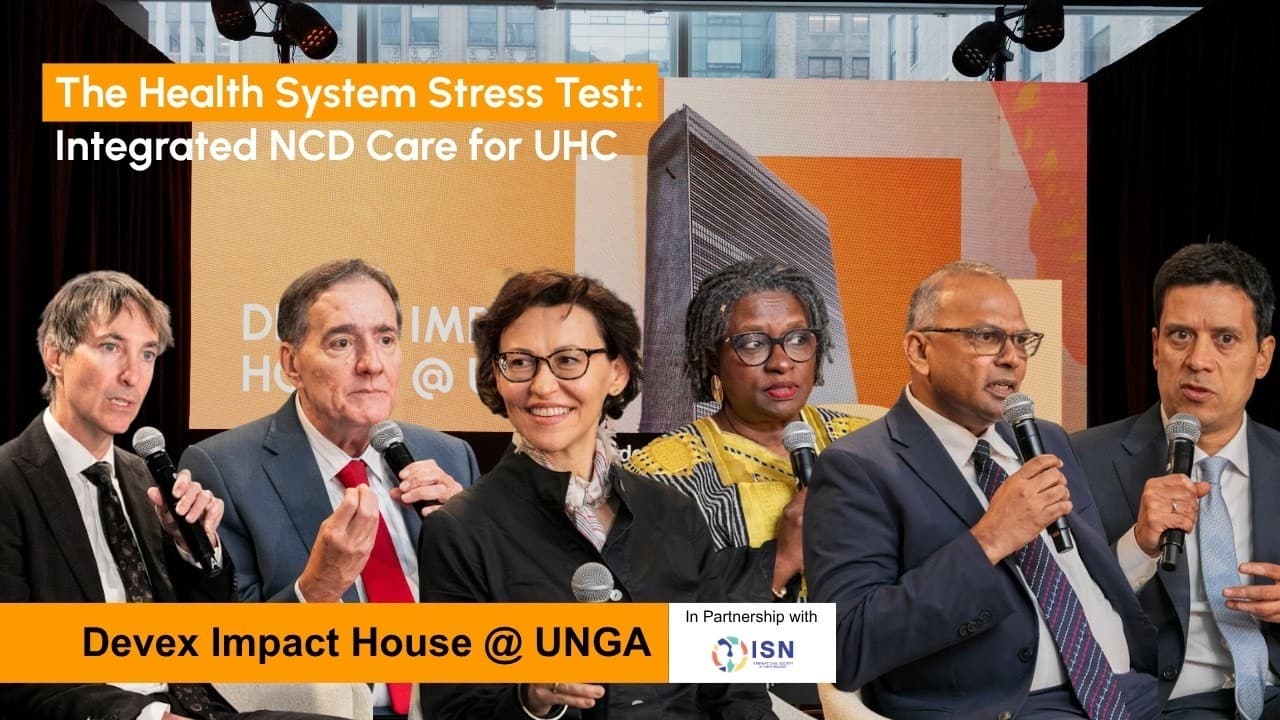
Devex - Sep 23, 2026 - Meeting
Devex • United NationsSeptember 23, 2026
Locunity is an independent informational service and is not an official government page for this commission. All information is sourced from public footage and an analysis of official agendas with the aid of responsible, fact-checked AI. to report an error or omission.
Health Leaders Press to Embed Kidney Disease in Universal Coverage Before 2027 Deadline
Global health leaders convened at the Devex Impact House to build the case that noncommunicable diseases — especially chronic kidney disease — must move from afterthought to essential service in universal health coverage frameworks before a pivotal 2027 United Nations high-level meeting. Across two panels and a patient testimony, the message was consistent: $2 screening tests exist, prevention yields up to 45-to-1 returns, and new financing tools like debt-for-health swaps can create the fiscal space that governments say they lack.
- ISN president frames kidney disease as "the ultimate test" of universal health coverage, urging governments to shift spending from end-stage treatment to prevention
- PAHO reports 30,000+ primary care centers now running HEARTS 2.0 protocol across Latin America, backed by a $900M regional procurement fund
- PATH proves low-cost CKD screening can reach 100% of facilities in Ghana, up from 8% of nurses trained at baseline
- Guyana screens 100,000 people through universal health vouchers and 100,000 children through schools in 2025
- IDB unveils $600M Barbados debt swap redirecting $160M to NCD care, modeling a new approach for debt-burdened nations
- Three-time transplant recipient testifies that late diagnosis causes devastating physical, emotional, and financial harm
- Panelists warn health spending will more than double by 2050 without structural intervention, but prevention could avert 25 million deaths
Kidney Disease as the Stress Test for Universal Coverage
Why it matters: Half the world's population lacks access to essential health services, and kidney disease — detectable with inexpensive tests but ruinously costly when caught late — has become the proving ground for whether governments will integrate noncommunicable diseases into primary care or continue paying for them at the emergency end.
Where things stand: Dr. Marcello Tonelli, President of the International Society for Nephrology, opened the panel by framing the stakes in blunt financial terms: "Governments are paying for kidney disease now, or they can pay for them later. And what they're doing now is they're paying for it later at the end-stage disease where it's most costly and where the outcomes are the worst."
He noted that kidney tests cost $2 each — a urine test and a blood test — yet are not widely available in most health systems. "They're not widely available. That needs to be integrated and included in a package everywhere for universal healthcare," he said.
Dr. Magda Ravallo, Co-Chair of the UHC 2030 Steering Committee and President of the Institute for Global Health and Development, laid out three requirements for the 2027 political declaration: making NCDs part of minimum service packages, building coalitions beyond health ministries, and shifting from single-disease budgeting to integrated platform budgeting. "UHC cannot be universal without coverage of NCDs," she said, adding that governments must start seeing NCD investment as "an economic development pathway rather than being a center of cost for ministers of health and finance."
The other side: The aspiration for comprehensive integration runs headlong into fiscal reality. Dr. Tonelli warned that countries attempting prevention-first approaches have been derailed by premature investments in expensive treatments: "They've started in a promising fashion focusing on prevention, but then they've been derailed because they've started funding kidney dialysis or kidney transplant programs." He urged governments to take a strategic, "40,000-foot" view before allocating resources.
Dr. Ravallo argued the cost of fragmentation is higher than the cost of integration: "If we don't integrate, we are not going to increase the fiscal space because integration brings efficiencies, reduces duplication, and makes sure we can accommodate a little bit more."
What's next: With the 2027 UHC high-level meeting months away, Dr. Tonelli closed the event with a pointed number: "Investment in prevention, $1 buys up to $45 in averted downstream costs, untold human misery." The International Society for Nephrology is pushing for NCDs — and kidney disease specifically — to be embedded, not merely acknowledged, in the political declaration that will emerge from that meeting.
From 8% to 100%: How Ghana Proved CKD Screening Can Work
The basics: Chronic kidney disease has been among the least integrated NCDs globally because it has been perceived as too difficult and too expensive, effectively sequestering it in tertiary care despite the availability of low-cost screening tools.
Why it matters: PATH's work in West Africa demonstrated that perception is wrong — and offered a replicable playbook.
Where things stand: Dr. Kimberly Green, Global Program Director for Primary Health Care at PATH, shared results from an integration readiness assessment conducted in Ghana, Rwanda, and Senegal using a tool developed with communities and governments in Kenya, India, and Brazil. The baseline findings were stark: "Only 8% of nurses had been trained in any way, shape, or form in chronic kidney disease. Only 18% of facilities had capabilities around chronic kidney disease."
After working with Ghana's Ministry of Health to decentralize screening, management, and diagnosis, the results transformed: "100% of the facilities now are able to address chronic kidney disease, and all of the healthcare workers are trained and capable." Ghana's social health insurance covers the screening and follow-up care.
In Rwanda, PATH is partnering on a CKD register within the country's national intelligence center, enabling real-time tracking of care gaps from the facility level to the national level.
Dr. Green also made a structural argument, calling for an end to vertical disease programs across the global health architecture: "The way of having separate segmented vertical programs is a disservice to integrated people-centered care, to primary healthcare, and to the health outcomes that people have a right to."
PAHO's HEARTS 2.0 Reaches 30,000 Health Centers
Why it matters: Latin America's rapid demographic transition means countries that don't modernize primary care now will face unsustainable costs — and PAHO's director argued the region is already underspending.
Where things stand: Dr. Jarbas Barbosa da Silva, Director of the Pan American Health Organization, reported that the HEARTS initiative — originally focused on hypertension — has expanded into version 2.0, encompassing diabetes and other chronic metabolic diseases. "We now have more than 30,000 primary healthcare centers in the region that have implemented what we call the HEARTS 2.0 as part of IberaCare for NCD," he said.
The scale is backed by purchasing power. PAHO's Strategic Fund — a regional procurement mechanism — purchased approximately $900M in medicines, equipment, and vaccines on behalf of member countries last year. Dr. Barbosa said the consolidated regional demand delivers prices "really much, much lower than the individual negotiation that each country can get."
He also highlighted a partnership with the Inter-American Development Bank and World Bank called the Alliance for Primary Healthcare, providing countries access to approximately $7 billion in loans for renovating health centers, providing connectivity, telehealth infrastructure, equipment, and training.
But the spending gap remains wide. Dr. Barbosa noted that countries need public health expenditure at roughly 6% of GDP — "the average in this region is four point three" — requiring a stronger dialogue between health and finance ministries to close the gap.
A Patient's Testimony: "Dialysis Is Not Only Physically Damaging"
Christopher Bryant, Patient Advocate and Ambassador for the American Kidney Fund, put a human face on the panel's data. A three-time kidney transplant recipient with type 1 diabetes who was diagnosed at stage 4 kidney disease, Bryant described the cascading toll of late detection:
"Dialysis is not only physically damaging over time, it's also mentally and emotionally draining for a patient, an area that we don't talk enough about, but it is actually a financial burden also."
His core message was simple: "If you treat it earlier, it turns out to be cheaper than having somebody sitting on a dialysis machine."
Dr. Ravallo responded to Bryant's testimony by emphasizing what often gets left out of the economic calculus: "The emotional burden, the traumatizing to dialysis on him and on his family is something that we don't talk about enough. And it should be included and construed as part of the people-centered care approach we talk about."
Debt Swaps and Health Vouchers: How to Pay for Prevention
Two models for financing NCD prevention in resource-constrained settings anchored the event's second panel.
Guyana's Voucher Experiment
Honorable Dr. Frank Anthony, Minister of Health of Guyana, described a universal health voucher distributed to adults and children allowing patients to use private-sector facilities for basic tests including HbA1c, lipid profile, and kidney function tests. "In the last year, we, for 2025, we saw more than 100,000 persons using the vouchers. And I think that that's a good response. So we're able to pick up people earlier," he said. Abnormalities detected are channeled into the care system.
A parallel school screening program covering Guyana's 280,000 children has already screened 100,000, identifying health challenges early.
Minister Anthony also stressed that international partnerships must outlast their funding cycles, citing a hybrid nursing training program with Brazil that graduated 660 nurses now employed in Guyana's health system: "What we need is partnerships that can help to build local capacity so that after the funding finishes, we'll be able to sustain it."
The Barbados Debt Swap
Javier Guzmán, Chief of Health, Nutrition, and Population at the Inter-American Development Bank, outlined an innovative financing mechanism: the Multi-Guarantor Debt Swap Resilience Caribbean Fund. In Barbados, the IDB, World Bank, CAF, and Caribbean Development Bank are supporting a $600M debt purchase that will generate $160M in savings invested directly into the health system for noncommunicable diseases.
The model addresses a fundamental constraint. With multilateral funding representing only about 1% of regional health expenditure, countries cannot rely on aid. Guzmán noted that an estimated 40% of what is invested in health is inefficient, and that without structural change, health expenditure in the Americas will more than double by 2050. The upside: "You could prevent 25 million deaths, averted deaths by 2050 by investing in prevention."
An audience member contributed the example of Ghana's Medical Trust Fund, which covers catastrophic health expenditures — partly inspired by dialysis patients' advocacy — as a model of financing infrastructure that builds system confidence and attracts health entrepreneurship.
Audience Pushes Back on Feasibility
The Q&A session revealed the tension between aspiration and fiscal reality. Russell Rainsburg of the Rural Health Advocacy Project asked whether a basic standard UHC package is even feasible given competing priorities — chronic HIV, AI disruption, donor transitions, and limited fiscal space: "Is it possible to come up with a sort of standard UHC package, a basic one, that covers most of the things, but not all of the things that we can coalesce around and have a much stronger advocacy agenda?"
Dr. Ravallo responded by urging countries to start with high-impact interventions to build confidence and political support rather than attempting comprehensive packages immediately.
Christine Younggren, CFO of Moving Health, which manufactures ambulances in rural Ghana, asked how to measure the impact of prevention — essentially, how to prove the value of problems avoided. Dr. Lippy Roy, Founder of CitaMed, praised the inclusion of people with lived experience on panels and asked how to better leverage storytelling and policymaker engagement for NCD advocacy in lower- and middle-income countries.
- Prevention ROI figure: Dr. Tonelli cited that $1 invested in prevention buys up to $45 in averted downstream costs — a figure the ISN is positioning as a central advocacy tool for upcoming negotiations with health and finance ministries ahead of the 2027 UHC meeting.