Antigua's PM Calls on World Leaders to Sign Eye Health Compact Ahead of Historic Summit
Devex • United NationsSeptember 24, 2026
Locunity is an independent informational service and is not an official government page for this commission. All information is sourced from public footage and an analysis of official agendas with the aid of responsible, fact-checked AI. to report an error or omission.
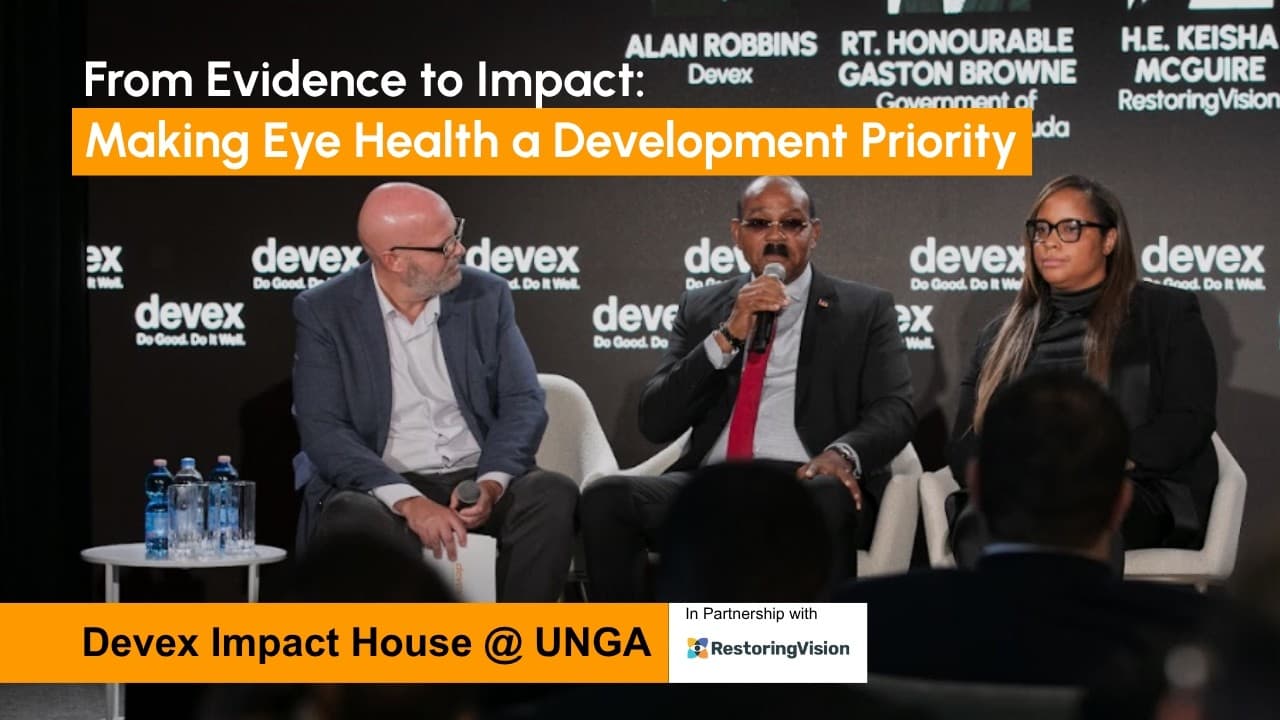
At the Devex Impact House during UN General Assembly week, Prime Minister Gaston Brown of Antigua and Barbuda and Ambassador Keisha McGuire, chief global affairs officer for Restoring Vision, made an ambitious case for treating vision care not as a medical niche but as a global economic imperative — previewing the first-ever Global Summit for Eye Health set for Nov. 2 in Antigua and Barbuda.
- PM Brown urges world leaders to sign a global eye health compact at the upcoming November summit, calling for increased government budgets and philanthropic investment
- Over 800 million people worldwide lack corrected near vision, costing the global economy $400 billion a year in lost productivity — yet every dollar invested in vision care yields a $28 return
- Antigua and Barbuda plans to build one of the Caribbean's most comprehensive eye health systems within 18-24 months, including two new eye health units and a regional hospital
- Restoring Vision has reached 660,000 older adults in Peru and distributed nearly 2 million eyeglasses across Mexico by embedding vision care into existing social protection programs
- Nigeria's President Tinubu launches national vision initiative after his mother regained her sight through a pair of eyeglasses
Why Eye Health Has Sat on the Sidelines
The basics: More than 800 million people globally live with uncorrected near vision — a condition often solvable with a pair of reading glasses. Yet vision care has been largely absent from national development strategies and international health agendas.
Why it matters: Ambassador Keisha McGuire, chief global affairs officer at Restoring Vision, argued that the neglect is structural. "Vision has sat on the sidelines of global health and development agendas for far too long. And it is primarily because vision is seen really as a specialized medical issue rather than the driver of development that it is," she said. Unlike infectious disease outbreaks, vision loss is gradual — it doesn't generate the political urgency that unlocks funding.
McGuire introduced the concept of "visionomics" — the economic case for treating eye health as a development investment rather than a cost center. "The global economy loses productivity, over $400 billion in lost productivity every year due to vision impairment. Yet on the flip side, for every dollar invested in vision care, it yields a $28 return," she said.
Those numbers position eyeglasses as one of the most cost-effective health interventions available — yet one that rarely appears in national budgets.
What Moves Governments to Act
Where things stand: McGuire identified three conditions that have proven effective at getting governments off the sidelines: "A compelling economic case. A solution that can be delivered through existing systems. And having champions within the government that are willing to lead."
Restoring Vision's model relies on embedding vision care into social programs already reaching vulnerable populations. In Peru, the organization partnered with Pension 65, a social protection program for older adults, reaching more than 660,000 people with eyeglasses. In Mexico, a partnership with the National System for Integral Development of the Family has distributed nearly 2 million pairs of eyeglasses across all 32 states.
The champion model has proven equally powerful. In Nigeria, President Tinubu launched a national vision initiative rooted in personal experience — his mother regained her sight after receiving a pair of eyeglasses.
Antigua and Barbuda's Caribbean Ambitions
Prime Minister Gaston Brown described his country's rapid pivot from neglecting eye health to building what he called one of the most comprehensive eye health systems in the Caribbean. He credited Ambassador Aubrey Webson, Antigua and Barbuda's representative who is visually impaired, as the catalyst.
"Ambassador Aubrey Webson, who is visually impaired, has been a champion for eye health. He would have been very instrumental in helping our government to focus on eye health and to make it mainstream," Brown said.
The country has already distributed 25,000 reading glasses in recent months and is now providing prescription glasses. But Brown's ambitions extend further: "Within a matter of maybe 18 to 24 months, we'll have one of the most comprehensive eye health systems within the Caribbean, which will focus on screening, surgeries, including cataract surgeries. We are currently building out 2 eye health units. We hope to establish an eye health hospital that will serve people of the Caribbean and beyond."
Brown credited public-private partnerships for making the plan financially viable in a small island state with limited fiscal capacity.
The November Summit and Global Compact
What's next: Both panelists previewed the Global Summit for Eye Health scheduled for Nov. 2 in Antigua and Barbuda — described as the first global summit dedicated to the issue.
Brown called directly on world leaders to commit. "I would like to see global leaders sign on to the compact that we have developed that will feature during this forum that we'll have in Antigua and Barbuda. At the same time, we are hoping that we'll see an increase in the amount of funds budgeted for eye health," he said.
He framed the problem as a failure of recognition: "I don't think that many governments would have recognized that it is within their scope to fund healthy eye care. They should see putting eye health infrastructure in place as critical to national development, to increase productivity, and to provide better living standards for the citizens."
McGuire emphasized that delivering on summit commitments will require cross-government coordination — not just ministries of health, but finance, labor, education, and social development working alongside NGOs, multilateral bodies such as the International Agency for the Prevention of Blindness, and philanthropy.
"I think this sector is very well coordinated, and it really presents an opportunity to solve an issue that is low cost, that is immediate in many circumstances, and really can give people their lives back," she said.
Brown acknowledged the long delay in elevating the issue but struck an optimistic note: "The fact that it's the first Global Eye Health Summit, it speaks for itself because such an important issue obviously should have been elevated long ago, but as I say, better late than never."