Devex - Sep 22, 2026 - Meeting
Devex • United NationsSeptember 22, 2026
Locunity is an independent informational service and is not an official government page for this commission. All information is sourced from public footage and an analysis of official agendas with the aid of responsible, fact-checked AI. to report an error or omission.
Corporate Expertise, Not Just Cash, Is the Future of Global Development
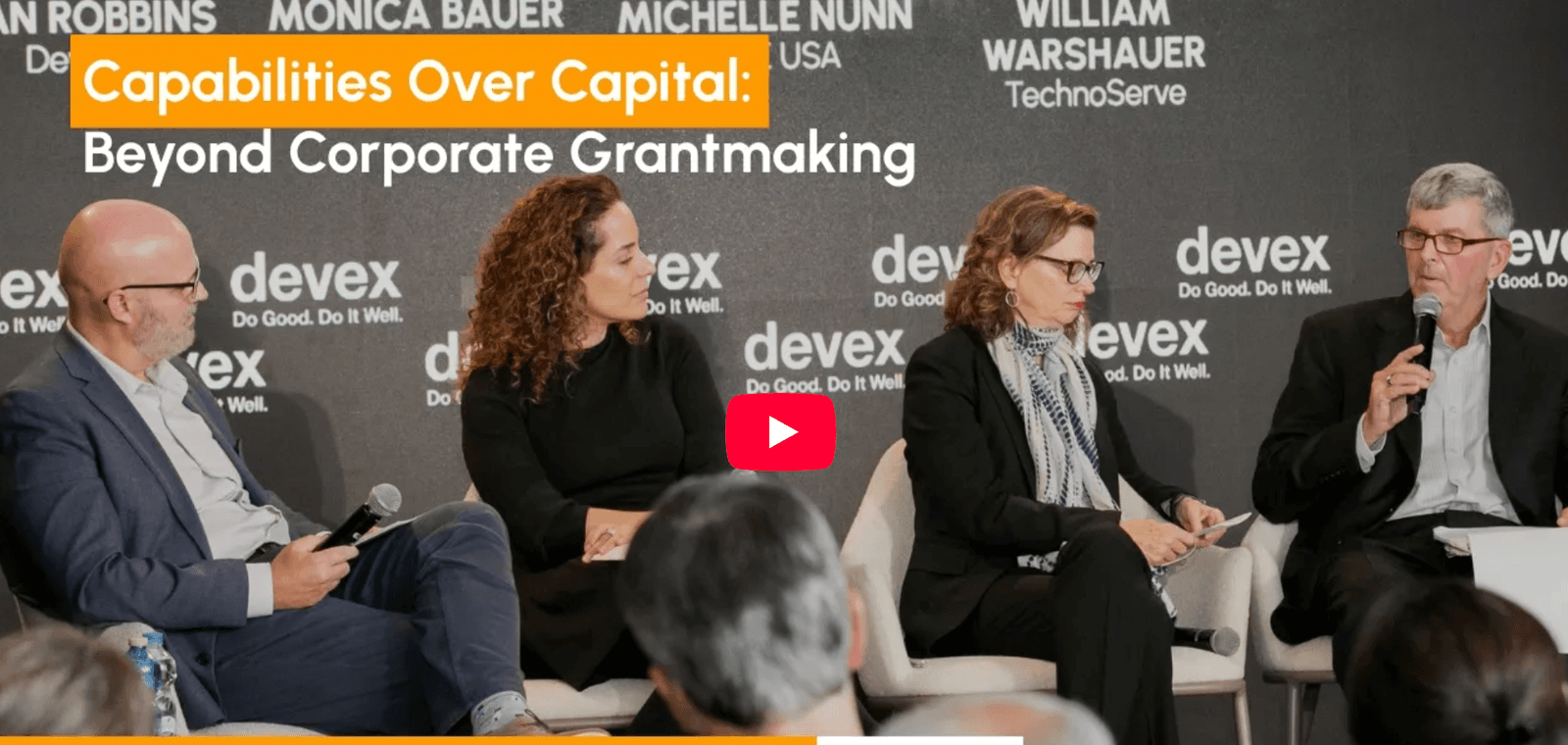
Leaders from PepsiCo Foundation, CARE, and Technoserve convened at Devex Impact House to make a forceful case that the most durable development outcomes come not from corporate checkbooks but from corporate supply chains, R&D labs, and market access. Across nearly 30 minutes of discussion, the panelists presented concrete results — smallholder farmers earning $8,000 a year, governments matching private investment, and alliances outlasting grants — while delivering a pointed critique of a development sector that still lacks basic data on whether its interventions actually last.
- PepsiCo Foundation, CARE, and Technoserve leaders champion "capabilities over capital" as the sustainable alternative to traditional corporate grantmaking
- Mexican banana farmers trained to PepsiCo's commercial standards now average $8,000 in annual sales — and additional buyers are entering the market
- CARE-PepsiCo partnership reaches 4 million people across 9 countries, doubling potato yields in Egypt and attracting $1.5 million in Colombian government matching funds
- Panelists expose critical blind spot: traditional donors have never funded post-project measurement, leaving almost no data on whether development gains last
- PepsiCo's fortified food for malnourished children required entirely different deployment models in Mexico and Guatemala due to cultural differences
Capabilities, Not Capital: A New Development Thesis
Why it matters: With global development budgets under pressure and traditional aid models under scrutiny, three leaders of major organizations converged on a single argument: the most valuable thing a corporation can offer the developing world is not money but its operational DNA — the expertise, quality standards, supply chain relationships, and R&D capacity that make it competitive in global markets.
Where things stand: Monica Bauer, President of PepsiCo Foundation and Senior Vice President of PepsiCo, framed the philosophy explicitly: "We really believe in that philosophy that it's capabilities over capital, because that's exactly where you'll find a very unique and nuanced intervention where every company has some unique skills, some potentially amazing and very sophisticated innovation, R&D, ethical practices that are of tremendous value to some countries, to some markets, to some communities."
Michelle Nunn, CEO of CARE, reinforced the point by reframing what corporate partnerships actually deliver: "I actually don't think we're under the illusion that this is going to be the biggest capital infusion. I think what we see is this is going to be the biggest impact infusion."
Will Warschauer, CEO of Technoserve, was perhaps the most direct about what makes this model work — and why it's not charity: "When we work with corporations, we don't ask them to be philanthropic. We take them a business case which is good for their bottom line. And oh, by the way, in implementing that business case, you're going to take X thousand small farming families who's sourcing from you now out of poverty in a way that is financially sustainable and environmentally sustainable."
The convergence was striking: all three panelists argued that when community benefit and business benefit align — what the development world calls "shared value" — interventions can sustain themselves long after grants end. The implication for nonprofits and development organizations is strategic: pitch corporate partners on their self-interest, not their generosity.
From Banana Farms to Global Supply Chains: The Agrovita Model
The basics: The Agrovita initiative in Mexico paired PepsiCo's decision to source bananas locally with Technoserve's capacity to train smallholder farmers to meet commercial-grade standards.
Why it matters: The initiative offers a proof point for the panel's thesis — development interventions that operate on market terms can transition into self-sustaining commercial activity, replacing aid dependency with genuine market integration.
Where things stand: CEO Warschauer emphasized that PepsiCo deliberately maintained the same quality, safety, and pricing standards for smallholder farmers that it applies to any supplier: "One of the brilliant things that Pepsi did is they did not change a thing for those farmers. All of the standards, all the safety standards, the quality standards remained exactly the same. The prices remained exactly the same."
The result: farmers trained through the program averaged approximately $8,000 per year in banana sales. But Warschauer identified a more significant milestone — the moment the project stopped being a development intervention and became a functioning market: "I would say that we saw that in Agrovita the moment that we had the first buyer of bananas in addition to Pepsi."
That second buyer is the key indicator. When other commercial purchasers enter, the farmers are no longer dependent on a single corporate patron — they are participants in a competitive market. Warschauer credited PepsiCo for embracing this broader ecosystem view, recognizing that more buyers ultimately strengthen the supply chain for everyone.
The initiative also incorporated a focus on youth and women at PepsiCo's request, which broadened the model's appeal to potential co-investors — a practical illustration of how layering social objectives can attract additional partners in a tight funding environment.
She Feeds the World: 4 Million People, 9 Countries, and Governments Writing Checks
The basics: She Feeds the World is an eight-year CARE-PepsiCo partnership operating across nine countries on three continents, employing farmer field and business schools focused on diversifying incomes, increasing productivity, enabling market access, and promoting women's equal opportunity.
Why it matters: The initiative's most compelling metric isn't the 4 million people reached — it's the evidence that governments and local institutions are voluntarily investing their own money to replicate the model, the strongest possible signal that an intervention has proven its value.
Where things stand: CEO Nunn described the partnership's architecture: "We had a global framework, but we had localized context and also implementation and execution. And it wasn't just CARE's local context, it was in partnership with Pepsi." That structure — global standards, local adaptation, corporate co-ownership — produced dramatically different outcomes in different countries.
In Egypt, smallholder potato farmers doubled their yields within a year and then received direct supply contracts with PepsiCo. Moderator Alan, co-founder of Devex, provided context for the scale of this opportunity, noting that PepsiCo is the largest purchaser of potatoes in the world.
In Colombia, the results prompted the Ministry of Agriculture to put up its own money. Nunn described the progression: "Colombia would be an example where they said, look, this is working so well, we actually, the Ministry of Agriculture, we want to put in $500,000 and the next year $1 million to be matched."
And in Peru, Nunn pointed to what may be the strongest evidence of sustainability: "In the instance of Peru, where the grant has finished, there are now 12 public-private alliances that continue in Peru that were born out of our initiative together."
The partnership also navigated COVID by pivoting to virtual farmer training and bringing in third-party evaluators to verify effectiveness — a moment that forced both organizations to align on measurement standards. Nunn noted that reconciling different approaches to data was itself a key learning: "One of the learnings was we were measuring things in different ways. And so how do we come together and look at measurement and evaluation in a way that there was a shared understanding of our respective perspectives."
Nunn framed CARE's ultimate goal in terms rarely heard from nonprofit leaders: the ability to leave. Transitioning impact to government, civil society, or the market — rather than perpetuating organizational presence — is, in her view, the real measure of success.
The Measurement Black Hole: Nobody Tracks What Happens After the Grant Ends
Why it matters: The entire development sector's ability to distinguish interventions that create lasting change from those whose gains evaporate depends on post-project data — and, according to the panelists, that data barely exists.
Where things stand: CEO Warschauer delivered the panel's most striking critique: "The donor agencies, the traditional donors that fund projects like these, don't — have not historically funded anything after the end of the project. So you can imagine a 3-year project and you're training farmers and there's all sorts of people doing things and everything's going on and you meet some KPIs. And then what happens after that is actually the most important thing."
The implication is significant: billions of dollars in development spending are evaluated based on activity during the project period, with almost no systematic effort to determine whether outcomes persist three, five, or ten years later. Warschauer noted that some foundation leaders are beginning to take the gap seriously: "There's helpfully smart people at some of the foundations now, particularly some folks at Gates and Rockefeller who are thinking hard about this."
President Bauer was equally blunt about where the priority should be: "To me, the most important metric is what happens once you're gone. That's the most important metric."
CEO Nunn echoed the call, arguing that resources must be dedicated specifically to post-project measurement and evaluation — an expense that current funding structures do not cover.
What's next: Whether the Gates and Rockefeller foundations translate their interest in post-project measurement into funded mandates could reshape how the entire development sector defines success. For now, the gap remains a systemic vulnerability.
When Parents Eat the Kids' Food: Cultural Adaptation in Corporate R&D
Why it matters: Even when a corporation deploys its most sophisticated capabilities — in this case, PepsiCo's R&D team designing a fortified food product specifically for malnourished children — the intervention can fail if it ignores local cultural dynamics.
Where things stand: President Bauer described how PepsiCo developed a fortified food product targeted at undernourished children, deploying it first in Oaxaca and other Mexican states and then in Guatemala. But the intervention models diverged sharply between countries. In Guatemala, CARE added a water program alongside the nutrition product. In Mexico, an unexpected cultural dynamic emerged: "In the case of Mexico, we had to go fully on education because otherwise, it was the parents who were eating the fortified food and not the kids because that's a cultural nuance that you find."
Bauer drew the broader lesson explicitly: "Sometimes corporations, and I would say even partners, come and try to just deploy an intervention. That doesn't work. Unless you listen, learn, understand, course correct, you're not gonna make an impact."
The example underscored the panel's running theme: corporate capabilities are necessary but not sufficient. They must be paired with deep local knowledge and a willingness to redesign approaches mid-stream.
A Call for Coalition, Not Ownership
The panelists closed with a unified call for a different way of organizing development work. President Bauer urged the sector to move past branded, single-organization programs: "Let's be less about ownership and programs that are labeled with one name and do more coalition-based interventions, because that's the way you're going to be able to make a difference."
She framed the stakes in practical terms: "Money is tight, needs are high and potentially will get worse. So I think the more we do together, the more creative we get, and especially the more we hit the space where we can find the intersection of value to the communities and value to the business, the more sustainable any intervention and impact will be."
CEO Nunn reinforced the point, arguing that nonprofits have a responsibility to help their corporate partners see development as strategy, not charity: "We have to find ways of ensuring that our corporate partners, that we help them to make the business case so that it transcends philanthropy and really does move into their value and the shared value that Monica started us out with."
What's next: The panel offered no specific policy proposals or legislative timelines — this was a strategic framing exercise, not a decision-making body. But the convergence of three major institutional leaders on a single thesis — capabilities over capital, shared value over grants, coalitions over branded programs — suggests the argument is maturing from theory into operational consensus. The test will be whether funders, governments, and corporations follow through on post-project measurement and multi-partner models at scale.