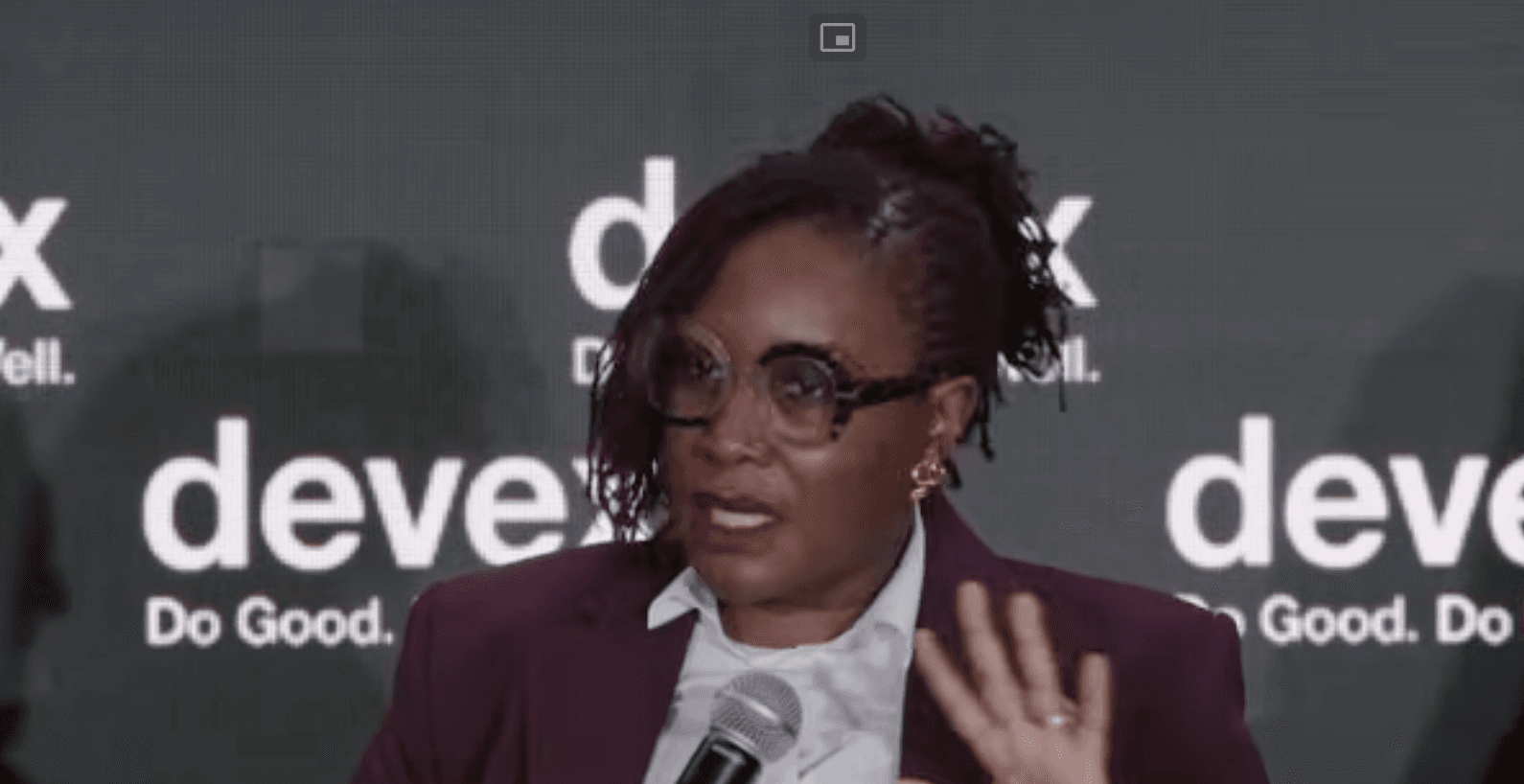
Devex - Sep 21, 2026 - Meeting
Devex • United NationsSeptember 22, 2026
Locunity is an independent informational service and is not an official government page for this commission. All information is sourced from public footage and an analysis of official agendas with the aid of responsible, fact-checked AI. to report an error or omission.
$129 Billion Wasted: Panel Exposes Africa's Hidden Learning Crisis
A Devex Impact House panel featuring the heads of Ubongo and Global Schools Forum laid bare a sobering reality behind rising school enrollment numbers across Africa: the vast majority of children sitting in classrooms are not actually learning. The discussion reframed a global education debate typically anchored in funding levels and access, redirecting it toward what panelists called "learning capability" — curiosity, confidence, and self-regulation — and the evidence that low-cost well-being interventions can dramatically improve academic outcomes.
- Nine in 10 children in Sub-Saharan Africa cannot read a simple sentence, despite enrollment climbing from 655 million to 770 million primary students
- $129 billion is wasted annually on education globally, according to a UN estimate cited by Devex's co-founder
- A happiness curriculum in Indian government schools boosted math outcomes by the equivalent of 15 months of learning at minimal cost
- Ubongo reaches 69 million children across Africa through TV and media content localized into 12 languages, including programs designed for children with autism and ADHD
- Global reading levels are declining, not just stagnating, based on the latest PISA scores
The Enrollment Illusion: Access Without Learning
Co-Founder and Executive Vice President Alan Robbins opened the panel by questioning the standard terms of the education spending debate — whether budgets should rise 3% or 5% — without asking whether the money is producing results.
"There's a number I read about from the UN that $129 billion is wasted every year on education," said Alan Robbins, Co-Founder and Executive Vice President of Devex. He followed with a stark regional statistic: "In Sub-Saharan Africa specifically, I believe it's 89% of people are afflicted by learning poverty."
Only one in five people completing primary school in the region have basic foundational reading capability, he said — a figure that reframes enrollment gains as an incomplete success at best.
Why it matters: Primary enrollment across the developing world has risen dramatically — from 655 million to 770 million students — and higher education enrollment has grown from 100 million to 269 million. But those numbers, panelists argued, have masked a crisis hiding in plain sight: children are in classrooms five to six days a week and still cannot read.
Where things stand: CEO Mwasi Wilmore of Ubongo, a social enterprise producing educational media across Africa, painted a vivid picture of what enrollment actually looks like in practice.
"There's 100 children, 1 teacher, 1 to 2, maximum 3 to 4 books that are passed row to row," said Wilmore. She described a child sitting silently through lessons — not out of shyness, but from experience: "She has learned that taking the risk of being wrong in that room is very unforgiving."
The result is a generation trained to comply rather than engage. Curiosity, the engine of real learning, is systematically crushed rather than cultivated.
"That's not an access crisis. There's another crisis hidden underneath the access crisis," Wilmore said.
CEO Alina Liepkahn of Global Schools Forum underscored the point with global data, noting that the latest PISA scores show "reading levels are declining globally" — meaning the problem is not confined to the developing world but is sharpest in Sub-Saharan Africa, where 90% of children cannot read a simple sentence.
Curiosity, Confidence, and Self-Regulation: Redefining What It Means to Learn
Wilmore pushed the panel beyond traditional metrics of educational success, arguing that the field needs to measure — and invest in — what she calls "learning capability."
"For us, capable means the child is curious," she said, defining the concept as the intersection of curiosity, confidence, and self-regulation. If a child isn't curious, she argued, they won't lean into difficult problems; without confidence, they won't speak up or try; without self-regulation, they can't manage their thinking, behavior, or emotions well enough to learn.
The monitoring systems tracking education in the developing world are not built to detect these breakdowns. "That's a chain breaking down somewhere between the classroom and the child's mind. And almost nothing in our monitoring systems are built to catch this," Wilmore said.
The evidence: Liepkahn brought data to support the argument, citing the largest review of its kind — covering 270,000 students — which found that academic performance and well-being gains move in tandem. "Students who focused on well-being ended up 10 places higher out of 100 in their academic skills as well," she said.
She pointed to a concrete example: a happiness curriculum in Indian government schools where students begin each day with a mindful check-in. The intervention decreased anxiety significantly and "increased outcomes in maths by the equivalent of 15 months of learning, which is very significant," Liepkahn said. She described it as a low-cost intervention successfully implemented within a government system — a proof point that these approaches can scale.
"What I think is missing is actually the fact that we are measuring all of these skills in silos and we're not looking at how they reinforce each other, because they really do," Liepkahn said, calling on funders to invest more in evidence-building work that bridges the artificial divide between academic skills and well-being.
Ubongo's Model: 69 Million Children, 12 Languages, Representation That Matters
Wilmore outlined how Ubongo is attempting to put this philosophy into practice at scale. The organization reaches over 69 million children through television and media programming across Africa, localizing content into 12 different African languages.
"We currently reach over 69 million children all over Africa. We also know that the child learns best in their mother tongue. So we also then adapt it and localize the content to 12 different African languages," she said.
The basics: Ubongo operates three programs: Akili and Me for ages 3–6, focused on building a love of learning and preschool readiness; Nuzo and Amia for ages 6–9, targeting reading comprehension and also designed for children with autism and ADHD; and Ubongo Kids for ages 7 and up, focused on STEM. Each program is built around the same principles of curiosity, confidence, and self-regulation.
Why it matters: Representation is a deliberate strategy. Female characters receive over 50% of screen time, and programming includes children with disabilities who are shown thriving rather than being defined by their circumstances. Wilmore, who grew up in Africa, said she doesn't remember seeing herself represented in media as a child.
She also drew attention to a related crisis: in Tanzania, only two doctors in the entire country can diagnose autism, and both are in the main city. "That is another hidden pandemic that we haven't even been able to touch upon," Wilmore said — making media-based interventions one of the few scalable tools available.
Robbins closed the session by reinforcing the panel's central theme: "It just really does show how important it is to get in there early and that just getting the children in school, it is important. No one's saying it's not important, but it's just the first step, really."
What's next: Liepkahn called for increased funding of evidence-building research that examines how academic and well-being skills reinforce each other — an area she said current funders treat as separate causes. If the argument gains traction among major education donors and policymakers, it could begin to redirect how billions in annual global education spending are allocated, shifting the metric of success from how many children are enrolled to how many are actually learning.