Anthropic Embeds Social Impact Inside Its Sales Operation to Reach Nonprofits and Governments
Devex • United NationsSeptember 25, 2026
Locunity is an independent informational service and is not an official government page for this commission. All information is sourced from public footage and an analysis of official agendas with the aid of responsible, fact-checked AI. to report an error or omission.
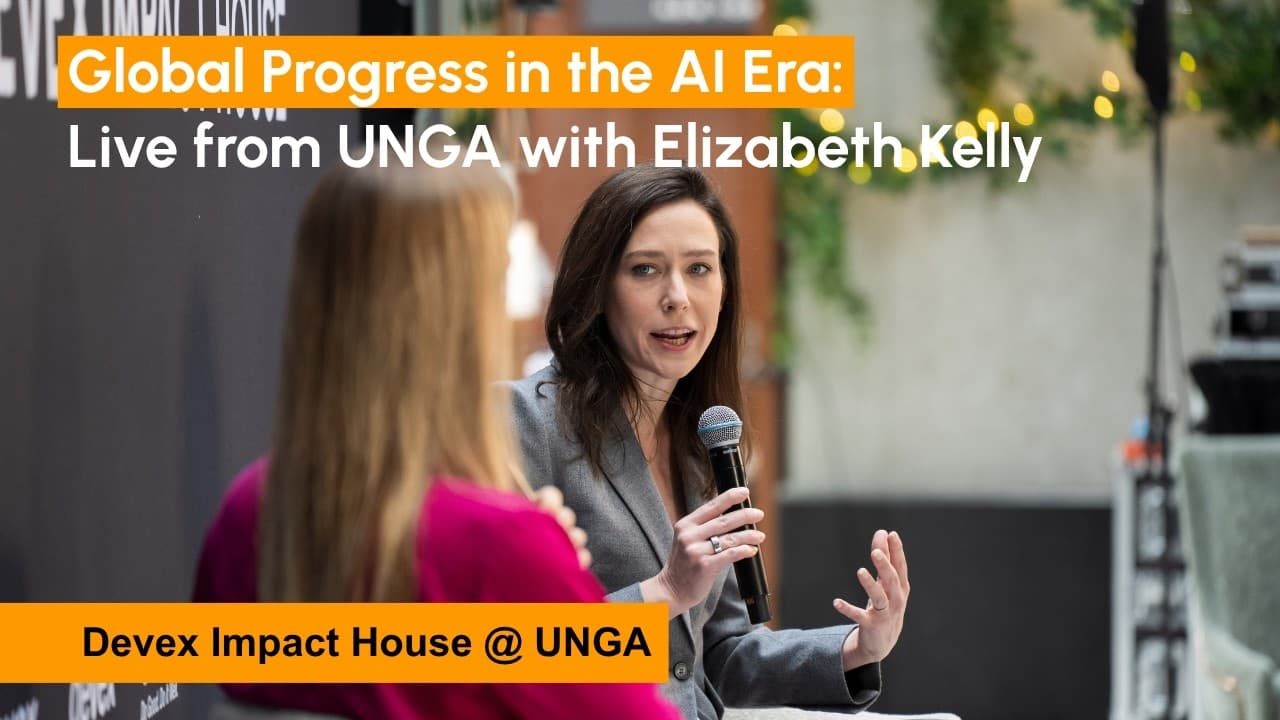
At a live podcast recording during UN General Assembly week, Elizabeth Kelly, Head of Beneficial Deployments at Anthropic, laid out the frontier AI company's unusual strategy for channeling its technology toward global health, education, and humanitarian work — embedding her impact-focused team inside the company's commercial sales organization, launching a 1,000-person fellowship to place AI-trained professionals in U.S. nonprofits, and detailing flagship government partnerships with Rwanda and Kenya. The conversation, hosted by Catherine Cheney, Senior Editor for Special Coverage at Devex, surfaced sharp questions about sustainability, local capacity, and what separates Anthropic's approach from rival AI labs.
- Anthropic's beneficial deployments team sits inside sales but is scored on impact, not revenue, giving nonprofits and governments the same engineering and customer support as enterprise clients
- Rwanda signs MOU with Anthropic across health, education, and government capacity, with cervical cancer elimination and disease surveillance among top priorities
- Claude Core will place 1,000 early-career professionals — no college degree required — in nonprofits across the U.S. for a year of embedded AI work
- $200 million, four-year Gates Foundation partnership funds language datasets, benchmarks, and AI tools for low-resource settings
- World Food Program, IRC, and CEPI deploy Claude for food insecurity forecasting, child malnutrition reduction, and Ebola outbreak response
- Kelly frames safety and equitable access as inseparable, arguing benefits cannot materialize without foundational safety investments
Impact Team Inside Sales: Anthropic's Structural Bet
Why it matters: Most major tech companies house their social impact work in a foundation or corporate social responsibility arm, separate from the commercial engine. Anthropic is betting that putting its impact engineers alongside the sales team — while scoring them only on outcomes, not revenue — can deliver a higher caliber of support to nonprofits and governments than a standalone philanthropy operation.
Where things stand: Kelly said her Beneficial Deployments team studied past tech-for-good programs at Google, Salesforce, and others before designing Anthropic's approach, deliberately recruiting leaders from those efforts. The result is a unit that can offer nonprofits, universities, and governments the same forward-deployed engineers and applied AI resources that paying enterprise clients receive.
"My team actually sits inside the sales organization, which I know sounds incredibly paradoxical, but I think it is actually our biggest strength," said Elizabeth Kelly, Head of Beneficial Deployments at Anthropic.
She contrasted this with the OpenAI Foundation, which operates as an independent entity that does not promote OpenAI's technology. Cheney pressed the point, noting the tension between embedding social impact inside a commercial operation and maintaining independence. Kelly argued Anthropic's structure uniquely allows it to deliver both the AI models and the technical expertise needed for real transformation — something a standalone foundation cannot do as effectively.
The team also invests in public goods that benefit the broader ecosystem regardless of which AI model organizations use, including the open-source Model Context Protocol (MCP), MCP connectors built with Candid and Benevity, the Model Hardware Standard, and language and dataset work with the Gates Foundation.
The other side: Micah from the Triple Strategy Group raised a pointed question from the audience about long-term sustainability: when Anthropic's highest-impact deployments currently run on subsidized cloud credits and company engineers, how does the model sustain itself, and when does the company turn to impact funders like foundations or impact investors? Kelly acknowledged that AI alone is only part of the solution.
"We are not the entire solution, and so we need to show up in coalition, in partnership with people who have been doing this work for a very long time," she said.
Rwanda and Kenya: Anthropic's Government AI Playbook
Why it matters: Rwanda and Kenya represent Anthropic's "lighthouse examples" — proof-of-concept government partnerships intended to demonstrate what cross-sector AI deployment looks like before scaling to other countries.
Where things stand: Anthropic has formalized a memorandum of understanding with Rwanda covering three sectors. In health, the focus includes eliminating cervical cancer and improving disease surveillance and supply chains. In education, Claude is being provided to teachers to help them manage multi-grade classrooms and individualize instruction. For government capacity, Anthropic is embedding engineers and providing technical training. A joint declaration is also in place with Kenya across health, education, and languages.
Kelly described the partnership as emerging organically from a 2025 convening where Rwanda brought together social sector organizations, governments, and AI companies. She named Minister Paula Ingabire from Rwanda and Minister Philip Thigo from Kenya as key government counterparts.
"The partnership came about really organically through the conversations that we were able to have on the ground with the ministers, folks across government about what their needs were, what they were prioritizing, where we could provide support," Kelly said.
Crucially, she said Rwanda's feedback — such as model performance needing improvement in Kinyarwanda or Kenyan contexts — directly informs Anthropic's product and model investments. This feedback loop, backed by the $200 million, four-year Gates Foundation partnership funding language datasets and evaluations for low-resource settings, is central to the company's argument that beneficial deployment and commercial product development reinforce each other.
The other side: Dr. Kim McCall from A Child's Hope Foundation asked how to ensure AI builds capacity in locally led organizations rather than making them more dependent on technology and expertise from the Global North. Kelly responded by emphasizing that her team starts with listening rather than a technology-first approach.
"I think in tech, we have this sort of sense of, let's move fast and break things. And there can be admittedly a bit of hubris in thinking that tech is always the answer," she said.
Claude Core: 1,000 AI Fellows for U.S. Nonprofits
Why it matters: Nonprofits face an acute capacity gap in adopting AI tools. Claude Core is designed to address both the sector's technology gap and the emerging workforce pipeline for applied AI roles — with no college degree required.
Where things stand: The program will place 1,000 early-career professionals in nonprofits across the United States. Fellows go through an AI boot camp and are then embedded in organizations for a year, working alongside staff to integrate AI into day-to-day operations. Organizations range from food banks in Texas to larger national nonprofits.
Kelly cited a LinkedIn story to illustrate the program's accessibility: "Someone who 10 months ago was a sanitation worker is now going to be a Claude Core Fellow in a nonprofit, building his skills as well as really helping the nonprofit."
Before launching the related Claude for Nonprofits program, the team spent months conducting listening sessions with grantees of Robin Hood in New York, Tipping Point, and other organizations to understand their needs, usage patterns, and which tools — fundraising platforms, payroll systems — they used daily. That research informed the MCP connectors Anthropic built to integrate Claude with existing nonprofit workflows.
Kelly pushed back against the narrative that nonprofits and governments lag behind the private sector in AI adoption, saying they are often doing more innovative work than enterprise clients.
AI on the Frontlines: Food Security, Malnutrition, and Outbreak Response
Why it matters: As global food insecurity worsens, humanitarian organizations are testing whether AI-powered tools can meaningfully improve how they forecast crises and deliver care.
Where things stand: The World Food Program is using Claude to pull in 30 different data sources and refresh them every few hours, producing a more holistic picture of which countries are at risk of food insecurity. CEPI is using Claude to accelerate situation report production for Ebola outbreak response under its 100 Days Mission. And the International Rescue Committee is deploying Claude to reduce child malnutrition in Nigeria and improve maternal care in Burkina Faso.
Kelly emphasized that AI is only one part of the equation — infrastructure like roads, clinics, medications, and supplies must also be in place. She described the Gates Foundation partnership as exemplifying a coalition model that pairs technology with the broader investments needed to deliver results.
Safety and Access: Two Sides of the Same Coin
Cheney asked about the connection between Anthropic's leadership and effective altruism as a mindset, and what that means for how the development community should engage with AI labs. Kelly noted that Anthropic was founded as a public benefit corporation by Dario and Daniela Amadei and others who left OpenAI specifically to pursue a different approach to AI safety and governance.
Her closing message tied the conversation's threads together: "I really do think that safety and access are two sides of the same coin. We are not going to see any of the benefits from AI unless we really invest in the safety."
She stressed that most organizations are still barely scratching the surface of what current AI models can do, and warned against replicating the technological inequities of past eras.
What's next: Anthropic's Rwanda and Kenya partnerships, Claude Core fellowship, and Gates Foundation collaboration are all in active deployment. The company's approach — embedding impact inside the commercial operation rather than spinning it off into philanthropy — will face its real test as these programs scale and the question of long-term sustainability sharpens.