
Council Consolidates Flock Camera Billing Despite Wave of Public Opposition
City Council • Desert Hot SpringsNovember 17, 2026
Locunity is an independent informational service and is not an official government page for this commission. All information is sourced from public footage and an analysis of official agendas with the aid of responsible, fact-checked AI. to report an error or omission.
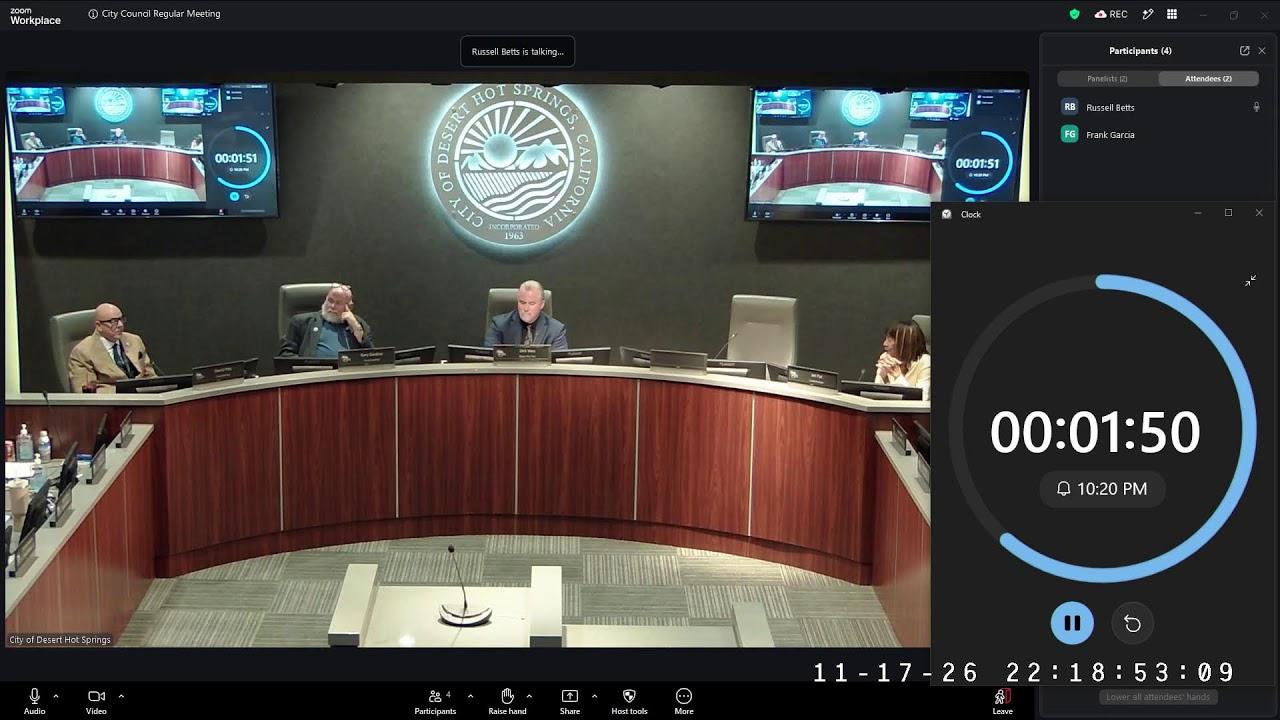
Desert Hot Springs' surveillance debate dominated the Nov. 17, 2026, City Council meeting. Six public commenters urged the council to pause or shut off the city's Flock Safety license plate cameras. The four members present, with the mayor absent, instead voted unanimously to merge the program's billing for the rest of the fiscal year, signaling a fuller review later. The same night, the council advanced police drone purchases, waived impact fees for 167 affordable homes and heard renewed demands to repeal a stalled rental registration law.
- Flock camera billing consolidated: 26 cameras, about $78,000 a year, approved despite six opponents
- Police drone policy advances on first reading, including four drones at $108,232
- $30,000 conservation-land drone funded through a CVCC patrol extension over transparency objections
- Park Lane Homes wins impact fee waiver for 167 affordable units and a childcare center
- Rental registration ordinance stays on hold, not repealed, as residents demand a formal vote
- Draft sewer plan prices Palm Drive infill at $35M and $52M across two zones
Flock Cameras Survive, but Scrutiny Grows
Why it matters: Automated license plate readers (ALPRs) photograph passing vehicles and log plate data. The vote neither approves nor ends the program, but it keeps 26 cameras running while opposition mounts.
Where things stand: Police Chief Shaw traced the city's Flock purchases since 2021 and said $60,000 remains for this fiscal year. The motion merged three active billing cycles into one contract, at about $78,000 a year, and funded the remainder of the fiscal year, with no other action taken. The chief cited cases solved with the cameras, a shutoff of out-of-state data sharing, and new memorandums of understanding (MOUs) and audits.
Earlier in the evening, Councilmember Daniel Pitts praised a police community meeting on Flock cameras, drones and ALPRs. “I believe Chief Shaw made a compelling case, supported by real statistics and examples demonstrated on how these resources can help keep our community safer,” said Pitts.
The other side: Opposition was broad and specific:
- Joshua Kedrick alleged out-of-state data sharing, including immigration-related searches from the Houston Police Department, plus purchasing policy violations. He urged the city to turn the systems off.
- Tabitha Davies asked the council to continue the item until a privacy policy, a list of agencies receiving data, audit logs and a public hearing exist.
- Carla Rocha said the audits were redacted and urged waiting for public data.
- Ty Peterson objected to for-profit surveillance, citing vague search reasons and contract terms.
- Walker Beverly noted other cities shutting the cameras down and urged funding for youth activities. Kristen Alexander called for spending on housing, education and jobs instead.
Decisions and stakeholder impacts: The motion passed unanimously by voice vote, with the mayor absent. One councilmember supported the item but said a robust discussion should come before any new contract. For now, the police department keeps its tools, and critics have a clear opening to press their case.
What's next: Members signaled a broader Flock review before a new contract comes forward. No date was set.
Drones Advance on Two Fronts
Why it matters: The council expanded the police department's authority over drones and other equipment twice in one night, once citywide and once on conservation land.
Where things stand: California's AB 481 requires council approval of police "military equipment" policies. Under that law, Chief Shaw presented a revised ordinance and the 2025 annual use report. Possible 2026 purchases include four DJI drones at $108,232, rifle and bean bag ammunition, and a possibly donated Bearcat armored vehicle with $5,000 in annual maintenance. The chief called the items a wish list with no immediate fiscal impact. He said patrols will not involve routine drone flights and that rifles were left off the staff report in error.
The council also approved Amendment No. 3 to its MOU with the Coachella Valley Conservation Commission (CVCC). The amendment provides $57,000 through June 30, 2027: $27,000 for overtime patrols and $30,000 for an autonomous drone. Kathleen Brundage, Director of Conservation, CVCC, said patrols reduce vandalism and dumping on 7,000 acres of conservation land. On the drone money, she said “we went to CalRecycle for the approval of moving it from the original cameras.”
The other side:
- Kedrick alleged earlier reports understated drone purchases. He argued the CVCC funds were sought before council approval, contrary to Government Code 7071.
- Davies raised concerns about where the Bearcat came from, the drone policy, impacts on burrowing owls and the choice to hold the community meeting at the police station. She urged stripping the drone from the CVCC deal or continuing the item.
- Rocha said loose wording and donation loopholes make it hard to trust the department.
- Alexander Galdames opposed arming police with military-grade equipment. Ashley Venzuela urged a subcommittee to study privacy concerns first.
- Critics also questioned whether the CVCC drone counts among the four authorized and whether it could tie into the Palm Springs Real-Time Intelligence Center.
Decisions and stakeholder impacts: Both items passed unanimously by voice vote. A councilmember defended the CVCC partnership and moved its adoption. Conservation land managers gain patrol capacity, while privacy advocates lost both votes.
What's next: The equipment ordinance returns for second reading at the next regular meeting.
Rental Registration: On Hold, Not Repealed
Why it matters: Chapter 5.58 remains in the municipal code. Owners and tenants are left unsure whether they are in compliance while a subcommittee works.
Where things stand: A coordinated group of commenters pressed for formal repeal. Crystal Watson asked the council to put the ordinance “on the City Council agenda and vote to formally repeal it,” and to answer residents' emails. Andy Dean said individual assurances cannot suspend an ordinance and urged repeal on the Dec. 1 agenda. Property owner Tom Wilhelm said no registration application exists and asked whether owners are already in violation. He urged a fresh start with a new ordinance. Venzuela sought repeal and better communication. Davies urged heavy revisions to the inspection provisions for occupied units.
Councilmembers said the fees were rejected and the program was paused. “So there is no program because it was put on hold by the vote of that day,” said Mayor Pro Tem Dirk Voss. Councilmember Jan Pye said no councilmember had requested repeal and that members are awaiting an amendment.
The other side: Closing the meeting, Russell Betts said the ordinance was never repealed and asked that any repeal be placed on a noticed agenda. “Chapter 5.58 remains on the books,” said Betts. The city attorney and a councilmember replied that no one had claimed it was repealed.
What's next: A subcommittee of Voss and Pitts is expected to return with recommendations around January.
Park Lane Homes Gets Its Fee Waiver
Why it matters: Waiving development impact fees helps Abode Communities stack funding for 167 affordable units and a childcare center. That funding includes a $24.6M state Affordable Housing and Sustainable Communities (AHSC) loan and an $11.2M city grant.
Where things stand: Planning Manager Patricia Villagomez presented the project, which the Planning Commission already approved. Staff said a traffic signal at Palm Drive and Park Lane is funded with $850,000 and would be built before the homes. A councilmember cited the city's Regional Housing Needs Allocation (RHNA) obligation and the project's 55-year deed restriction.
The other side: Watson opposed waiving $1.7 million in fees until a subcommittee studies traffic at Park Lane and Palm Drive. Commenters also questioned the timing of the waiver request and discrepancies in the resolution. Davies backed the waiver with conditions: recorded 55-year affordability, a recapture clause and Phase 2 income tiers. “Public money needs to have public guarantees,” said Davies.
Decisions and stakeholder impacts: Voss moved the resolution, and it passed unanimously by voice vote. Lower-income renters and families needing childcare stand to gain. Nearby residents worried about traffic are relying on the funded signal.
Sewer Plan Maps Path to Infill Housing
Why it matters: Without sewer extensions, the city's south end cannot support infill housing. The plan also aims to move homes off septic systems to protect the aquifer.
Where things stand: Anthony Herda, an engineer with Engineering Resources of Southern California, presented a draft plan covering three zones. It estimates $35M for the central zone and $52M for the south zone, with funding options including grants and loans. Davies raised concerns about crossing habitat conservation plan land, septic-to-sewer costs for homeowners and nitrate reduction. The deputy city manager said the document is only a feasibility study. A councilmember noted the Mission Creek Conservancy is not in the area and suggested the Wildlands Conservancy or CVCC instead.
“I'll agree with the mayor pro tem that we need to do this for the long-term survival of our city,” said Councilmember Gary Gardner, who made the motion. It passed unanimously.
The council also adopted an application process for two public seats on an Enhanced Infrastructure Financing District (EIFD) authority. The authority is being set up through a $200,000 state-regional grant study.
What's next: The final sewer plan returns for adoption at a future meeting.
- Signal safety contract: $421,791.70 to Crosstown Electrical and Data, the lowest bidder, for upgrades at 17 intersections. The work is funded by an HSIP grant of up to $552,200, with a city share of about $55,000.
- Spay-neuter pilot: Up to $30,000 for Animal Samaritans to serve about 179 pets of verified residents. Transportation to the Thousand Palms clinic was raised as a concern.
- Mobile health clinic: A one-year MOU brings a monthly Eisenhower clinic to the city. “The goal is to provide care at no cost regardless of insurance status,” said Victor Cisneros, Chief Community Health Officer, Eisenhower Health.
- Housing Successor report accepted: The report lists 42 loans and 12 properties valued at $4.6M. Three parcels, now used for the Corporation Yard and Eagle Sports Park, were put back on the housing asset list, and an appraisal is underway.
- Little Morongo chip seal: The council approved a Riverside County agreement for the project, with a city share of roughly $100,000 from SB 1 funds. The work was substantially complete as of Nov. 10.
Looking ahead: The ordinance updating accessory dwelling unit (ADU) rules to match state law, including a 500-square-foot maximum for junior units, returns for second reading at the next regular meeting. SunLine's bus shelter maintenance and advertising deal now runs through June 30, 2027. Kedrick also asked the city to publicly notice any bond vote tied to a $3.05 million building purchase. Staff reported a preliminary A+ S&P rating for anticipated 2026 lease revenue bonds.