
Council Adopts Six District Budgets, Zeroes Out St. Luke's Assessment
City Council • City and County of DenverNovember 16, 2026
Locunity is an independent informational service and is not an official government page for this commission. All information is sourced from public footage and an analysis of official agendas with the aid of responsible, fact-checked AI. to report an error or omission.
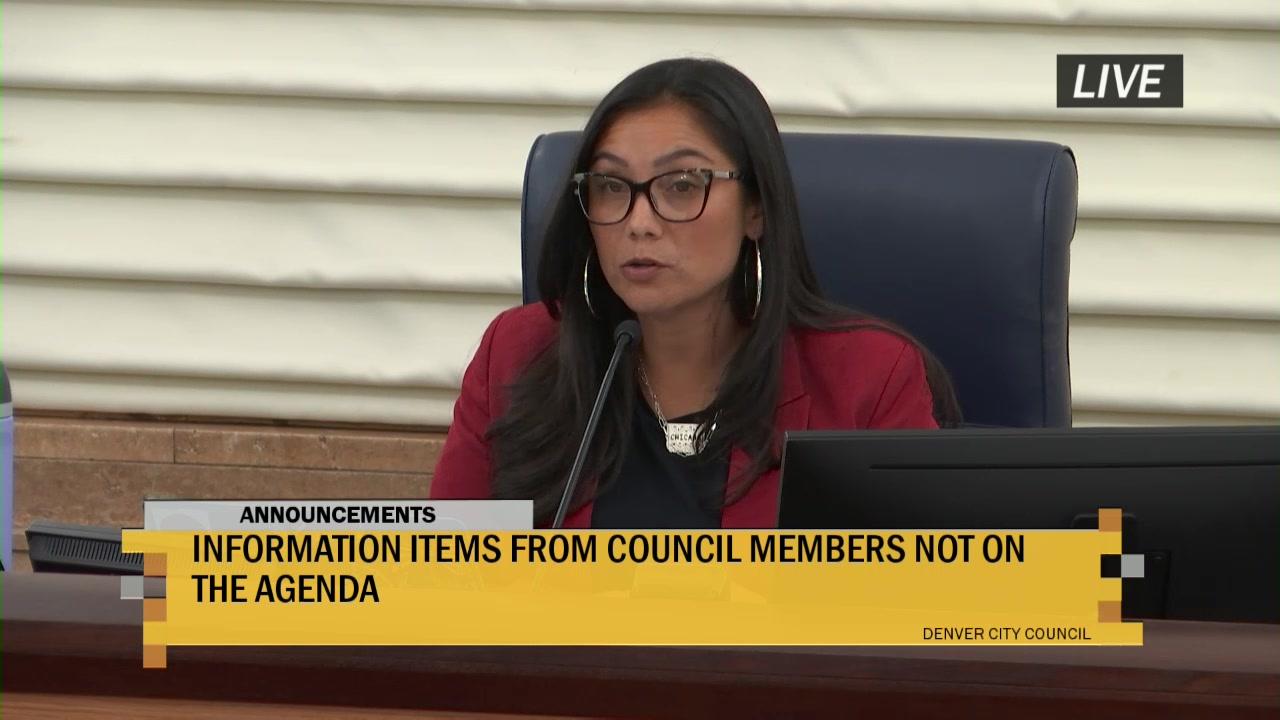
Denver City Council spent most of its Nov. 16, 2026, meeting deciding what property owners in special districts will pay to clean, maintain and staff commercial corridors in 2027. Members adopted six general improvement district budgets on 10-vote tallies, cut the St. Luke's Pedestrian Mall assessment to $0 after staff conceded maintenance falls short, and passed the Cherry Creek North business improvement district plan 9-2 over objections to private security. The sharpest questions were about accountability: who controls district money, who sits on district boards and whether the districts deliver what owners pay for.
- Six GID budgets adopted, each with 10 ayes, after a public commenter opposed every district.
- St. Luke's Pedestrian Mall assessment cut to $0 for 2027 as the district holds about $500,000.
- Cherry Creek North BID budget passes 9-2, with Gilmore and Lewis opposed over private security.
- 2027 Long Bill introduced, along with a $500M airport bond anticipation note and a downtown fund bill that drew governance questions.
Six Districts, Six Budgets, One Recurring Question
The basics: General improvement districts, or GIDs, levy mills and charges on property inside their boundaries to pay for services such as cleaning, maintenance and outreach. Each 2027 work plan required a public hearing before adoption.
Why it matters: These votes set 2027 levies and spending across six corridors. They also show council members increasingly testing whether districts use private or armed security.
Where things stand: Dennis Wojcik of the Department of Finance delivered one staff report for all six districts:
- Ballpark: $1.25M in revenue at 5 mills.
- Broadway: $1.07M at 8.96 mills.
- 14th Street: $622,350 in maintenance and capital charges.
- Gateway Village: $450,871 at 10.5 mills, against about $556,750 in spending.
- RiNo: $1.79M, plus $175,829 in capital charges, against about $4.16M in planned spending. Council also amended its 2025 and 2026 budgets.
- Sun Valley: $95,515 at 6 mills, with an amended 2026 budget.
Kate McKenna, executive director of the Ballpark General Improvement District, described an ambassador program covering 42 blocks around Coors Field. "To date, they've emptied 15,000 city trash cans, collected 39,000 pounds of loose litter, and removed over 8,000 pieces of graffiti," she said. She credited ambassadors with 1,750 service connections and 17 overdose reversals. She also said the program is not a substitute for first responders or private security.
The other side: Jesse Paris, a public commenter who described himself as representing the Black Star Action Movement for Self-Defense, testified against all six resolutions. "Every time y'all have these GIDs and these BIDs and these business improvement districts, it does nothing to better the community," he said. He argued that the districts drive displacement and do not benefit Black or unhoused residents. At several hearings, he asked whether the districts pay for private security.
Councilmember Shontel M. Lewis (District 8) asked about armed security at each hearing, and staff and district leaders answered no every time. "This district does not provide for armed security," Wojcik said of Ballpark. Lewis responded: "I am excited that this year it does not contain armed security." At Sun Valley, Erin Clark, Denver Housing Authority chief of real estate and president of the Sun Valley GID advisory board, said the district hires no private or armed security. Instead, it relies on an intergovernmental arrangement with DHA.
Decisions and stakeholder impacts: All six resolutions passed with 10 ayes and no recorded nays. Councilmember Darrell Watson (District 9) and Councilmember Flor Alvidrez (District 7) praised Ballpark, RiNo and Broadway. "So I'm enthusiastically yes, and I encourage my colleagues to join me enthusiastically yes," Watson said of Ballpark. Property owners in the districts carry the levies. In exchange, businesses and visitors get services the city does not directly provide.
What's next: The districts' 2027 spending plans take effect as adopted.
St. Luke's Owners Win a One-Year Break
Why it matters: Sitting as the Board of Equalization, council voted to collect nothing from St. Luke's Pedestrian Mall property owners in 2027. Staff admitted the district isn't delivering the maintenance owners pay for.
Where things stand: Nicholas Williams, deputy manager of the Department of Transportation and Infrastructure, reported two protests. He noted the proposed 2027 assessment of $176,000 was already a 40% cut, with about $500,000 on hand, and recommended keeping it. He also said the district's board has only one public member. DOTI plans an effort to fill district boards and decide whether to dissolve some districts.
The other side: Parker Semler, representative of property owners in the St. Luke's district, cited limited transparency and no accounting that weighs benefits against assessments. "We ask that because there's $500,000 in the bank for this year, the assessment be eliminated," he said. Neil Goldblatt, a property manager, confirmed that an owners' representative tried to join the board and got no response.
Councilmember Chris Hinds (District 10) questioned staff on brick sidewalks and access to district documents. He also confirmed with the City Attorney's Office that a pause was possible. Watson established that one LLC owns about 24% of the district. Asked how maintenance compares to expectations, Williams answered: "I would say currently not to the standard that should be expected."
Decisions and stakeholder impacts: Hinds moved to cut the assessment to $0 for 2027 while keeping the district intact. The motion passed with 10 ayes. Owners avoid roughly $176,000 in charges, and the district will draw on its reserves. Brad Nieman of the City Attorney's Office said the city "would basically submit a zero assessment ordinance for 2027."
What's next: The zero-assessment ordinance is expected at first reading at the following week's meeting. DOTI's board-recruitment and possible dissolution review remains pending.
Cherry Creek North Splits Council 9-2
Where things stand: Lewis pulled the Cherry Creek North Business Improvement District's 2027 operating plan and budget from the consent agenda for a separate vote. She moved it for final passage and then announced her opposition. "I'm a no on this item, like all such items in the past because it contemplates the use of private security," she said, citing her experience on the RTD board.
Decisions and stakeholder impacts: The plan passed (For: 9; Against: 2, Councilmembers Stacie Gilmore and Lewis). Every other BID budget passed in the consent block without debate. The vote marks a consistent two-member bloc against district plans that include private security.
Long Bill, Downtown Fund Move Forward
Why it matters: The bills introduced this week include the 2027 appropriation ordinance, known as the Long Bill. Under the charter, the budget takes effect whether or not council approves it. The Long Bill records how that money is to be spent.
Where things stand: The clerk read the 2027 Long Bill and a set of fund bills. The slate included a bond anticipation note of up to $500M for the airport, the Denver Health FY2027 agreement and Buffalo Bill Museum fees. Lewis said she voted no on the budget last week but will vote yes on the Long Bill. "This bill is the record of how the money is to be spent," she said.
The other side: Council Bill 26-1646 creates a custodial fund for Denver Downtown Development Authority (DDDA) loan proceeds and interest. Lewis called a separate revenue fund an accounting best practice. "What I do take issue with are the strange boundaries between the DDDA and the City of Denver," she added. She noted that the city's Department of Finance oversees DDDA funds, yet the DDDA is treated as independent in deals such as the Alterra deals.
Councilmember Amanda P. Sandoval (District 1), a DDDA board member, responded that the authority has its own auditor, lawyer and internal accounting. She said the board and its secretary oversee the funds alongside Finance, and the board is working to become more independent.
Mobility money gap: Council Bill 26-1435 updates rules for automated vehicle identification systems and passed in the consent block. Alvidrez warned that colleagues will receive a letter from DOTI. It says the department doesn't know how to absorb $8.9M in parking revenue that should fund mobility, and she said the bill could bring in revenue next year. Lewis said legislation to update the special revenue fund would follow, so an amendment could come later.
What's next: All bills for introduction were ordered published and return for final votes.
Minor Items
- Consent block passed 11-0: It included an $83.8M airport restroom contract, $27M in Link and Pin Apartments housing bonds, an Energize Denver extension and Kirsten Decker's Board of Ethics appointment.
- Veterans proclamation adopted 11-0: It recognizes nearly 30,000 Denver veterans. Councilmember Kevin Flynn (District 2) said, "this is my last Veterans Day proclamation."
- Feed-A-Family Day: Proclamation set for Nov. 21, 2026, passed with 10 ayes. The Epworth Foundation aims to distribute 3,000 baskets, and Lewis recalled receiving a Daddy Bruce basket as a child.
- Q3 General Fund report: It projects a $198.3M year-end balance, with $1.121 billion collected through Sept. 30.
- Financial advisors: Finance retained Stifel and Frasca, chosen through a June 2026 competitive RFP, to advise on city debt and airport financings.
Looking Ahead
Watch for the St. Luke's zero-assessment ordinance at first reading, final votes on the 2027 Long Bill and $500M airport note, and DOTI's review of district boards.