City Council - Sep 21, 2026 - Meeting
City Council • City and County of DenverSeptember 21, 2026
Locunity is an independent informational service and is not an official government page for this commission. All information is sourced from public footage and an analysis of official agendas with the aid of responsible, fact-checked AI. to report an error or omission.
Food Justice, Housing Dissent, and Worker Reclassification Dominate Denver Council Session
Denver City Council tackled food insecurity, housing strategy, and city workforce policy at its Sept. 21 meeting, unanimously declaring September as Right to Food Action Month while sharp disagreements emerged over the city's housing stability strategy and a pay reclassification that critics say could shut working-class residents out of city jobs. Councilmember Flor Alvidrez cast dissenting votes on four separate items, emerging as the council's most vocal critic of the evening's direction.
- Council declares September Right to Food Action Month, with advocates demanding sustained city investment in 2027 budget
- Housing Stability continuation plan passes 9-2 as Alvidrez and Lewis say the city is repeating failures
- Pay reclassification for FLSA compliance clears 9-2 despite warnings it will block working-class job seekers
- Flynn casts sole vote against Civic Center Park redesign, calling it "an abomination"
- MWBE contracting overhaul passes 10-1 over concerns about declining goals for minority- and women-owned businesses
- Sawyer flags venture capital buyout behind city trash hauler contract
Denver Says Food Is a Human Right — Now Advocates Want Budget Dollars to Back It Up
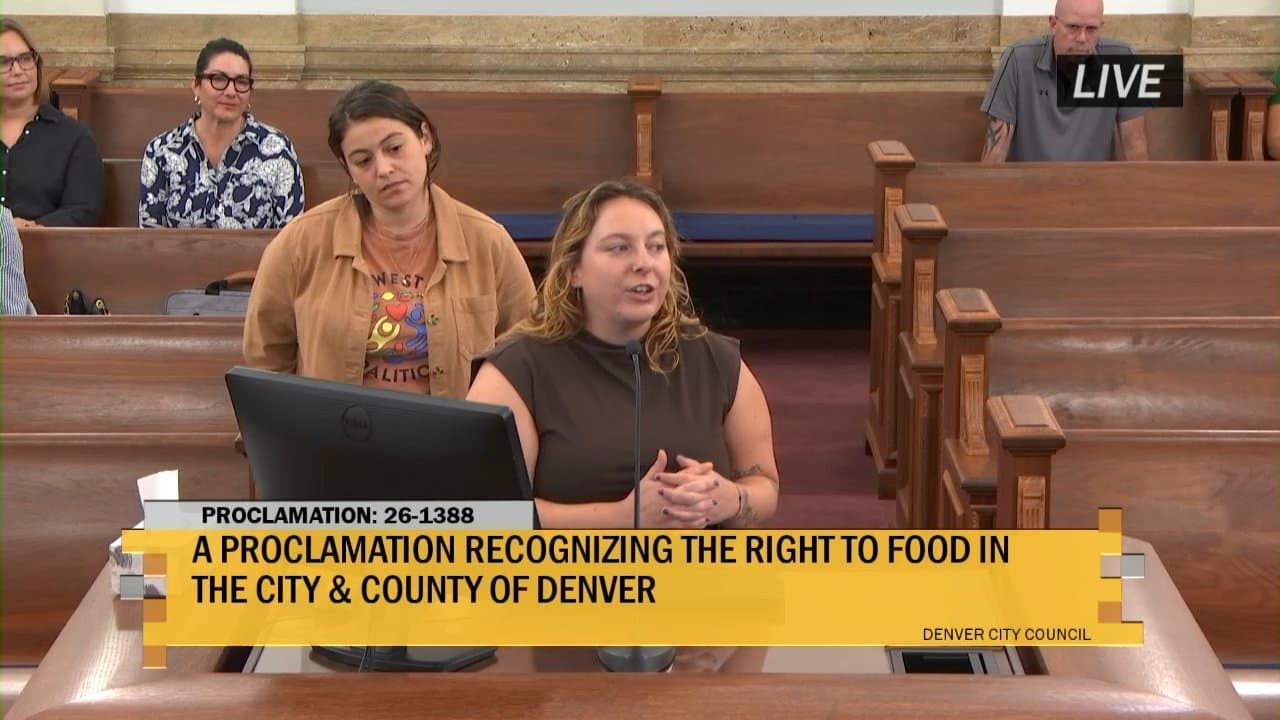
Denver City Council unanimously adopted Proclamation 26-1388, declaring September 2026 as Right to Food Action Month, with five co-sponsors and an extended debate that reflected growing urgency around food access in a city where an estimated 1 in 3 residents struggle to put food on the table.
Why it matters: The proclamation establishes a human-rights framework for food access — language advocates intend to leverage as the city heads into 2027 budget planning. It follows Denver's first Food Justice Summit, held in August 2026.
Where things stand: Multiple council members spoke to the scope of the crisis. Council President Pro Tem Serena Gonzales-Gutierrez drew a direct line between food insecurity and structural poverty: "Poverty is a policy choice. And that's why if we ever want to truly eliminate food insecurity, we must work to eliminate poverty in Denver."
Councilmember Flor Alvidrez highlighted SNAP cuts and federal funding challenges threatening existing safety nets. Councilmember Darrell Watson and Councilmember Paul Kashmann also spoke in support, with Kashmann co-sponsoring the measure.
After the 11-0 vote, two food-system leaders accepted the proclamation and used the moment to press for concrete action. Emily Sedlakowski, senior manager of food access at Metro Caring, framed the proclamation as an actionable tool: "We believe that this gives us a tool in order for our local government to respect, protect, and fulfill every resident's human right to food."
Sydney Skilken, coalition director of the Southwest Food Coalition, delivered the sharpest call for investment, citing a "30% rise in food costs since 2020" and arguing that "philanthropy alone cannot see the building of new and better systems to ensure Denver residents can thrive in this city." Skilken urged council members to champion food systems during 2027 budget planning.
What's next: With budget season approaching, advocates are positioning Right to Food as a spending priority — not just a symbolic declaration. The proclamation's co-sponsors will face pressure to translate the human-rights language into line items.
Housing Stability Plan Passes, but Two Votes Signal Trouble Ahead
Council Resolution 26-1254, approving the Department of Housing Stability's one-year continuation plan for 2027, passed 9-2 — but the dissenting votes from Councilmember Flor Alvidrez and Councilmember Shontel M. Lewis delivered a pointed message: the status quo isn't working.
The basics: HOST is operating under a one-year bridge plan while a new long-range strategic plan is developed, expected by September 2027. The continuation plan extends the department's current goals and framework for one more year.
Why it matters: Two council members publicly broke with the department's approach, arguing that extending the same goals papers over failures the city should be confronting head-on.
Councilmember Alvidrez was blunt: "I just feel that we should be recommitting to where we're failing and not just continuing the same goals for another year."
The other side: Councilmember Lewis voted no as well but drew a distinction — she supports the companion ordinance (26-1253) granting the department authority to run continuation plans in general. Her objection was to the substance: "I don't agree with the strategy here. I understand the need for the continuance, but I don't think we're helping people on this one."
Decisions: Passed 9-2 (For: 9, Against: 2 — Alvidrez and Lewis; Absent: 0).
What's next: HOST must deliver a new long-range strategic plan by September 2027. The two dissenting votes increase pressure on the department to demonstrate measurable progress — or face tougher scrutiny when the plan comes before council.
Pay Reclassification Clears Council, but Worker Access Debate Lingers
Council Bill 26-1190, previously postponed from August, passed 9-2 after the most substantive policy debate of the evening. The bill amends the city's classification and pay plan to convert certain salaried (exempt) positions to hourly (non-exempt) for Fair Labor Standards Act compliance — a necessary legal adjustment that nonetheless raised concerns about who gets locked out of city employment.
Why it matters: While the bill brings Denver into FLSA compliance, the reclassification introduces new education requirements that could create barriers for existing employees and future applicants without four-year degrees.
Where things stand: Council President Pro Tem Serena Gonzales-Gutierrez delivered extended remarks acknowledging the concerns of impacted employees and urging agencies to take proactive steps: "Given the impact this change has on a number of existing city employees, I want to encourage the agencies to provide special attention to meeting with the impacted workers to address duties, titles, and qualification requirements."
Gonzales-Gutierrez noted that the Office of Human Resources plans to recognize industry certifications as alternative minimum qualifications — a concession aimed at softening the blow for workers who entered city employment through experience rather than formal degrees.
The other side: Councilmember Alvidrez requested a vote that was not originally planned and stated she would vote no, arguing the changes move the city in the wrong direction: "These type of changes will make it much harder for working-class people to access jobs in the City of Denver. And I think it's literally the opposite of what we need to be doing."
Decisions: Passed 9-2 (For: 9, Against: 2 — Alvidrez voted nay; Absent: 0).
What's next: Agencies will need to meet with impacted workers to review duties, titles, and qualification requirements. The Office of Human Resources' plans to accept industry certifications as alternatives to degree requirements will be closely watched.
Flynn Stands Alone Against Civic Center Park Redesign
Council Resolution 26-1280, approving a $1.63 million contract expansion with Studio Gang Architects for Phase 1 of the Civic Center Next 100 project, passed 10-1. Councilmember Kevin Flynn called the item out specifically to register his opposition.
Flynn did not mince words: "I think it's an abomination and it's ruining Civic Center, our historic landscaped National Register landscaped park in the middle of the city."
Decisions: Passed 10-1 (For: 10, Against: 1 — Flynn; Absent: 0). Flynn's consistent opposition underscores an ongoing divide over the future of one of Denver's most prominent public spaces.
MWBE Contracting Overhaul Passes Over Equity Concerns
Council Bill 26-1216 repeals and reenacts key articles of the Denver Revised Municipal Code to establish updated Division of Small Business Opportunity programs for minority/women-owned and small business enterprise contracting. The measure passed 10-1.
Why it matters: The ordinance governs equitable access to billions of dollars in city contracts. Martin Gonzalez from Denver Economic Development and Opportunity was present with staff to answer questions.
Councilmember Alvidrez cast the lone no vote, arguing the revisions move in the wrong direction: "I see our goals going down and not supporting more and more small women and minority-owned businesses."
Decisions: Passed 10-1 (For: 10, Against: 1 — Alvidrez; Absent: 0).
Sawyer Flags Venture Capital Pattern in Trash Hauler Deal
Councilmember Amanda Sawyer called out Resolution 26-1290 to put on the record a pattern she finds troubling: 5280 Waste Solutions, which won a city trash removal RFP in 2023, has since been acquired by a venture capital firm. The resolution before council would formally assign the contract to the new ownership entity.
Sawyer recalled that a lower bid from another company was rejected on a technicality and that the city promoted 5280 as a local company worth supporting. She also noted that "the person who used to run Dottie's waste division went to 5280 Waste Solutions."
Sawyer acknowledged the assignment must be approved but warned the pattern is recurring. The item passed on the consent block vote, 11-0.
Minor Items
- Proclamation 26-1389: Council unanimously honored retired Denver Police detectives Abe and Amy Alonso during Hispanic Heritage Month, recognizing Abe's 34-year career — including solving a 28-year-old cold case — and Amy's distinction as one of the first Hispanic female officers in the department. Chief Ron Thomas spoke in support. Passed 11-0.
- Council Bill 26-1127: Updated the Mayor's Youth Commission ordinance to give council a confirming role in appointments. Councilmember Jamie Torres noted a future name change will be proposed by commission youth themselves in early Q1 2027. Passed 11-0 on consent.
- Bill 26-1302: Jefferson Park rezoning (2246 N. Federal Blvd.) introduced; public hearing set for Oct. 19, 2026. Would upzone from G-MX-3 to U-MS-5.
- Bill 26-1291: $500,000 HUD Community Project Funding grant for brownfield remediation planning on a 7-acre Brighton Blvd. site introduced.
- Bill 26-1279: Stormwater and sewer easement relinquishment near Green Valley Ranch introduced.
- Block consent vote on all remaining resolutions, proclamations, and bills for final consideration passed 11-0, including homelessness rapid resolution contracts, eviction legal services, a co-responder grant, the Globeville Levee project, and DIA contracts.