
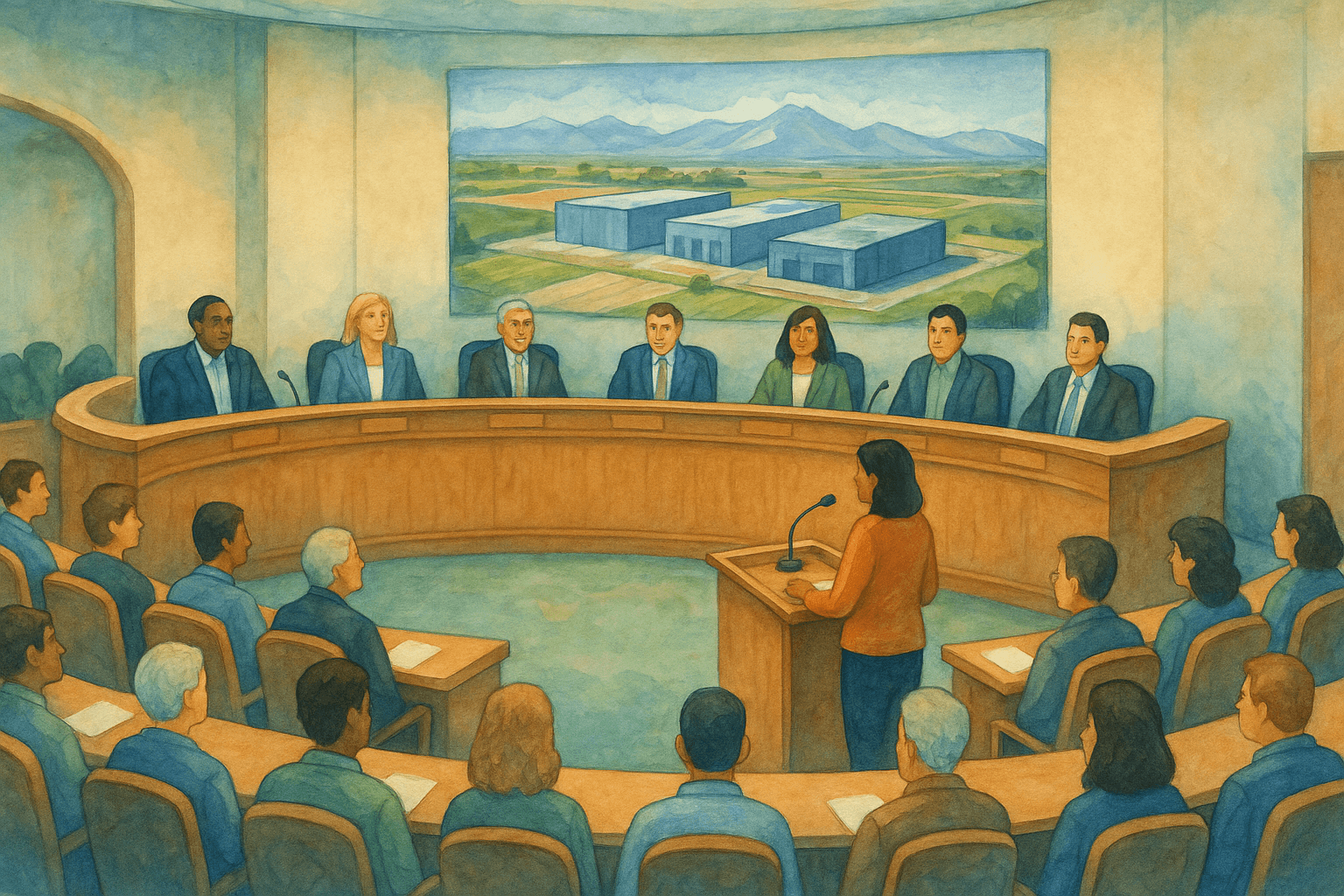
Data Center Panel Caps Outside Experts, Backs Permit Moratorium
Data Center Advisory Committee • Imperial CountyOctober 5, 2026
Locunity is an independent informational service and is not an official government page for this commission. All information is sourced from public footage and an analysis of official agendas with the aid of responsible, fact-checked AI. to report an error or omission.
Imperial County's Data Center Advisory Committee settled its fight over who gets a seat at the table on Oct. 5, 2026. Members rejected a residents-only rule 4-9, then voted 12-1 to allow up to three out-of-county subject matter experts. The committee also unanimously urged the Board of Supervisors to pause data center permits, and county planners explained how one project advanced under zoning rules written before hyperscale AI existed.
- Residents-only membership rule fails 4-9, then a three-expert cap passes 12-1
- Moratorium on data center permits backed 14-0 ahead of a supervisors' vote
- County planner says data centers are by-right in industrial zones under a pre-AI code
- Staff recommends conditional use permits and a dedicated data center ordinance
- Public commenters push for non-voting expert seats and an IID seat
Locals Get the Majority, Experts Keep a Foothold
Why it matters: The vote keeps an out-of-county energy-sector appointee eligible to serve. It also guarantees that Imperial County residents will hold the majority on the body shaping local data center rules.
Where things stand: The committee chair brought forward language drafted by County Counsel. It would have required every member to live in Imperial County to be appointed or remain on the committee. Two current members, the energy and nonprofit appointees, live outside the county.
Chris, Senior Deputy County Counsel, told members that "elector" and "voter" carry defined meanings in the state Elections Code. He also flagged a technical wrinkle: "there is a difference between residence and domicile." Residence generally refers to where a person lives, while domicile refers to the place a person treats as their permanent home.
Members split over the principle. Some argued that outside experts bring knowledge and neutrality, and that a single vote would not change outcomes. Others said the rule should simply be applied, noting that outside experts could still present to the committee without holding seats.
The other side: Public commenters looked for a middle path. Kimberly Palacio, a public commenter, said she preferred residents but proposed letting the non-resident members sit as non-voting members.
Terry Rodriguez, a public commenter and north Calipatria resident, supported subject matter experts only if they have no vested interest in any specific data center. She urged the committee to "have non-voting members that are subject matter experts," including researchers. She also asked that the Imperial Irrigation District (IID), the region's public water and power provider, be added as a non-voting member.
Decisions and stakeholder impacts: The residents-only amendment failed (For: 4, Against: 9). A substitute motion then passed (For: 12, Against: 1). It requires the committee to be made up primarily of Imperial Valley residents and allows no more than three out-of-county subject matter experts. Individual votes could not be tied to specific members.
Residents who wanted a fully local panel lost that fight, but they keep a guaranteed majority. Industry and nonprofit expertise from outside the county stays in the room, capped at three seats. The non-voting IID seat requested by Rodriguez was not acted on.
What's next: The chair indicated a motion on the full bylaws would come at the end of the process. Whether the complete document was formally adopted at this meeting was not clearly stated, and some language may still need counsel review.
Rest of Bylaws Advance, Section by Section
Members also approved several other bylaw sections that govern how the 19-member body operates:
- Section 5: Each appointing authority may remove its own appointees. The Board of Supervisors may fill a city's vacancy if the city leaves it open for three weeks.
- Section 6C: Regular meetings must be set by formal action and noticed under the Brown Act, the state's open-meetings law, at least 72 hours in advance.
- Section 7F: Members may request that items be placed on the agenda.
- Section 9: A member who misses three consecutive meetings without good cause may be referred to their appointing authority for removal.
Sections 5 and 6C passed by roll call, but no clear tally was stated. Section 7F passed by voice vote with no opposition heard. On Section 9, the chair said, "motion's good on 14."
Committee Puts Itself on Record for a Pause
Why it matters: This is the committee's first formal recommendation to supervisors. It was timed to land before the board took up a moratorium the day after the Oct. 5 meeting.
Where things stand: The chair read a resolution asking the committee to "formally support a moratorium on data center permits." The resolution cites pressure on land use, water and energy. It states that current zoning and general plans do not address modern AI data centers, and it calls a pause necessary to develop guidelines, a general plan update and an ordinance.
The other side: One member pressed on what a moratorium would accomplish and how long it would last. The member questioned whether the committee could realistically complete its task. The member asked the county for an achievable assignment, a county expert to assist, and permission to hire outside experts.
Another member responded that no county money is allocated for the committee to hire experts. That member argued a moratorium is warranted regardless of where a project lands, because any data center would draw on IID's grid and Colorado River water.
Decisions and stakeholder impacts: The resolution passed by roll call (For: 14, Against: 0). It now goes to the Board of Supervisors. Water users and residents worried about grid strain gain an advisory voice backing a pause. Developers face the prospect of a halt while the county writes new rules.
The exchange over resources also exposed a real constraint: the committee has no budget for independent expertise. That leaves it reliant on county staff and volunteer presenters.
What's next: The decision now rests with the Board of Supervisors, which was scheduled to consider the moratorium the following day.
A 2017 Code Meets Hyperscale AI
Why it matters: The county's zoning code treats data centers like warehouses. That gap explains how a recent project advanced without a discretionary permit.
Where things stand: Minnick, a planner with Imperial County Planning and Development Services, walked members through the county's planning hierarchy. It runs from the general plan to specific plans, the land use ordinance and the building code.
"Under the current zoning, data centers under the general zoning are allowed in the M-1 zone within a building," said Minnick. Data centers are also allowed outside buildings in M-2 zones. Staff can use a "similarity of use" determination to classify uses the code does not name.
That definition dates to 2016-2017. "We did not anticipate hyperscale AI systems," Minnick said.
Minnick described how the project in question advanced. It moved forward under a notice of exemption, paired with a lot merger and a road abandonment. A court later ruled that the California Environmental Quality Act (CEQA), the state's environmental review law, applied.
The industrial-zone limits still have teeth. Asked about an agricultural-zoned owner converting a shed into a data center, Minnick said staff "would tell you no. Go find an industrial zone 1 or 2."
State rules set the floor: Staff cited SB 887, which requires CEQA clearance even for by-right projects and a water assessment for any data center regardless of size. Staff also cited AB 2619, which defines three tiers:
- Type 1: over 25 megawatts
- Type 2: 2 to 25 megawatts
- Type 3: under 2 megawatts
Whether those tiers measure storage or usage was unclear. Staff said the bills also address long-term power contracts and renewable power, and urged members to mine them for ideas.
Decisions and stakeholder impacts: Staff made several recommendations:
- Require conditional use permits.
- Keep data centers in industrial zones.
- Add a dedicated division to the code, likely in Division 4.
- Reference the state's size tiers.
- Use buffers from residentially zoned areas.
- Avoid conflicts with state law.
- Designate the Gateway and Mesquite Lake areas as preferred locations through specific plan updates.
On rewriting the outdated definition, Minnick said, "I would welcome the recommendation." He cautioned that staff cannot recommend one site over another. Staff also cannot easily calculate proximity to schools without site-specific data.
Minor Items
- Minutes and agenda: Both approved by voice vote.
- Draft guidelines: The Board of Supervisors' June 2026 draft data center guidelines, presented to the board but not approved, were handed to the committee as a starting document.
- Remote attendance: The clerk outlined three pathways for remote participation. A quorum of 10 must be physically present, and annual caps on "just cause" remote attendance disadvantage members without a public location.
- Cleanup costs: Kelly Jordan, a public commenter, asked that the guidelines' decommissioning section, Section 17, address catastrophic incidents and require developers to set aside cleanup money.
Looking ahead: The chair has reached out to IID about its large-load tariff and water, as well as to Good Jobs First, Food & Water Watch and a UC Riverside professor. The chair is also seeking a public health speaker. County departments, including the Air Pollution Control District (APCD), Workforce and Economic Development, Fire and possibly IID, may attend future meetings.