City Council - Jul 14, 2026 - Study Session

City Council - Jul 14, 2026 - Study Session

City CouncilDanvilleJuly 14, 2026

Sources:

Locunity is a independent informational service and is not an official government page for this commission.We use AI-assisted analysis and human editorial review to publish information.

Danville Explores Developer Fees for Public Art, Eyes San Ramon Model

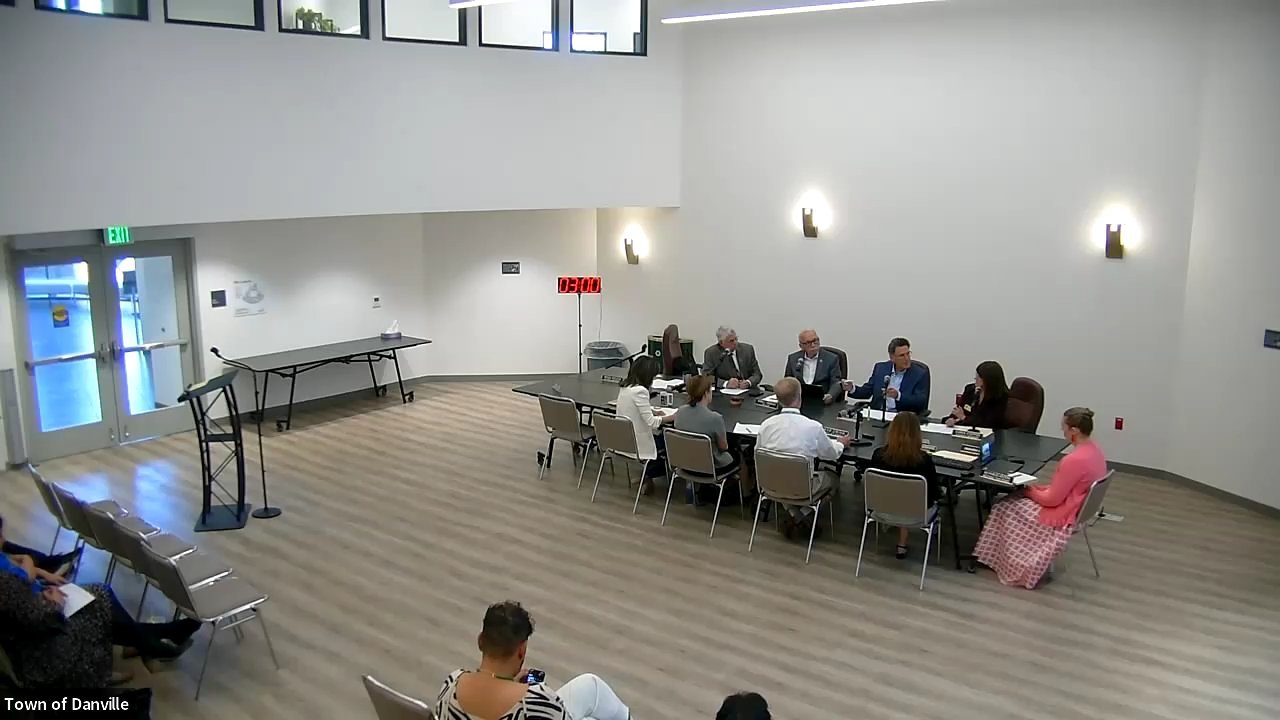
The Danville Town Council took its first serious look at creating a public art ordinance that would require developers to fund art on new construction projects, surveying how five neighboring cities handle the issue and hearing enthusiastic support from a growing local arts community. No votes were taken at the July 14 study session, but the council directed staff to return with deeper analysis and broader stakeholder outreach.

  • Council weighs requiring developer fees on all new construction to fund public art, exploring models ranging from 0.33% to 1% of project costs
  • Vice Mayor Storer proposes flat fee — not percentage-based — after paying $92,000 in art fees on a single San Ramon project with no accountability for where the money went
  • Four local artists and advocates turn out in force, announcing the formation of the Danville Artist Network and pitching projects from heart sculptures to a Danville Bowl memorial
  • Council consensus builds around an arts master plan that would identify locations for art before collecting fees, inspired by San Ramon's evolving approach

A Public Art Ordinance Comes to Danville

Staff presented the council with a comprehensive survey of how Walnut Creek, Dublin, San Ramon, Lafayette and Livermore each require developers to either install publicly visible art or pay fees into a municipal arts fund. The models vary widely — from Livermore's 0.33% of construction costs to Walnut Creek's 1% — but all have survived legal challenges.

The basics: A public art ordinance would require certain development projects to either provide art viewable by the public or pay an in-lieu fee. "In the broadest terms, a public art ordinance requires that certain development projects either provide art that is viewable by the public or pay an in-lieu fee to the local agency, which then uses the funds to provide public art," said Jessica, staff presenter. Courts have treated the requirement like other aesthetic conditions such as landscaping. "There have been a couple lawsuits challenging these ordinances and the cities have won all of them," said Rob, town attorney/staff.

Why it matters: Danville currently has no dedicated public art revenue stream. An ordinance would affect every future development project in town and establish a framework for where and how art appears — a question that drew sharp philosophical debate among council members.

The $92,000 Question: Flat Fee vs. Percentage

The sharpest exchange came over how to structure fees. Vice Mayor Robert Storer, who is also a developer, drew on painful personal experience to argue against percentage-based models. "My project as an example was a $12 million valuation and I paid $92,000 in art fees that I have no idea where the money went," he said of a San Ramon project. He proposed instead a flat common fee — perhaps $500 per project — applied to everything from ADUs to commercial builds, with no exemptions. "If you're an ADU, you're 500 bucks. If you're a room addition, you're $500," he said.

Council Member Mark Belotz pushed back, arguing a flat fee would unfairly equalize small homeowners and large developers. "You don't want to charge a homeowner that's doing a rebuild, adding a bedroom and a bathroom, $500 and then a developer that's putting in 49 three-story townhouses $500," he said, proposing a weighted or tiered structure instead.

"Hidden" Art and the Case for a Master Plan

Mayor Newell Arnerich raised a more fundamental concern: forcing developers to install art on individual sites often produces forgettable results. "Lafayette's a great example. If you go around and look at it, I can show you 10 art pieces. You wouldn't even know they were art. You wouldn't even know they're there. They're hidden. They just don't exist," he said. He advocated for creating an arts master plan that would pre-identify high-impact locations for purpose-built, site-specific installations — collecting in-lieu fees rather than scattering art across development sites.

He also questioned the fairness of placing the entire burden on developers. "If the taxpayers, and if we represent the taxpayers, they want art, who should pay for it? Because we have some way, we've established legally that we have the pure authority to say you're going to pay for it. And that's a hard statement."

Developer Outreach and Arts Commission Role

Council Member Karen Stepper wanted to slow down enough to hear from the people who would pay the fees. "The developers in this area, do they know this is happening this morning? Are they coming in? Have you gotten any feedback?" she asked, urging staff to notify the chamber of commerce and development community before the next session. "I just want to have this next meeting where we have some people from the chamber and from the other community areas. Let them know we're discussing this."

She also emphasized the importance of community input on where art goes, citing the successful relocation of an eagle sculpture at Memorial Park that was not originally planned for its current site overlooking the valley.

All four present council members agreed the Arts Advisory Board should be formally embedded in any ordinance's approval process. Council Member Belotz was direct: "I want to make sure the Arts Advisory Board is part of the process for doing this." Jessica confirmed Danville already has a curatorial committee that includes an Arts Advisory Board representative.

Artists Line Up in Support

Four members of the public spoke, all enthusiastically supportive of expanding public art in Danville.

Taryn Christensen, a local artist and 40-year Danville resident, said she currently shows her art in Benicia because Danville has lacked an active art community, and expressed excitement about the emerging Danville Art Network.

Trish Graham, a longtime resident, advocated for selective, high-quality outdoor sculpture — and pitched placing heart sculptures at major intersections to play on the name of Hartz Avenue. She cautioned against painting utility boxes, calling it too busy for Danville's character.

Carlos Martinez, an interior designer and artist who moved from San Ramon, proposed a community-driven memorial art installation using collected stories and relics from the demolished Danville Bowl, requesting collaboration with the town.

Jim Murphy, a Danville resident since 1991 and artist, made the strongest policy ask: any fees collected should go into a dedicated arts fund, not the general fund. He noted that proceeds from a recent gallery exhibit went into the general fund rather than back into arts programming. Murphy also announced the formal creation of the Danville Artist Network and pledged ongoing community engagement.

What's next: Staff will return to a future study session with a deeper analysis of San Ramon's evolving model and nexus study approach, revenue projections based on upcoming housing element units and historical building permit data, options for common or tiered fee structures, and broader community notification including developers and the chamber of commerce.


Minor Items

  • Council Member Renee Morgan was absent from the study session. All other council members were present.
  • Mayor Arnerich noted that Walnut Creek's ordinance allows in-lieu fees to fund art exhibitions, not just permanent installations — a model that could support rotating art featuring local and regional artists.
  • No formal votes were taken, consistent with the study session format.
Danville Explores Developer Fees for Public Art, Eyes San Ramon Model | City Council | Locunity