
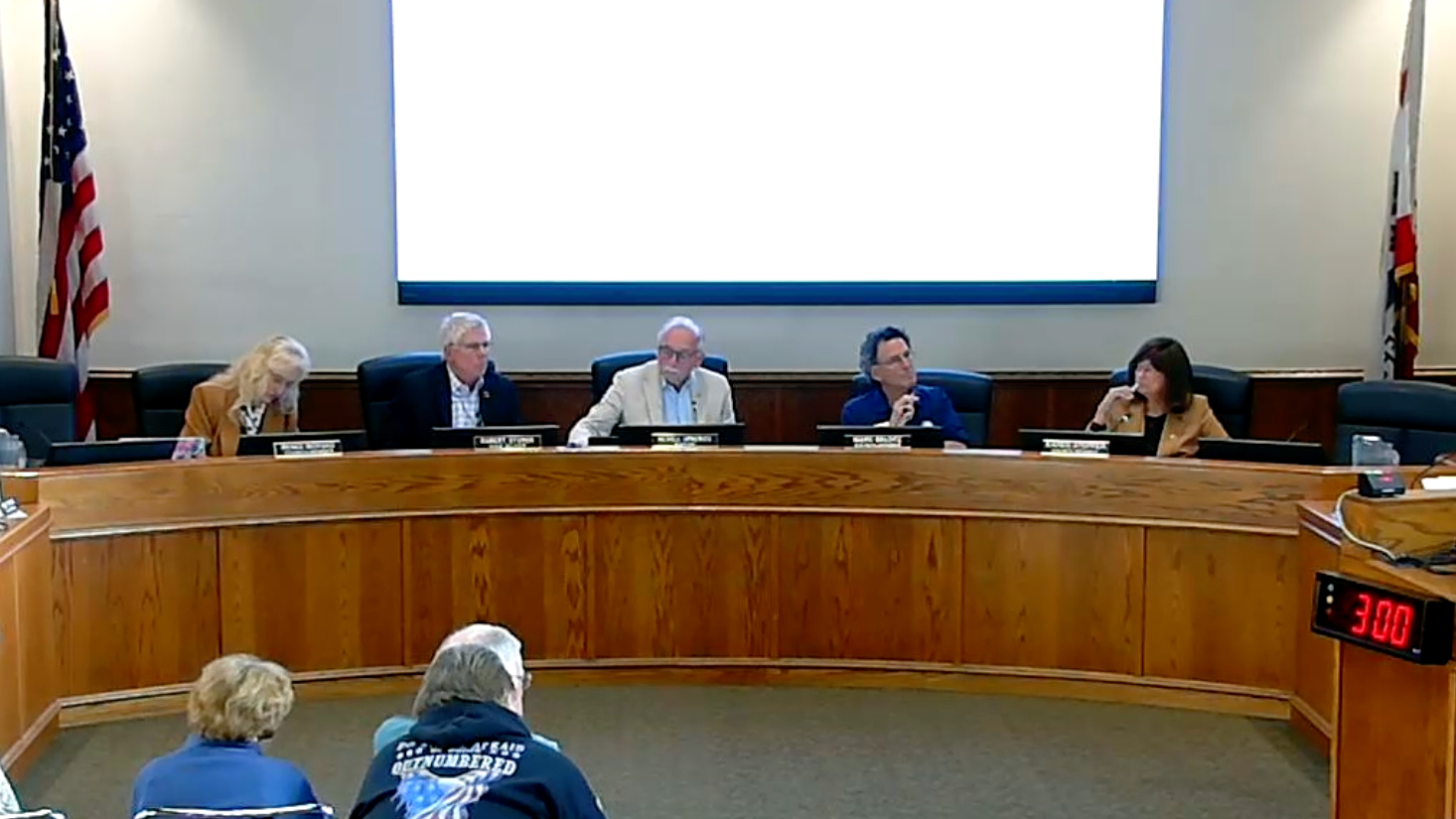
City Council - May 12, 2026 - Special Meeting
City Council • DanvilleMay 12, 2026
Locunity is a independent informational service and is not an official government page for this commission.We use AI-assisted analysis and human editorial review to publish information.
Danville Advances Park E-Bike Rules as Council Splits on Residential Sidewalk Ban
Danville's Town Council held a special study session devoted entirely to e-bike safety, directing staff to draft the town's first park speed-limit ordinance while revealing a politically charged split over whether to extend the existing downtown sidewalk e-bike ban into residential neighborhoods. Nine residents packed the public comment period with emotional testimony and survey data showing nearly 90% of respondents want action — but the council's own members remain divided on how far local authority should stretch while Sacramento stalls.
Council directs staff to draft parks ordinance establishing a 15 mph e-bike speed limit and restricting e-bikes to paved trails in town-owned parks
Residential sidewalk ban debate splits the dais — three members want to see a draft ordinance; Mayor Arnerich and Vice Mayor Storer oppose extending the ban beyond the commercial district
Zero sidewalk collisions on record in Danville, even as community survey of 700+ residents shows 87% support a ban and 89% report feeling personally unsafe
Police launch diversion program offering ticket dismissal for families who complete online safety courses within 30 days
Eight state e-bike bills face heavy lobbying; Mayor reports real legislative change unlikely before next session
E-bike injuries doubled at John Muir Health in the past year, per public commenter citing hospital data
E-Bikes in Danville: A Town Caught Between Data and Fear
The basics: Danville already bans e-bikes on sidewalks in its commercial district. The question now is whether to extend that restriction to residential sidewalks and park paths — and whether the town even has the regulatory tools to make a meaningful difference while the state controls manufacturing standards, sales rules, and age limits.
Town Manager Tai Williams framed the challenge bluntly:
"Fundamentally, once a device capable of traveling more than 30 miles per hour is allowed to be operated by a teenager without any sort of education or guidance, basically it sets us up so that every downstream tool that the town has access to — more local ordinances, signage, enforcement, education — we're just all working around the margins."
Williams detailed what the town has done so far: a "Not My Kid" education campaign, coordination with San Ramon Valley Unified School District, targeted enforcement including impoundment, creation of the first East Bay regional working group on e-bikes, and direct advocacy with state legislators.
Two town commissions offered divergent recommendations after months of study. The Parks Commission recommended restricting e-bikes and e-scooters to paved trails only within town-owned parks and establishing a 15 mph speed limit, consistent with the Iron Horse Trail standard. The Bicycle Advisory Commission recommended against extending the sidewalk ban to residential areas. Williams explained their reasoning:
"The residential sidewalk ban simply shifted the risk from the sidewalk to the street and did not solve the risk."
The commission concluded that pushing young riders off sidewalks and into vehicle travel lanes would trade one danger for another.
Williams also flagged a tension that goes beyond Danville:
"Local feedback pushes the town in one direction — more regulation, more enforcement, more restrictions. Just to be clear, the regional and statewide bike advocates push in a completely opposite direction."
Those advocates oppose a patchwork of city-by-city rules and view e-bikes as a clean transportation alternative that should not be over-regulated.
The Numbers: Collisions and Context
Transportation Manager Allan Shields presented collision data from January 2025 through April 2026: seven e-bike collisions, two e-moto collisions, three scooter collisions, and 13 bicycle collisions. Zero collisions occurred on sidewalks. In most e-bike cases except one, the at-fault party was the motorist. Severe injuries involved riders aged 14, 16, and 69.
Williams cited findings from the Mineta Transportation Institute: motor vehicle crashes are a factor in most e-bike fatalities, and pedestrians struck by e-bikes represent no more than 4% of e-bike incidents. He underscored a counterintuitive point:
"There are zero collisions on a sidewalk with an e-bike — and fatalities, zero."
Enforcement: A New Playbook
Police Chief Tom Rosberg described the department's evolving approach. Officers call parents when they stop youth riders. A new diversion program offers ticket dismissal if parents and children complete an online safety course within 30 days. The department coordinates with the CHP Street Smarts school program and stations officers near schools and parks.
Rosberg said the strategy is working:
"It's better because of the efforts we've put in, because of the enforcement stops, due to Street Smarts. Our young people are getting more used to this language. Our parents are starting to understand more and more of what they can buy."
But Rosberg also put the issue in stark human terms:
"My 13-year-old is taller than my wife, heavier than my wife. You could argue that he can drive a car. But we know the state says that he's not mentally capable to drive a car. Yet we are giving these young people the ability to drive these machines without the appropriate training."
He noted that most crashes occur at conflict points — intersections, crosswalks, and parking lots — not in parks or on sidewalks. Fewer than 10 e-motos have been towed in six months.
Sacramento: Eight Bills, Little Movement
Mayor Newell Arnerich shared intelligence from his role chairing the California League of Cities committee dealing with e-bike legislation. Eight bills are pending, but most face major amendments. Amazon recently announced plans to restrict bike classifications on its sales platform, though enforcement remains uncertain. The mayor has met with six legislators as part of a five-mayor Tri-Valley delegation.
Arnerich expressed frustration at the pace of state action, comparing the regulatory gap to other consumer products:
"If you own a swimming pool and you want to replace your pump, you can't buy that pump unless it meets California standard. All 49 states are blocked from selling that here. But somehow our legislature can't block e-bikes to the right classification."
Williams agreed that the state level is ultimately decisive:
"State legislative action isn't just a placeholder for the town. It's the action that is most likely to produce durable change."
Public Comment: Fear, Frustration, and Data
Nine speakers addressed the council, virtually all demanding stronger local action.
Chuck, a 45-year resident, presented results from a community survey with more than 700 responses. He referenced a southern California case of a 14-year-old killing an 81-year-old man on an e-bike and urged more aggressive action to keep Danville the safest town in California.
Al detailed the survey findings:
"When asked whether they had personally felt unsafe because of an e-bike or e-moto on a sidewalk or park path, over 600 of your neighbors — constituents — 89% said yes."
Overall, 87% of respondents opposed e-bikes on sidewalks and park paths, and 88% supported a prohibiting ordinance.
Bob Mittelstaedt, a retired lawyer from Marin County who counts bikes at schools across four counties, challenged the framing of the problem:
"When we count bikes at schools, 80% of the electric ones are e-motos. They go faster than 20. That's true in every county I've counted in."
He cited John Muir Health data showing e-bike injuries doubled in the past year and urged impoundment at school bike corrals.
Bryan Hughes, a 35-year resident, described daily violations at Osage Park despite clear "no motorized vehicles" signage, calling out Little League umpires riding e-bikes in uniform and parents driving golf carts on park grounds. Catherine Cuevas described being hit by a 13-year-old on a Bonnell Aux e-bike, causing $4,200 in car damage and noting the bike model can be upgraded via app to reach 37 mph. Tracy Davis challenged the chief's assessment that things are improving, describing frequent near-misses on sidewalks along Camino Tassajara and Sycamore Valley.
Carol Dodd offered a counterpoint to the Parks Commission recommendation, noting that restricting e-bikes to paved trails would concentrate them exactly where seniors and families walk. Several speakers shared personal accounts of abandoning trails and sidewalks during peak hours.
Kristin Manning argued the core issue is access: children lack the cognitive development and judgment to safely operate e-bikes, and the solution is not allowing children to have them at all.
The Council Split: Parks Yes, Sidewalks TBD
City Attorney Rob Ewing clarified the legal landscape:
"The vehicle code does not prohibit any kind of bike on sidewalks, whether it's a regular bike or an e-bike. The vehicle code currently specifically allows that strictly to local jurisdictions."
He confirmed the town cannot require e-bike registration — that is a state function — and noted that only two pilot programs statewide (Marin and San Diego counties) currently allow local bans for riders under 16 on Class 2 e-bikes.
Ewing told the council that to move forward, staff needs clear direction:
"If at least three of you want to see a separate ordinance which would adjust sidewalks, we'll put that in front of you. And you would vote it up or down when you see it."
The council reached consensus on education and state advocacy. At least four members supported directing staff to bring back a parks ordinance based on the Parks Commission's recommendation — a 15 mph speed limit and restriction of e-bikes to paved trails.
The sidewalk question proved more divisive. Councilmember Karen Stepper pushed for broader action:
"To look at all these cities that have banned them off the sidewalks and off the paths is an easy answer that says we're not going to wait until someone's hurt."
Councilmember Renee Morgan pressed for creative interim solutions, asking why the town can't require e-bikes to be walked through parks. Councilmember Mark Belotz also wanted to see a draft ordinance.
Vice Mayor Robert Storer acknowledged the urgency but pushed back on the sidewalk ban, calling the idea of forcing 10- to 15-year-olds into street traffic "irresponsible." He also signaled impatience with enforcement, however:
"We've been hearing about e-bikes for so long that it feels like we can't be a nice guy anymore. It almost feels like it's time to really do some heavy enforcement."
Mayor Newell Arnerich was direct:
"I do not want to ban e-bikes on sidewalks other than the commercial area."
What's next: Staff will return with a draft parks ordinance implementing the 15 mph speed limit and paved-trail restriction. Staff will also bring back a draft residential sidewalk ban ordinance for formal consideration — setting up a contested vote where at least two council members have already signaled opposition. The town will continue state-level advocacy through the California League of Cities, though real legislative movement is not expected until the next session.