
Danville Holds $106M Portfolio Course as Rates Rise, Construction Surges
City Council • DanvilleOctober 20, 2026
Locunity is an independent informational service and is not an official government page for this commission. All information is sourced from public footage and an analysis of official agendas with the aid of responsible, fact-checked AI. to report an error or omission.
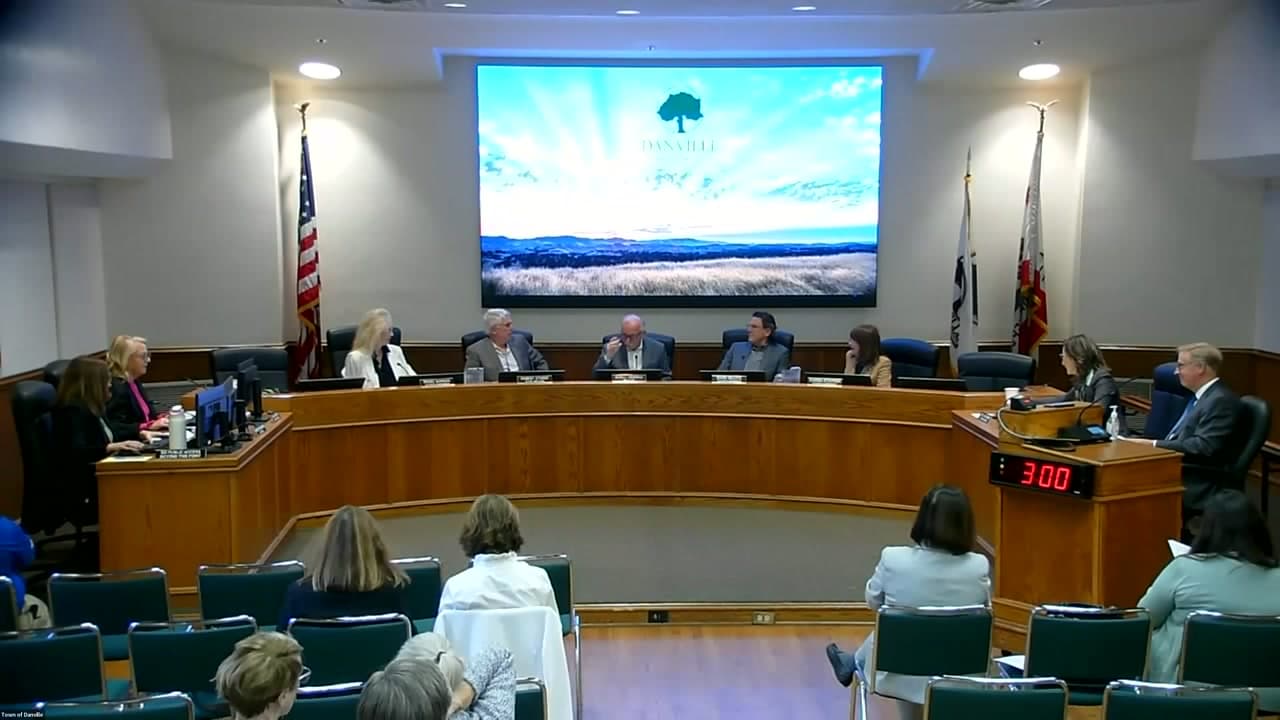
Danville’s roughly $106 million investment portfolio is earning more as interest rates climb, but on paper it is worth less. That was the message from the Town’s investment adviser at the Oct. 20, 2026, Town Council meeting. Council members also heard that state-driven housing projects and storm preparation are stretching an understaffed Development Services Department, and they approved a five-item consent package 5-0 that included an affordable housing grant.
- Portfolio nears $106M with a 4.23% purchase yield and a hold-to-maturity policy that keeps paper losses from becoming real ones.
- Construction surge meets staff shortages: vacancies in all four Development Services divisions as housing projects and El Niño prep pile up.
- Martin Hills Ranch heads to council Nov. 17; e-bike sidewalk rules are expected in early 2027.
- Governor signed 1,040 bills, and council members said none of the transit or housing legislation sends money back to Danville.
- November ballot set: two Town Council seats, 14 statewide propositions and the Measure RTM transit tax.
Rates Rise, Town Holds: Inside the Investment Report
Why it matters: Danville keeps about $106 million in reserves and operating cash invested. Its policy of never selling early means rising rates increase interest income without locking in market losses.
Where things stand: Steve, the Chandler Asset Management representative, told council that the Federal Reserve’s 25-basis-point increase marked a shift from rate cuts to rate hikes. He tied that shift to inflation concerns linked to energy prices. He also described a “butterfly shift” in the Treasury yield curve, which happens when short- and long-term rates move differently from rates in the middle.
The portfolio complies with state law, which ranks the goals as “safety first, then liquidity, and then return,” Steve said. Key numbers:
- Average purchase yield: 4.23%
- Current market yield: 4.87%
- Average credit quality: AA+
- Three-month total return: -0.24%, compared with a realized return of 1.05%
Market value rose to just under $106 million, mostly because of a $5 million cash infusion rather than market gains.
The tension: The negative total return reflects how rising rates reduce the market value of bonds the Town already owns. The realized figure, the income actually collected, stayed positive. Councilmember Renee Morgan asked whether the market swings put the Town’s money at risk.
“Not an impact on principal,” Steve said.
Vice Mayor Robert Storer questioned how the markets and the Fed fit together when rates stay high and spending continues. “Where’s the Federal Reserve chairman in all this?” he asked. Steve walked through his view of the economic logic in response.
Decisions and stakeholder impacts: Council received the report without taking action. Mayor Newell Arnerich emphasized the guardrail that makes the paper losses largely academic: “Our policy is we do not sell. We hold to maturity.” For residents, that means rate-driven dips should not cut into money for Town services. As older holdings mature, they can be reinvested at higher yields. Councilmember Karen Stepper complimented the presentation.
What’s next: Chandler reports quarterly. The full Quarterly Investment Report is posted with the agenda.
Building Boom, Thin Bench at Development Services
Why it matters: Plan checks, inspections and capital projects all run through one department. Vacancies there can slow permits, delay revenue and prolong neighborhood construction disruption.
Where things stand: Development Services Director Diane Friedmann named three drivers of the workload: capital projects, private multifamily construction and the governor’s El Niño emergency. She said the department has been short-staffed since May, with vacancies across all four divisions.
“There is a significant amount of construction that has been going on over the past several months,” Friedmann said.
The project pipeline: Her report covered a long list of work:
- Housing: Walnut Apartments, The Orchard, The Ivy on Diablo Road, Ten Pins Lane, Grand Oak Estates, Evergreen Estates and Martin Hills Ranch, a 21-home project scheduled for council on Nov. 17
- Roads: cold-in-place recycling on Sycamore Valley Road, which grinds and reuses existing pavement on site, plus other pavement projects
- Facilities: a bid for the police fleet garage
- Mobility: the Diablo Road Trail, smart signals and Street Smarts e-bike education
Cheaper storm drain repair: A trenchless storm drain rehabilitation lines aging pipe instead of digging it up. “This will save us over 70% on the cost of the project,” Friedmann said. Councilmember Mark Belotz asked, “How thick is it?” Friedmann replied, “I think that’s an engineering question,” and staff will follow up.
ADU results: “The town distributed $75,000 in funds to build 17 ADUs in Danville,” Friedmann said of the ADU Accelerator program. ADUs are accessory dwelling units, often called backyard cottages or in-law units.
The other side: Arnerich framed much of the housing list as outside local control. “Those are all state projects that we were forced to have to accept,” he said. His comment reflects frustration common in suburban towns where state housing laws have narrowed local discretion.
Decisions and stakeholder impacts: No action was taken. Developers and homeowners seeking permits face a busy, understaffed department. Neighbors near the projects should expect continued construction activity. School families have a stake in the coming e-bike decisions.
What’s next: A Safe Routes to School network study goes to the Bicycle Advisory Commission in November. Recommendations on banning e-bikes from sidewalks are expected at council in early 2027. The department report is posted online.
Sacramento’s Verdict, and No Transit Dollars for Danville
Why it matters: New state laws on housing, e-bikes and public records take effect Jan. 1, 2027. Danville is likely to need to adjust its ordinances, and it gets little transit money in return.
Where things stand: Management Analyst Cat Bravo reported that the Legislature sent 1,160 of 1,846 bills to the governor. “Governor Newsom signed 1,040 bills into law and vetoed 120 bills,” she said.
Bravo reviewed bills the Town tracked on its own and through the Tri-Valley Cities Coalition:
- AB 1408, which gives the Contra Costa Transportation Authority authority to extend its sales tax
- AB 1383 and AB 1997, both vetoed
- Signed bills on e-bikes, remote inspections, townhome streamlining, public records timelines and the California Voting Rights Act
Bravo also previewed the November ballot. It includes two Town Council seats, 14 statewide propositions and Measure RTM, a regional transit sales tax.
The other side: Morgan asked about SB 79 and whether transit legislation returns any money to cities without BART service, noting “we get no funding back.” Bravo replied, “I don’t have anything off the top of my head, but I will do some research.” Another staff member then confirmed that none of the legislation reviewed would bring funds to Danville.
Stepper put the issue in local context. “We decided we were not going to be a transit hub several years ago,” she said.
Decisions and stakeholder impacts: City Attorney Rob Ewing said staff will check the Town’s density bonus and ADU ordinances for required compliance changes. “There’s every year there’s some sort of tweak,” he said. On e-bikes, he noted the Town already “did set a speed limit of 15 miles per hour on all town-maintained trails.” Arnerich praised the five-city Tri-Valley coalition as a way for Danville to amplify its voice in Sacramento.
What’s next: Bravo will follow up on SB 79. Staff will report back on any ordinance updates needed before Jan. 1, 2027.
- Beech Street affordable housing grant approved: Resolution No. 80-2026 sends Low and Moderate Income Housing Fund money to Community Resources, Inc. for 100-200 Beech Street (staff report).
- Downtown outdoor dining ordinance adopted: Ordinance No. 2026-04 (ZTA26-0001) passed with the Oct. 6 minutes, Register of Demands and August Treasurer’s Report. The consent package passed on a motion by Morgan, seconded by Stepper (For: 5, Against: 0, Absent: 0 — Arnerich, Storer, Morgan, Stepper, Belotz).
- Roll-call rules change: A state law effective July 1 requires audible clerk roll calls and roll-call votes on every action.
- Musicals coming to Village Theatre: Vicki Brooks, a former commissioner, plans five shows a week beginning April 9, with free Thursday dress rehearsals for students. “I’ve got 30 on the schedule right now that John Dunn has okayed,” she said.
- Off-agenda project redirected: Arnerich told a speaker that the project they raised is headed to the Planning Commission and should be addressed there.
Looking ahead: Martin Hills Ranch comes to council Nov. 17, 2026. The Bicycle Advisory Commission takes up the Safe Routes to School study in November. Voters will decide two council seats and Measure RTM on the November ballot.