
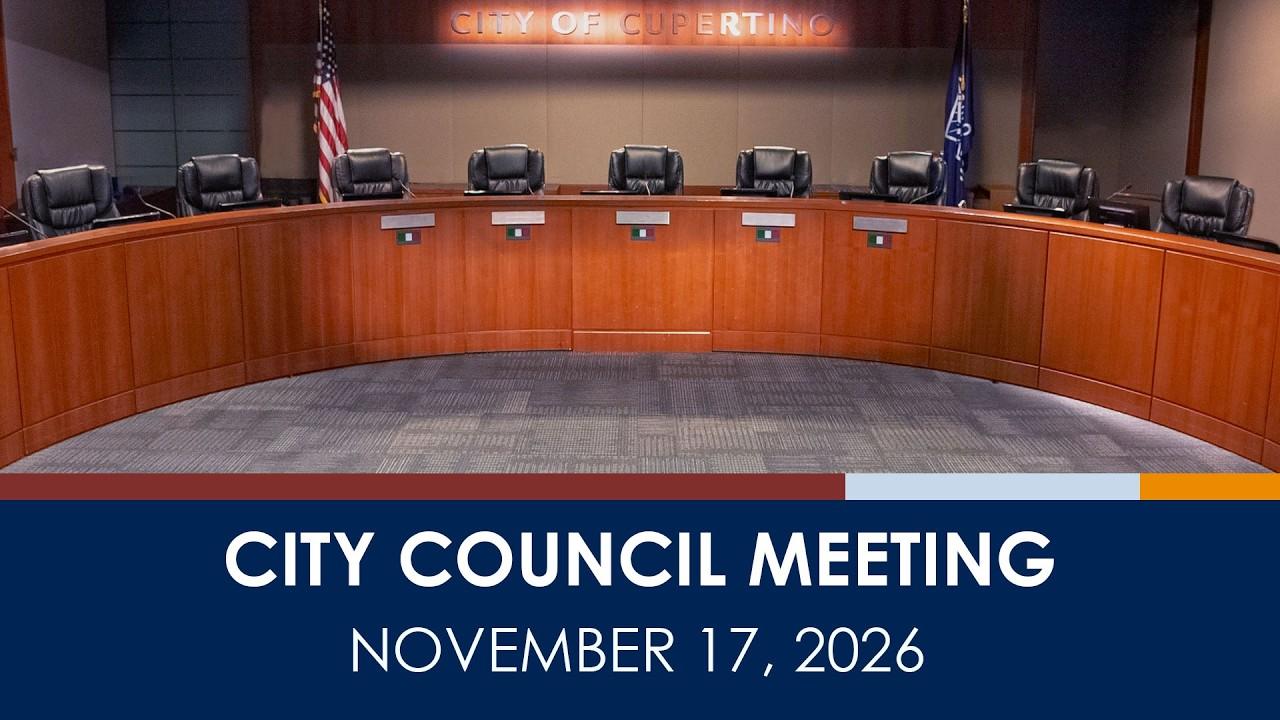
Cupertino Council Caps Festival Fee Waivers After Split Vote
City Council • CupertinoNovember 18, 2026
Locunity is an independent informational service and is not an official government page for this commission. All information is sourced from public footage and an analysis of official agendas with the aid of responsible, fact-checked AI. to report an error or omission.
Cupertino's festival fee waivers, which have grown with little review, now have a ceiling. After a 71-minute debate on Nov. 17, 2026, the City Council directed staff to cap fee waivers at $145,000 and community grants at $35,000. Requests above the cap must come back to the council. In the same meeting, the council rewrote its own rules for remote attendance and ending debate, and it advanced the first council pay raise since 2006.
- Festival fee waivers capped at $145,000 and grants set at $35,000. A bid to leave the policy unchanged failed 2-3.
- Procedures manual overhaul adopted. It covers remote attendance, study sessions and closing debate, and fulfills commitments to the civil grand jury. Councilmember J.R. Fruen voted no.
- Council pay set to rise to $1,200 a month, up from $618.85 and $730.24. The raise takes effect after the November 2028 election.
- New debate-ending rule used the same night it was adopted. An objection to cutting off debate failed 2-3.
Festival Waivers Get a Ceiling
Why it matters: Festival fee waivers and community grants now cost the city about $228,000 a year. Until now, waivers faced little review. A cap means any request beyond the limit becomes a public council decision.
Where things stand: Mayor Kitty Moore and Vice Mayor Liang Chao served as the subcommittee and brought the recommendations. Moore's original request had three parts:
- A combined annual cap of $175,000, starting January 2027.
- Grants set at $32,500 within that total.
- The new grant figure would replace the current $70,000-$90,000 grant range.
Moore put the combined cost at about $228,000: roughly $195,000 in fee waivers plus $32,500 in grants. That total does not include Historical Society funding, staff time or sheriff costs. She also compared Cupertino with Sunnyvale.
Chao presented ideas from the subcommittee's Oct. 14 meeting:
- Tapered funding.
- One festival per organization.
- Annual reports from recipients.
- Public review of waiver applications.
- Pass-through funding.
Chao was blunt about the current process: "whoever applies almost automatically gets approved, and there is no review process," said Vice Mayor Liang Chao.
Moore framed the cap as a forcing mechanism. "But if you put a cap, then it needs to come back when the request comes in to go over that amount," said Mayor Kitty Moore.
Staff acknowledged that the existing range has worked as a soft ceiling. "Council kind of can decide what their final number is going to be, and that has happened multiple times in previous years," said Rochelle Sander, Director of Parks and Recreation.
The other side: Claudio Bono, president of the Cupertino Chamber of Commerce and the Historical Society, disclosed that the Historical Society receives a fee waiver and spoke as a resident. He asked the council to wait for the new council and to count sheriff and staff costs separately. "Waivers are what let large festivals get started, and these festivals are often a nonprofit's main fundraiser of the year," Bono said.
Jean Bedard, public commenter, argued the decision belongs in the next budget cycle. "This lame duck recommendation proposes a $49,000 reduction of over 20%," Bedard said.
Councilmember J.R. Fruen asked whether past applicants had been consulted. Moore said they had not. Councilmember Sheila Mohan questioned the timing and the Sunnyvale comparison. "I am not sure that the practical implications of this change have been well thought out," said Councilmember Mohan.
Councilmember Ray Wang noted that most festival attendees are not residents. He still acknowledged the draw: "Having attended about 40 events and festivals this year, these are definitely economic attractors."
Decisions and stakeholder impacts: Chao opposed a single combined cap and moved separate figures instead: $35,000 for grants and $145,000 for fee waivers. Moore seconded and added a friendly amendment. Applications will be accepted first-come, first-served until the cap is reached. Later requests go to the council.
- Mohan's substitute motion to keep the policy unchanged was seconded by Fruen. It failed 2-3, with Mohan and Fruen voting yes.
- The main motion then passed, with Mohan voting no. The full tally was not clearly announced.
Chao argued that inaction carries its own cost. "According to the trend, it will be like $220,000 next year, and it will just continue to climb if we don't control it," she said.
Nonprofits that rely on festivals as fundraisers face more competition for waivers and more council scrutiny. Taxpayers gain a firm spending limit.
What's next: Staff must revise the community funding policy and the fee waiver provisions.
Remote Meeting Rules Rewritten for Grand Jury
Why it matters: The updates, adopted as Resolution No. 26-052, set three things:
- How councilmembers can join meetings remotely.
- What happens when audio or video fails.
- How debate can be cut off.
The city committed to the civil grand jury that it would implement them by Dec. 15. The item had been postponed from May 5, 2026.
Where things stand: The interim City Attorney presented seven substantive updates. Three were promised to the civil grand jury:
- Teleconferencing conditions under Government Code 54953.
- Quorum rules.
- Procedures for audio-video failures under SB 707.
Asked by Chao, the attorney said none of the changes fixed a past legal violation. "The requirements of the grand jury were all items that we were already following," said the City Attorney.
The key choice was how a member attests that a remote location is open to the public and the agenda is posted. The two options were a simple confirmation or a signed affidavit. An affidavit "is not required by the statute," the attorney said. Moore chose the "confirm" language.
The other side: Fruen pushed back on the format. "I'm just surprised that in the document that's presented to us, there are no options," said Councilmember Fruen. He proposed capping remote participation at three uses.
Fruen also argued that seeing a member's real background shows who may be influencing a decision-maker. Wang and Chao questioned the ban on background-canceling technology. Moore left that language as written.
Jennifer Griffin, public commenter, opposed any cap on remote participation. She asked that Zoom viewers be kept informed during outages.
Chao opposed limits on remote participation. She framed the issue as voter representation: "council members do not represent themselves."
A second fight concerned public comment. A new sentence in Section 8.6 calls political campaigning during public comment inappropriate. "I think that's a violation of the Brown Act and a violation of my First Amendment rights," said Councilmember Wang. The attorney said campaigning falls outside the council's jurisdiction. Moore described the sentence as mild discouragement of conduct such as signs.
Decisions and stakeholder impacts: The council made two other notable changes:
- Study sessions: The council chose Option 1, which makes study sessions discussion-only, with no formal action. Griffin supported this option.
- Closing debate (Section 8.9.7): Limiting debate requires a motion, a second and four votes. Alternatively, the mayor can call the question, and a member can object by motion; overruling the mayor takes three votes.
The new debate rule was used immediately. Moore called the question, and Chao moved to object. The objection failed 2-3, with Chao and Mohan voting yes. The main motion, moved by Moore and seconded by Chao, then passed with Fruen voting no. Chao's friendly amendment was not accepted.
First Council Raise Since 2006 Advances
Why it matters: Council pay has not changed in 20 years. State law (SB 329) allows up to $1,600 a month for a city of Cupertino's size. The raise would apply only to the council seated after the November 2028 election.
Where things stand: Staff recommended Ordinance No. 26-2287, which would set equal pay of $1,600 a month for all five members. Today's two-tier structure was last set in 2006. "Council salaries are set at $618.85 per month for the first term and $730.24 per month upon beginning a second term," said Kirsten Squarcia, Deputy City Manager.
Chao said she brought the item as an outgoing member. "I'm the one who brought this up because I think this is my last year," she said. She proposed tying pay to the Consumer Price Index (CPI) so it would rise automatically. "The law does not provide for an automatic escalator," Squarcia said. Each change must be re-adopted. The attorney suggested reviewing pay every two years.
The other side: Moore noted she did not bring the item and that three members would not benefit. She opposed the raise: "we're sending mixed messages to the public," said Mayor Moore.
Public commenters backed an increase. "I do urge you to increase the salaries," said Bedard. Griffin went further: "I really think that the $1,600 is appropriate."
Decisions and stakeholder impacts: Chao moved a $1,200 substitute, and Mohan seconded. "Fiscally prudent doesn't mean no change for council compensation for 20 years," Chao said.
Wang pressed for closure: "Just agree on a freaking number and let's get going." Moore said she would go along with $1,200. The clerk announced the motion passed with one no vote, but the dissenting member was not clearly identified.
The change has no fiscal impact until after 2028. Compensation could also include allowances that members do not currently receive.
What's next: The ordinance requires a second reading.
Minor Items
- Consent calendar passed 5-0. It included November minutes, October accounts payable, a Cupertino Library lease amendment and Recology's Rate Period Seven schedule. Per the agenda, the Recology rates rise 2.67%, or $1.23 a month for the average resident.
- Emergency Operations Plan postponed. The council voted 5-0 to delay adoption of the 2026 plan to the next regular meeting. No reason was given.
- Small Business Saturday, Nov. 28, 2026. Moore honored Fantasia Coffee and Tea, which she described as the first standalone boba shop in the U.S. She also recognized Bonbon Matcha Cafe.
- Finch Avenue project concerns. Griffin raised concerns about an 8-story, roughly 100-foot apartment complex near Cupertino High School. She asked for underground parking, shade studies, setbacks and community meetings. "We need to be concerned about the traffic around the school," she said.
- Closed session. There was no reportable action on Chen v. City of Cupertino or Yes in My Backyard v. City of Cupertino.
Looking Ahead
- Emergency Operations Plan: returns at the next regular meeting.
- Council salary ordinance: needs a second reading.
- Procedures manual: the grand jury commitments are due Dec. 15.