
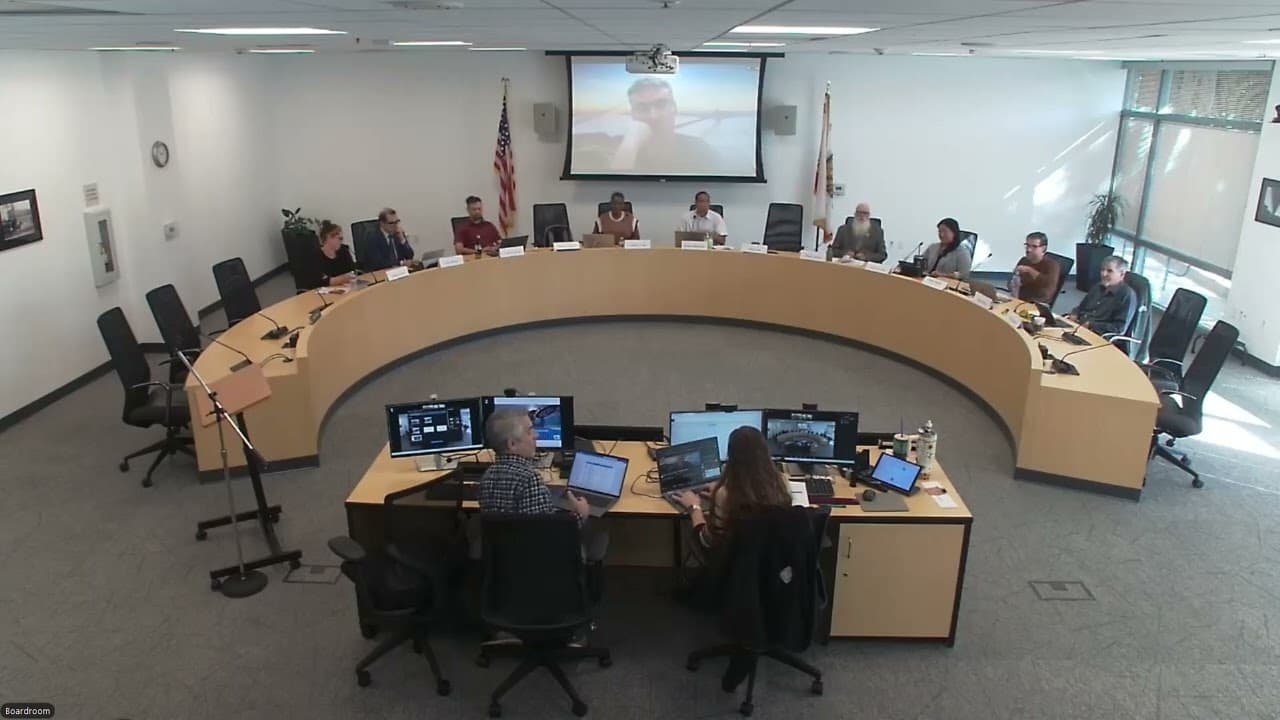
San Pablo Avenue Leads Crowded Field for $43.4M in OBAG 4 Funds
Countywide Active Transportation Advisory Committee (CATAC; formerly CBPAC) • Contra Costa Transportation AuthoritySeptember 28, 2026
Locunity is an independent informational service and is not an official government page for this commission. All information is sourced from public footage and an analysis of official agendas with the aid of responsible, fact-checked AI. to report an error or omission.
Contra Costa's bike and pedestrian projects are chasing far more regional money than exists, and the first meeting of the renamed Countywide Active Transportation Advisory Committee showed how the cuts will fall. Over a session that ran well past its normal end, members reviewed 14 sponsor presentations and heard staff explain how a field of 39 applications was ranked for MTC nomination. San Pablo Avenue, Coggins Drive and Safe Routes to School are at the top.
- OBAG 4 is oversubscribed by about 240%, with roughly $230M requested against a $43.4M formula target
- San Pablo Avenue safety overhaul ranks first; six people have been killed on the corridor since 2021
- 14 projects get advisory design feedback on cyclist space, lighting, speeds and signal detection
- Countywide student Bay Pass and Smart Signals Phase 2 are headed to MTC alongside Safe Routes to School
- Public commenter flags a sequencing risk for construction bids that still lack design funding
Too Many Projects, Not Enough Money
Why it matters: CCTA's ranked list decides which local projects compete regionally for federal OBAG 4 dollars. Most applicants will come up short.
The basics: OBAG 4 is the fourth round of the Metropolitan Transportation Commission's One Bay Area Grant program. CCTA ran a single coordinated call covering five funding sources: OBAG 4, CARE, TFCA and two Measure J programs.
Where things stand: "We, by formula, are supposed to get around $43.4 million from MTC," said Director of Planning Matt Kelly of CCTA. The 39 applications seek about $230M. "We are oversubscribed by about 240%," Kelly said.
Staff narrowed the field to a 23-project shortlist and scored 20 applications by averaging their ranks across six reviewers. The rules include an 80/20 split favoring priority development areas and an 11.47% local match. CCTA will submit a list totaling $52.1M to MTC. That list includes three countywide programs: Safe Routes to School, Smart Signals Phase 2 and the student Bay Pass. It also includes the top-ranked projects down through Concord's Cowell Road project.
CARE and TFCA lists are also due, and TFCA funds will be split among eight projects. Two pots remain undecided. The Transportation for Livable Communities (TLC) program covers West, Central and Southwest County with $33.1M. The Pedestrian, Bicycle and Trail Facilities (PBTF) program holds about $8.4M, and this committee will rank those projects.
The other side: Leah, a public commenter, asked what happens to projects recommended for OBAG construction money when their design and environmental phases depend on later TLC and PBTF decisions. She argued that MTC reviewers might judge those projects not ready for construction.
"We don't think the projects will be at risk," Kelly responded. He said MTC knows about the coordinated call and has not raised a flag. He added that staff will flag funding dependencies and may ask regional transportation planning committees or this committee for matching funds.
Decisions and stakeholder impacts: The committee took no action on this item. Cities with top-ranked projects have the strongest shot at OBAG 4 money. Lower-ranked sponsors will need TLC, PBTF or other local sources to fill their gaps.
What's next: The CCTA board will finalize nominations to MTC by the end of the month, and final regional rankings are expected by early next year. Kelly said staff will work closely with MTC and be transparent with the board on any funding gaps.
San Pablo Avenue Tops the List
Why it matters: The six-mile West County corridor has seen 93 crashes, 91 injuries and six deaths since 2021. It ranked first with the scoring subcommittee of CCTA's Technical Coordinating Committee (TCC).
Where things stand: Greenblatt, presenting for the West Contra Costa Transportation Advisory Committee, described Phase 3 of a multi-phase effort. Partners include El Cerrito, Richmond, San Pablo, Caltrans, AC Transit, BART, WCCTAC and CCTA. The OBAG request would fund:
- New crossings and rectangular rapid flashing beacons
- Pedestrian hybrid beacons and bulb-outs
- Removal of "pork chop" turn islands
- Protected left-turn phases
The project's core pitch is coordination. Jurisdictions acting alone could not deliver consistent improvements along a corridor that crosses multiple cities and a Caltrans-controlled road.
"It is a very, very challenging corridor just with all the jurisdictions," said Committee Member Brianna Byrne, who praised the application. Committee Member Steven Price also thanked the team. He argued San Pablo should function as an urban avenue rather than an arterial relief valve for Interstate 80.
Decisions and stakeholder impacts: No vote was required. West County pedestrians, bus riders and cyclists stand to benefit most. Success will depend on Caltrans and AC Transit staying aligned with the three cities.
Cities Make Their Pitch, Members Probe Designs
Why it matters: MTC requires a countywide bike and pedestrian committee to review Complete Streets checklists for OBAG 4 and CARE projects. "It's not an approval that you are providing today. It's a review and input," Kelly told members. Their feedback can still shape designs before MTC scores the applications.
Where things stand:
- Concord: The Cowell Road project would add a Class 1 path, a sidewalk and raised crossings. Senior Traffic Engineer Aaron Elias called it "about a $10 million project, and we're about 10% design at the moment." A member objected that cyclists lose the road shoulder. Chair Candace Evans pointed to the tradeoff for children's safety near sports fields: "It seems that the bicyclists kind of took the back end on this because you can't do everything."
- El Cerrito: The city presented four BART-area improvements. Price raised a signal-phasing conflict for cyclists at San Pablo Avenue and East Shore Boulevard. El Cerrito said it is handling the issue with Caltrans.
- Lafayette: The Aqueduct Pathway would run from Brown Avenue to Pleasant Hill Road. "We are building the backbone of a future east-west low-stress connection," said Patrick Goyer of the City of Lafayette. Members asked about lighting, landscaping and bollards.
- Hercules: Community Development Director Tim Rood cited 17 crashes over a recent four-year period on Sycamore Avenue.
- Pittsburg: The West Leland Road project seeks $4M in OBAG funds. Members asked about speed limits.
- Pleasant Hill: The city presented Coggins Drive and Contra Costa Boulevard projects with Class 4 protected bikeways. Members asked about U-turns at Boyd Road and Contra Costa Boulevard. "I just wanted to thank you so much for upgrading from Class 3 to Class 4," said Committee Member Dani Lanis.
- Walnut Creek: The Newell Avenue project totals $7.8M.
BART's requests: Monica Maher, BART's group manager of sustainability, sought about $1.2M for LED lighting at Antioch, North Concord/Martinez, Pittsburg Center and Richmond stations. She described "a 1-for-1 replacement of our current lighting." "Is this lighting going to be dark sky compliant?" Price asked. Maher said BART would meet its code. Jumana Nabti of BART's Customer Access and Accessibility Department presented exterior wayfinding signs for five stations. The signs would be retroreflective and graffiti-resistant, use text larger than the ADA minimum, and include tactile bus-bay signs.
Countywide Programs: Student Transit, Safe Routes, Smart Signals
Why it matters: These three CCTA programs would spread benefits countywide, including areas without infrastructure projects. Safe Routes to School and the Bay Pass are exempt from Complete Streets review.
Where things stand: Director of Programs Nikki Filetta described the three parts of Safe Routes to School: Street Smarts, Walk and Roll, and route mapping. A member who runs a Lafayette Walk and Roll program asked for faster turnaround on maps.
Under the proposed Bay Pass program, eligible low-income students would get a Clipper card loaded with a Bay Pass, and school districts would handle sign-up. CCTA is "working on a pilot in Central County using other funds," Filetta said, with the Mount Diablo School District. How the pass would interact with West County's existing low-income student pass is still undecided.
Deputy Executive Director for Projects and Operations Ryan McClain said Smart Signals Phase 2 "would bring the total number of traffic signals to 527 throughout the county." The upgrades include:
- New controllers with video and radar detection
- Emergency vehicle preemption and transit signal priority
- Leading pedestrian intervals
- Video analytics at about 150 intersections to flag near-misses
Of the 228 Phase 2 signals, 196 sit on the county's high injury network. Phase 2 also covers Caltrans ramps not included in Phase 1. McClain said CCTA is not taking over signal timing from cities.
The other side: "This kind of boggles my mind how this actually works," Price said. He questioned whether adaptive signals can keep up with future density. McClain said the new detection should recognize bicycles, but the project does not include an indicator confirming to cyclists that they have been detected.
Minor Items
- Consent calendar: Members approved the July 27, 2026, consent calendar by roll call. For: 9, Against: 0, Abstain: 1 (Weeks, who missed the July meeting), Absent: 2 (Wilson, Keeshen).
- New name: This was the committee's first meeting as CATAC, formerly the Countywide Bicycle and Pedestrian Advisory Committee (CBPAC).
Looking Ahead
Committee Member Chris Weeks suggested discussing SB 1167, a state e-bike bill, if it advances. Kelly said staff and partners are planning a "countywide micromobility summit of sorts," possibly before the committee meets again in October or November.