
EU Climate Pact Ambassadors Pitch Citizen Role, Pivot Toward Adaptation
COP 31 Press Conferences • United NationsNovember 19, 2026
Locunity is an independent informational service and is not an official government page for this commission. All information is sourced from public footage and an analysis of official agendas with the aid of responsible, fact-checked AI. to report an error or omission.
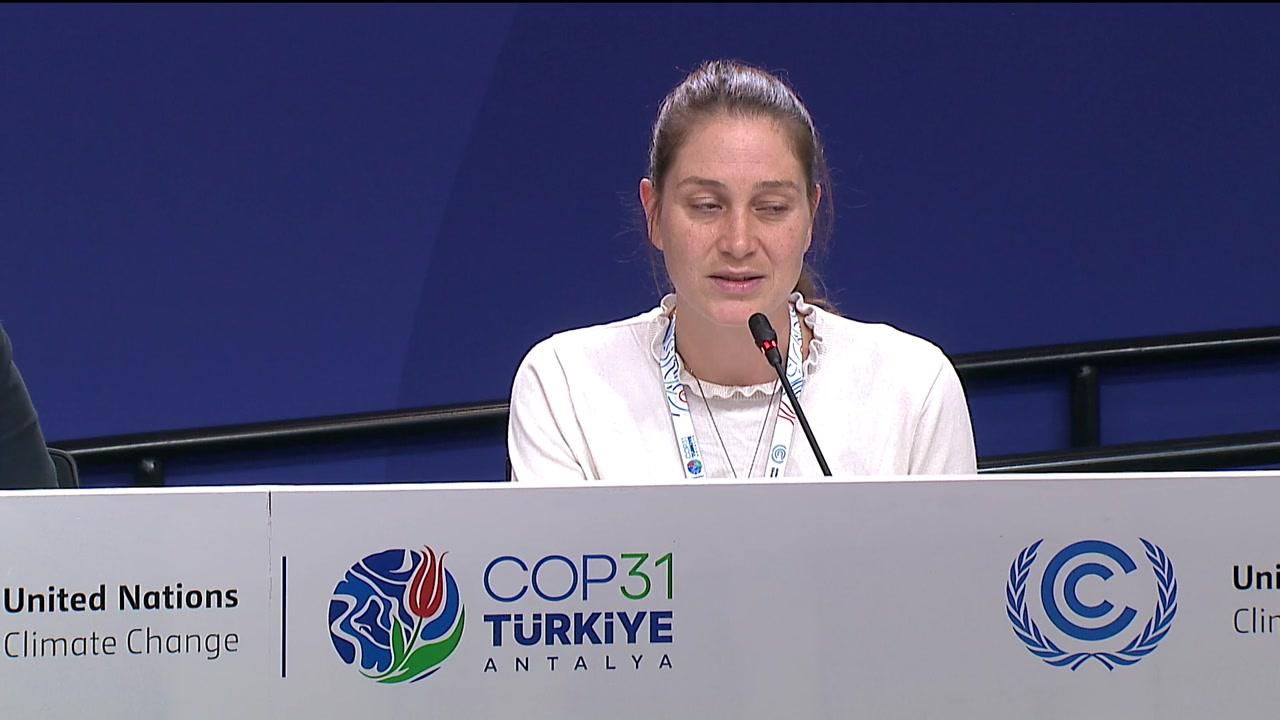
A group of volunteer ambassadors for the European Climate Pact used a Press Club Brussels Europe briefing at COP31 on Nov. 19, 2026, to make the case that ordinary citizens belong in global climate talks. The session was informational, with no decisions taken. It also showed a network shifting its focus from cutting emissions toward adapting to a warming world.
- Over 1,000 volunteer ambassadors, with more than 70 at COP31, pitched the Pact as Europe's "citizen channel" for climate policy.
- Ambassadors from five countries described their work: Germany, Spain, Estonia, Portugal and Belgium.
- A former IPCC vice chair urged keeping the 1.5C ceiling in view and said fossil-fuel-funded doubt campaigns persist.
- Ambassadors said the Pact's role is moving toward adaptation and disaster management.
Volunteers Make the Case for Citizen Climate Voices
The basics: The European Climate Pact launched in 2020 to support the European Green Deal. The Green Deal is the EU's framework for reaching climate neutrality by 2050 and cutting emissions 55% by 2030. The Pact's ambassadors are volunteers, and speakers stressed they were not speaking for the EU.
Why it matters: The Pact presents itself as a way to carry local citizen engagement into EU and global climate policy. Its network now spans more than 1,000 people across Europe, and more than 70 of them attended COP31.
Where things stand: Larry Moffitt, Ambassador, European Climate Pact, and Delegate, Press Club Brussels Europe, moderated the briefing. Isabelle, Ambassador and Country Coordinator for Germany, European Climate Pact, explained the Pact's origins and its link to the Green Deal.
"We are really the citizen channel," said Isabelle.
Three ambassadors then described their work on the ground:
- Carmen Marqués Ruiz, Ambassador (Spain), covered activities in Spain.
- Mark Skljarov, Ambassador (Estonia), covered work in Estonia and Oman.
- José Chen, Ambassador (Portugal), covered activities in Portugal.
Their accounts included public events, municipal workshops and work on health evidence. Valencia, Tallinn University of Technology, the Lancet Countdown, the Covenant of Mayors and Matosinhos all came up.
Decisions and stakeholder impacts: No action was taken. The model depends on volunteer energy rather than formal authority. That gives ambassadors room to work with:
- Municipalities, through workshops and city-level networks such as the Covenant of Mayors.
- Researchers, through ties to universities and health-evidence projects.
- Residents, through public events.
The trade-off is influence. Ambassadors can convene and amplify, but they do not set EU policy.
What's next: Ambassadors signaled upcoming campaigns centered on adaptation, the theme that dominated the Q&A.
From 1.5C to Resilience: Q&A Exposes a Strategic Shift
The basics: The 1.5C ceiling refers to the Paris Agreement goal of limiting global warming to 1.5 degrees Celsius. The Intergovernmental Panel on Climate Change (IPCC) is the UN body that assesses climate science.
Why it matters: The Q&A showed advocates reorienting from mitigation, or cutting emissions, toward adaptation and resilience as warming targets prove hard to meet.
Where things stand: Katerina, a questioner who works for an organization in Brussels, asked how the climate conversation and skepticism have changed over 40 years.
Jean-Pascal, a climate scientist, former IPCC vice chair and European Climate Pact ambassador, answered with three points:
- He compared global temperature to body temperature.
- He noted the progress made since projections issued in 1990.
- He argued the 1.5C ceiling must stay on the table.
He also said the forces behind climate doubt have not gone away. In his view, fossil fuel interests still fund doubt campaigns.
"What has not changed is the tendency to protect one's interests," said Jean-Pascal.
The other side: Monika Simon, an attendee from Hungary, offered the session's sharpest challenge. She questioned whether COP itself is still valid. She also asked whether communities should prepare for shortages rather than keep hoping that targets will be met.
In the exchange that followed, the ambassadors leaned into her framing rather than rebutting it:
- Isabelle cited a new EU Adaptation and Resilience Framework.
- Carmen Marqués Ruiz said the Pact's role is moving toward adaptation and disaster management.
Decisions and stakeholder impacts: No action was taken. The shift still matters for local stakeholders:
- Municipalities and emergency planners may find a more willing partner in a Pact focused on resilience and disaster prevention.
- Mitigation advocates heard a reminder from Jean-Pascal that the 1.5C goal should not be abandoned.
The tension between holding the line on emissions and preparing for impacts ran through the discussion without being resolved.
What's next: Speakers pointed to the EU Adaptation and Resilience Framework and to upcoming Pact campaigns on adaptation as the next arenas for this work.
Looking Ahead
The Pact's pivot toward adaptation is the thread to watch. Watch how ambassadors translate the EU Adaptation and Resilience Framework into municipal workshops and community preparedness. Also watch whether the 1.5C message survives alongside it.