
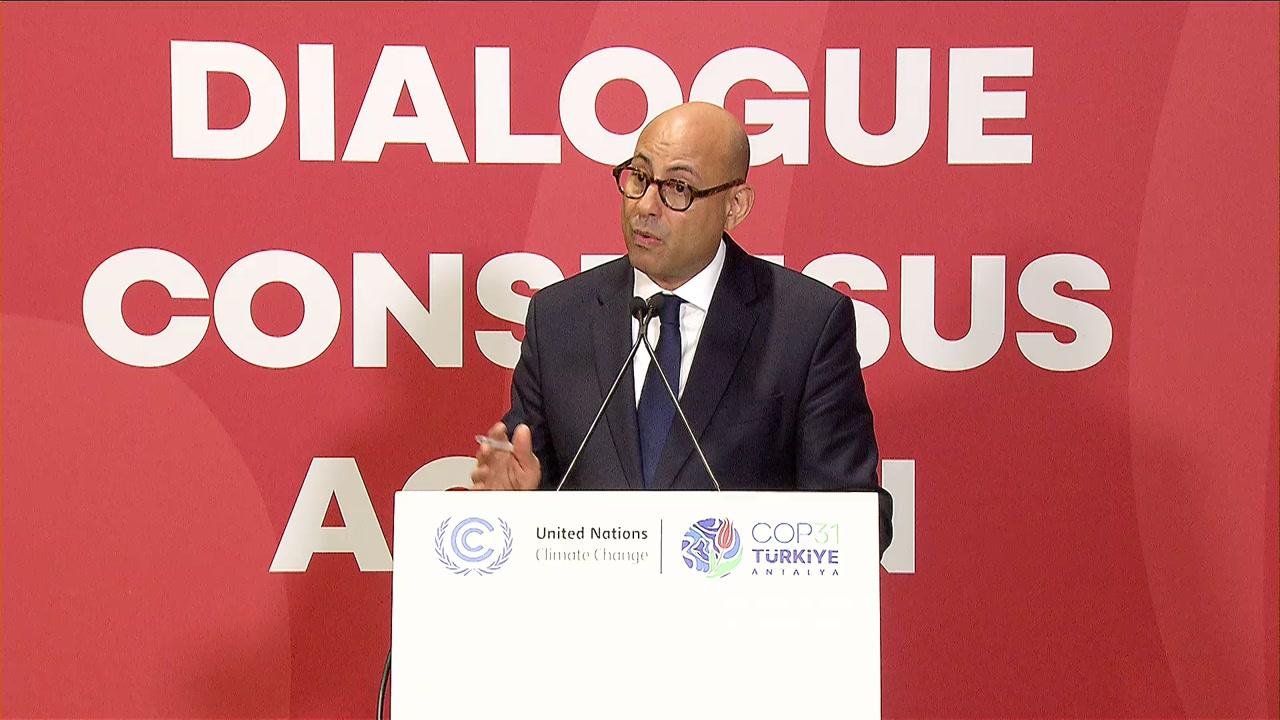
UN Climate Chief Concedes COP31 Shortfall as Consensus Model Faces Scrutiny
COP 31 Press Conferences • United NationsNovember 22, 2026
Locunity is an independent informational service and is not an official government page for this commission. All information is sourced from public footage and an analysis of official agendas with the aid of responsible, fact-checked AI. to report an error or omission.
Talks at COP31 ended without agreement on presidency-led decisions, and the United Nations' top climate official said Nov. 22, 2026, that he shares the disappointment. At a press stakeout, officials defended the consensus rules that govern the talks. They also pointed to a voluntary electrification pledge from countries representing about half the global economy as evidence that action is still moving.
- Consensus process under fire: reporters asked whether unanimity-based talks can still deliver. Officials said reform is a "live conversation."
- Negotiations fell short: COP31 failed to agree on presidency-led decisions, though just transition decisions were made.
- Electrification pledge survives: countries representing about half the global economy back 35% electrification by 2035 or sooner.
- Warming outlook: officials said projections fell from near 5 degrees to 2.6 degrees, but 1.5-degree overshoot is approaching.
Can Consensus Still Deliver? Officials Say Reform Is Live
The basics: Under the UN Framework Convention on Climate Change (UNFCCC), decisions at the annual Conference of the Parties (COP) generally require consensus. In practice, any country can block an outcome.
Why it matters: The breakdown at COP31 gave fresh ammunition to critics who argue that unanimity can't keep pace with a warming planet. The questions from the press room put that tension at the center of the briefing.
Where things stand: Reporters from BBC News and AFP pressed officials on whether the consensus model is still fit for purpose after the talks collapsed. The Q&A drew the most sustained discussion of the briefing. Respondents offered a three-part defense:
- The consensus approach is what delivered the Paris Agreement.
- The process addressed 165 agenda items at COP31.
- Projected global warming has fallen from near 5 degrees to 2.6 degrees, a shift officials credited to progress made under the current system.
The other side: The reporters' questions reflected doubts about whether consensus can meet current urgency after the talks collapsed. Officials did not dismiss those doubts. They said reform is a live conversation, but noted that the UNFCCC is a party-driven process. Any change to the rules would have to come from member governments, not the secretariat.
Decisions and stakeholder impacts: No decisions were taken at the briefing. Officials signaled that the secretariat is engaging external advisers on the process question. The framing suggests the secretariat sees its role as facilitating reform, not imposing it.
The stakes cut several ways:
- Smaller and climate-vulnerable nations rely on consensus as a guarantee that their voice counts.
- Countries pushing faster action see the same rule as a veto that lets holdouts stall outcomes.
- Advocacy groups and businesses tracking the talks face continued uncertainty over whether future COPs can produce binding, ambitious decisions.
What's next: Officials pointed to the engagement of external advisers but did not announce a timeline or a formal proposal. Whether parties take up reform at future sessions remains open.
COP31 Falls Short, but Electrification Signal Holds
The basics: A "just transition" refers to policies that protect workers and communities as economies move away from fossil fuels. Electrification means shifting energy uses such as transportation, heating and industry from burning fuels to electricity. The "1.5 overshoot" refers to warming passing the Paris Agreement's 1.5-degree Celsius threshold.
Why it matters: With 1.5-degree overshoot approaching, the gap between weak negotiated results and stronger voluntary commitments is now the defining story of COP31.
Where things stand: Simon Stiell, Executive Secretary of UN Climate Change, opened the stakeout by acknowledging that COP31 could not agree on presidency-led decisions. Parties did reach decisions on just transition.
"So I share deep disappointment of many," said Stiell.
He then pivoted to the conference's action agenda, the track for voluntary commitments outside the formal negotiated text. He described an electrification target as a market signal.
"Countries representing around half the global economy have said they are charging ahead with 35% electrification by 2035 or sooner," said Stiell.
Decisions and stakeholder impacts: The electrification commitment is a voluntary signal, not a negotiated decision of the parties. For utilities, grid operators, clean energy manufacturers and labor, a 35% electrification benchmark covering about half the global economy points to sustained demand for electric infrastructure. Stiell did not name the participating countries, and they were not identified at the briefing.
For local governments and residents, the practical effect depends on how national governments translate the pledge into building, transportation and grid policy at home.
What's next: No implementation timeline beyond the 2035 target was announced. Watch whether participating governments convert the pledge into domestic policy, and whether the just transition decisions produce follow-up work at future sessions.