
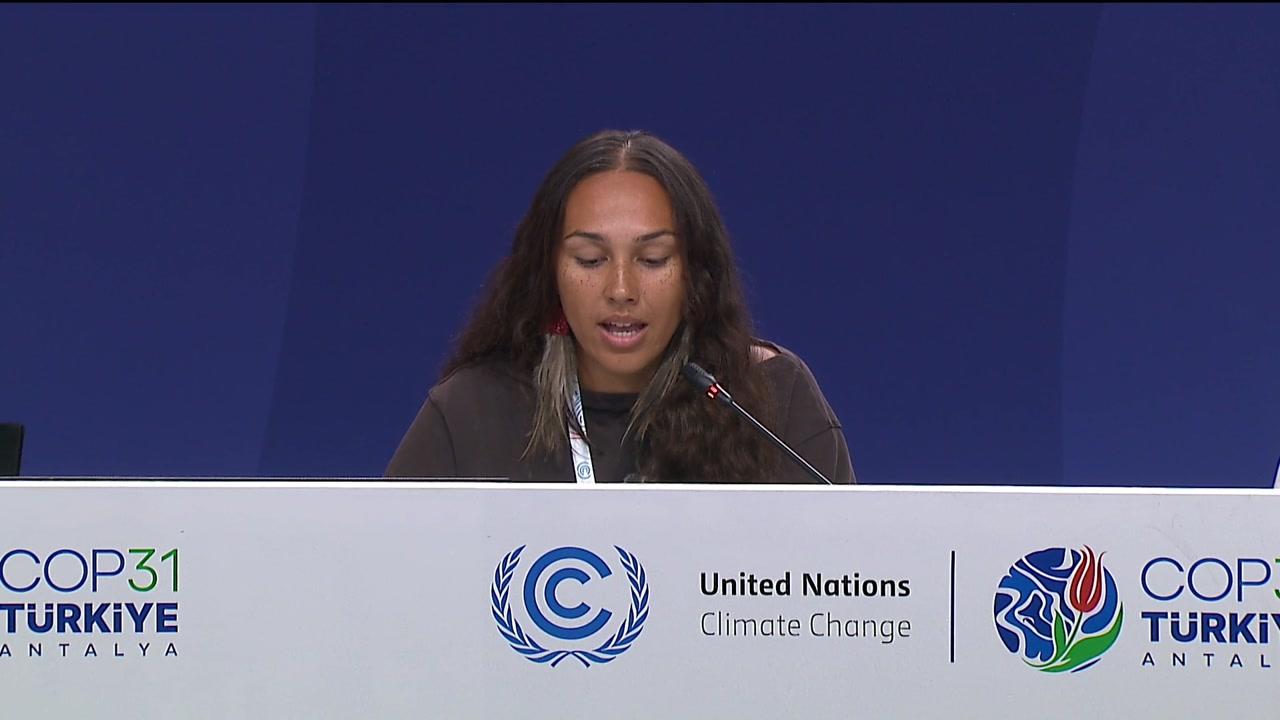
Indigenous Leaders Say COP31 Drafts Erode Their Rights
COP 31 Press Conferences • United NationsNovember 20, 2026
Locunity is an independent informational service and is not an official government page for this commission. All information is sourced from public footage and an analysis of official agendas with the aid of responsible, fact-checked AI. to report an error or omission.
Indigenous leaders used a closing-day COP31 press conference on Nov. 20, 2026, to warn that draft negotiating texts weaken Indigenous rights. They called one change a "red line." Speakers from the International Indigenous Peoples Forum on Climate Change also called climate finance pledges inadequate and Australia's leadership of the talks inconsistent with its fossil fuel approvals.
- Rights language weakened or blurred in draft decisions, speakers say, including the just transition text and the presidency's cover decision
- Indigenous caucus calls a human rights paragraph essential and urges parties to restore it
- Loss and damage fund: $822M pledged against about $2.8B requested
- Adaptation Fund draws about $50M in new pledges, short of a $300M target
- Australia's leadership criticized over new coal and gas approvals and reliance on carbon removal
Rights Rollback Tops Indigenous Concerns
Why it matters: Indigenous speakers argue that when draft texts blur who holds rights, they also blur whose consent governments must seek. Those texts shape how countries carry out climate action on and near Indigenous lands.
The basics: Free, prior and informed consent is the principle that Indigenous peoples must agree to projects affecting their lands before those projects proceed. It is a core element of the UN Declaration on the Rights of Indigenous Peoples (UNDRIP).
Where things stand: Speakers said Indigenous rights language was weakened in several draft decisions. They pointed to the just transition text and the presidency's cover decision, the overarching political statement for the conference. They said some drafts cut references to Indigenous peoples. Others folded Indigenous peoples into a combined category with "local communities."
That merging drew the sharpest objection. It treats groups with distinct rights under international law as one, which speakers said dilutes consent protections.
"That conflation is a red line," said Squakwesh Dunstan Moore (Sunshine), International Indigenous Peoples Forum on Climate Change.
Speakers asked parties to:
- Restore a human rights paragraph in the draft texts
- Recognize Indigenous peoples' distinct rights and knowledge systems
- Keep free, prior and informed consent in the texts
Decisions and stakeholder impacts: The press conference was informational, and no decisions or votes were taken. Indigenous peoples have the most at stake. Speakers said language that groups them with local communities could weaken their standing when governments plan energy, mining and land-use projects under climate commitments. National governments negotiating the texts would carry the obligations the language defines.
What's next: The objections came as COP31 closed and before final adoption of the draft texts. Watch whether a human rights paragraph and distinct Indigenous rights language appear in the adopted decisions.
Finance Pledges Fall Far Short, Speakers Say
Why it matters: Speakers said less than 1% of climate finance reaches Indigenous peoples. Most money flows through governments and large intermediaries rather than to the communities facing climate impacts.
Where things stand: Speakers cited pledges to two funds:
- Fund for Responding to Loss and Damage (FRLD): $822M pledged against about $2.8B requested. The fund pays for climate harms communities cannot adapt to.
- Adaptation Fund: about $50M in new pledges against a $300M target.
Speakers also cited a $21.6M allocation for Nepal. They said little of this money reaches Indigenous peoples directly.
"What has been deposited thus far is peanuts," said Kalea Keno, International Indigenous Peoples Forum on Climate Change.
Decisions and stakeholder impacts: No funding decisions were made at the press conference. By the speakers' figures, loss and damage pledges cover less than one-third of the amount requested. Adaptation pledges reached about one-sixth of the target. Indigenous communities are pressing for direct access to funds rather than money routed through national governments. Donor countries face pressure to close both gaps.
What's next: Speakers framed direct finance for Indigenous peoples as a central demand heading out of COP31.
Australia, Fossil Fuels and Carbon Removal Under Fire
Why it matters: Australia, which led this year's talks, drew pointed criticism from Indigenous speakers. They argued that its domestic fossil fuel approvals undercut its climate diplomacy.
Where things stand: Speakers criticized Australia's new coal and gas approvals and named Chris Bowen, Australia's climate and energy minister. They also faulted:
- The "35 by 35" electrification pledge
- Due diligence language on mineral value chains, the supply chains for minerals used in clean energy
- The exclusion of civil society from negotiating rooms
Speakers called for a fossil fuel phase-out. They opposed relying on carbon removal, including direct air capture, carbon capture and geoengineering, in place of actual emission cuts. They argued these approaches could prolong fossil fuel production.
Thomas Joseph of the International Indigenous Peoples Forum on Climate Change called for real emission reductions. He urged governments to "allow Indigenous people to lead."
Decisions and stakeholder impacts: No formal action was taken. Fossil fuel producers and carbon removal developers benefit if technology-based approaches remain central to national plans. Indigenous communities near extraction and mineral sites have the most to lose, speakers said, if due diligence rules stay weak.
What's next: Speakers tied their demands to the Just Transition Work Programme, the UN track that addresses how workers and communities shift away from fossil fuel economies.
Minor Items
- Imprisoned co-chair: Taily Terena, moderator and representative, International Indian Treaty Council, noted that caucus co-chair Daria Egereva remains imprisoned.
- Speakers: Tamika Sadler, Brianne Bishkoul and Onel Masardule also spoke for the International Indigenous Peoples Forum on Climate Change.
Looking Ahead
The draft texts had not been adopted when the press conference ended. Readers tracking Indigenous rights in climate policy should compare the final COP31 decisions against the caucus demands: a restored human rights paragraph, distinct Indigenous rights language, free, prior and informed consent, and direct finance.