
Climate Refugee Pavilion Launches as Guest Warns Disaster Fund Nearly Empty
COP 31 Press Conferences • United NationsNovember 20, 2026
Locunity is an independent informational service and is not an official government page for this commission. All information is sourced from public footage and an analysis of official agendas with the aid of responsible, fact-checked AI. to report an error or omission.
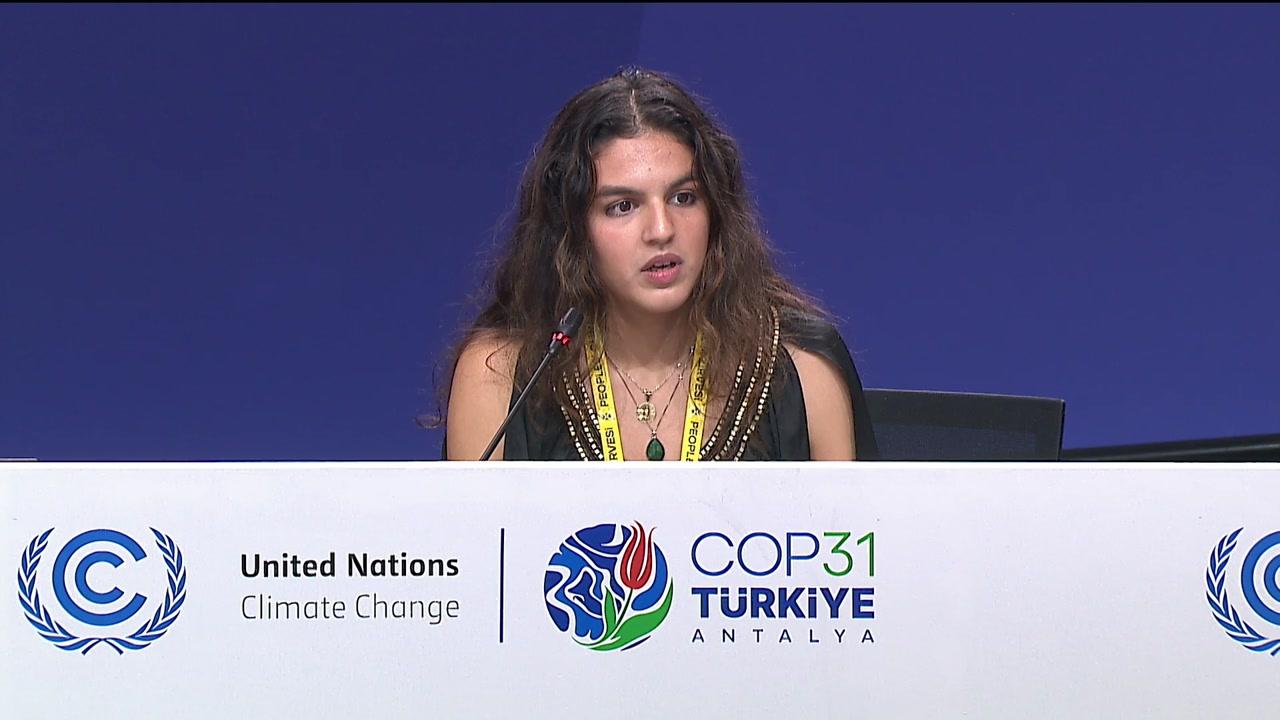
A press conference near the close of COP31 on Nov. 20, 2026, launched the Climate Refugee Pavilion. Organizers framed it as a lasting platform for people displaced by climate disasters, people who still have no legal status as refugees. Speakers tied that gap to a Fund for Responding to Loss and Damage that a special guest described as "nearly empty." No votes were taken, but the event showed how far global climate finance trails the scale of displacement.
- Climate Refugee Pavilion launched with a youth ambassador program and scholarships for 20 to 30 young people.
- Climate refugee is not a recognized legal status, organizers said, leaving displaced people without asylum protections.
- $822.71M pledged, $485.97M paid in to the Loss and Damage Fund, the moderator said.
- A $120 billion adaptation promise was removed from recent negotiating text, according to a guest speaker.
- A Haitian youth representative said funding stalls with intermediaries instead of reaching displaced communities.
A Pavilion for People the Law Doesn't Recognize
The basics: The Climate Refugee Pavilion is a new platform for people displaced by climate impacts. Organizers launched it officially at this COP31 press event.
Why it matters: International law does not define climate-displaced people as refugees. Without that status, they lack the asylum protections given to people fleeing persecution. Organizers want grassroots voices from affected communities heard in negotiations that have mostly left them out.
Where things stand: Geneviève Lavelle, who presented the pavilion, described three pieces of work:
- A coalition behind the pavilion.
- Technology and data tools to count displaced people.
- A Youth Ambassador Program offering scholarships for 20 to 30 young people to attend next year's COP in Addis Ababa.
Lavelle said climate refugee is not a recognized status. She cited two recent developments as signs of how unsettled protections are. One was the end of U.S. Temporary Protected Status, a designation that has allowed some people from disaster-hit countries to stay in the United States. The other was an agreement between Tuvalu and Australia on statehood, a sign that low-lying nations are already planning for the legal consequences of losing territory.
The other side: Reporters pressed on whether the law itself should change. Utku, a journalist with Istanbul climate media, asked whether it is time to redefine "refugee" in international law to include climate. Another questioner asked whether any organization is responsible for prevention strategy, which would aim to keep people from being displaced in the first place. Lavelle took both questions, and the exchange showed that no single international body currently owns either the definition or the prevention agenda.
Decisions and stakeholder impacts: No formal action was taken. The pavilion's value depends on whether it outlasts COP31, a goal organizers stated directly.
- Displaced communities and youth advocates gain a recurring channel into negotiations through the ambassador program.
- Governments face growing pressure to address legal status, as the Tuvalu–Australia arrangement shows some are already doing bilaterally.
- Humanitarian agencies stand to benefit from better displacement counts, since what isn't counted rarely gets funded.
What's next: Scholarship recipients are slated to attend next year's COP in Addis Ababa.
Loss and Damage Money Lags the Disasters
Why it matters: Speakers framed displacement as what happens when adaptation and loss-and-damage finance fail to arrive in time. For families in places like Haiti, delayed money means repeated moves, not one-time relief.
Where things stand: The moderator said the Fund for Responding to Loss and Damage has roughly $822.71M in pledges but only $485.97M paid in, leaving about $337M outstanding. The moderator also said $342M is available against $176M in requests from 119 countries. The moderator presented displacement statistics alongside those finance figures.
Kadesha Bertilus, a Haitian youth representative connected to the International Organization for Migration, called for displaced people to be counted, funded and met with a concrete response. She described displacement as a cycle, not a single event:
"People don't just move once," said Bertilus.
Bertilus said funds stall with intermediaries and do not reach local communities. Her point goes beyond how much money exists. Even pledged dollars that are paid in may not reach the neighborhoods where people are uprooted.
The other side: A special guest speaker offered a bleaker view of the negotiations themselves. The guest said the $120 billion adaptation promise had been removed from recent text and that there is no commitment to scale up loss-and-damage finance.
"Loss and damage fund is nearly empty," said the special guest.
That assessment sits uneasily beside the moderator's figure of more money available than requested. The difference may reflect pledges versus cash on hand, or the gap between formal requests and actual need. The speakers did not reconcile the two.
Decisions and stakeholder impacts: No funding decisions were made at this event.
- Frontline communities carry the cost of the gap between pledges and payments.
- Intermediary organizations face scrutiny over how quickly money moves to local groups.
- Donor governments face pressure over unpaid pledges.
What's next: Journalist Joydeep Gupta of the Earth Journalism Network asked for gender and age breakdowns of the displacement figures. The moderator promised to send them by email.
Minor Items
- Nepal on the marquee: The event was billed around Nepal's case, but discussion focused mostly on Haiti and global finance.
- Coping question: A reporter asked how the world will cope with rising numbers of climate refugees and casualties.
- Introductions: The moderator introduced a speaker identified as Gemma during opening remarks.
Looking Ahead
Watch whether the pavilion's displacement-counting work and youth ambassadors show up at next year's COP in Addis Ababa. Also watch whether unpaid Loss and Damage Fund pledges close before then.