
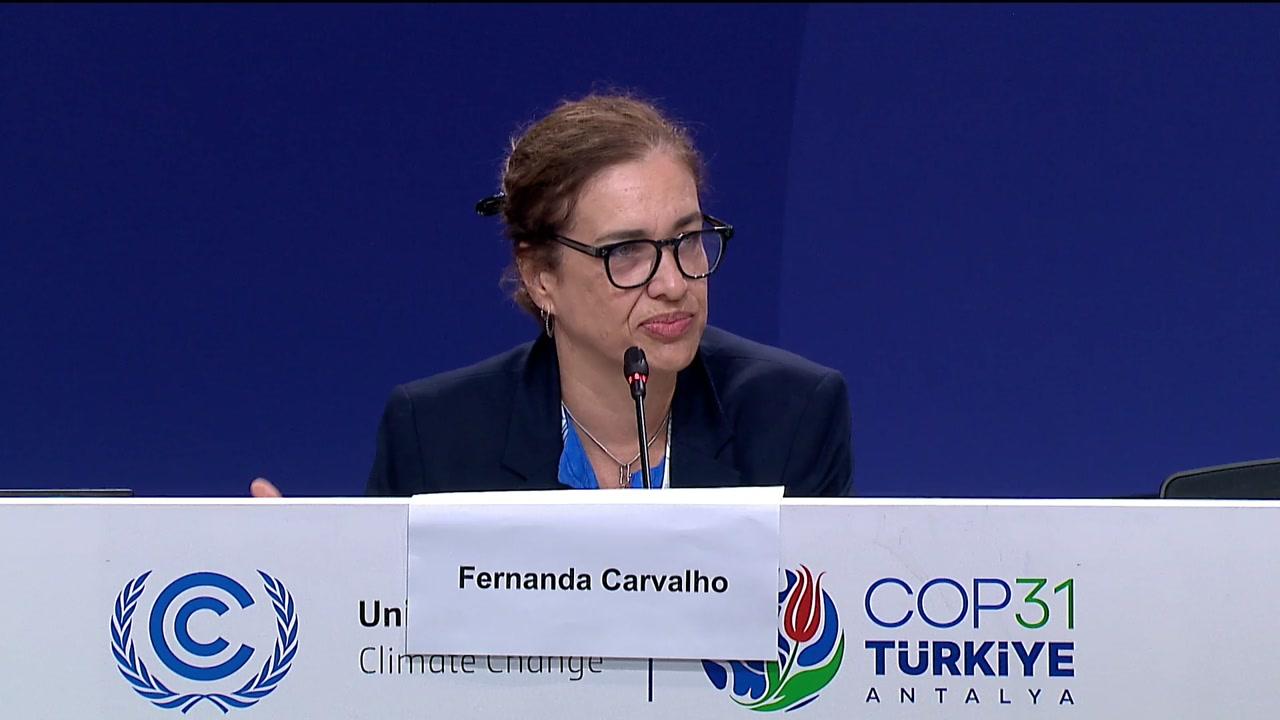
WWF Presses COP31 to Strip Carbon Capture Language, Halt New Arctic Drilling
COP 31 Press Conferences • United NationsNovember 17, 2026
Locunity is an independent informational service and is not an official government page for this commission. All information is sourced from public footage and an analysis of official agendas with the aid of responsible, fact-checked AI. to report an error or omission.
With four negotiating days left at COP31, WWF experts used a Nov. 17, 2026, press briefing to target what they see as a loophole in the summit's draft cover decision: language that blurs carbon capture with carbon removal. The group also pressed for no new Arctic oil and gas, a firmer commitment to 1.5C, science-aligned timelines and ocean action. No decisions were made at the briefing, but it lays out the asks NGOs will measure the final text against.
- WWF wants CCUS references removed from the COP31 cover text and warns that the draft conflates capture with removal.
- No new Arctic oil and gas is framed as a test of whether countries will actually implement the fossil fuel transition.
- Consensus is "far" on a 144-article, 18-page cover text, though WWF calls the draft a good basis.
- WWF's lead scientist says current policies point to about 2.8C and that the chance of 1.5C with limited overshoot is gone.
- Pacific advocates want ocean progress counted in the next Global Stocktake.
The Carbon Capture Fight: Capture Is Not Removal
The basics: Carbon capture, utilization and storage (CCUS) traps emissions at smokestacks. Carbon dioxide removal (CDR) pulls carbon already in the atmosphere back out. WWF says the COP31 cover text treats the two as interchangeable.
Why it matters: WWF warns that the wording could let carbon capture stand in for actual emission cuts. It could also divert scarce climate finance toward capture projects.
Where things stand: In response to reporters' questions, Fernanda de Carvalho, Head of Policy for Climate and Energy, WWF International, and Stephanie Rowell, Global Climate and Energy Lead Scientist, WWF International, drew a sharp line between the two approaches. They said CCS plays a negligible role in decarbonizing power. They also said the draft text conflates capture with removal. WWF's ask is direct: take CCUS references out of the cover text and keep CDR as a distinct category. The speakers highlighted land-based removals of about 2 billion tons as part of the removal picture.
The Arctic as a test case: Suzanne Wold, Fossil Fuel Transition Lead, WWF Norway, framed new Arctic drilling as a test of whether governments will act on their commitment to transition away from fossil fuels. She cited European Union policy and Norway, a major Arctic producer, as reference points. She also rejected the idea that drilling is a separate issue from nature protection.
"No new Arctic oil and gas is not separate to ocean or conservation issues," said Wold.
Decisions and stakeholder impacts: Nothing was decided at the briefing. If WWF's asks prevail, producers in Arctic states would face tighter political scrutiny of new licensing. Backers of capture technology would also lose cover-text language that could legitimize capture as a climate solution. Climate-vulnerable countries competing for limited finance could benefit if money is not routed to CCUS. WWF's framing sets up a clear benchmark: whether the final text separates capture from removal.
What's next: Negotiators have four days to settle the cover text. Watch whether CCUS language survives the next draft.
The Cover Decision: A Good Basis, but Consensus Is Distant
Why it matters: The cover decision is the summit's political headline document. WWF says it is where commitments on overshoot, finance and fossil fuel roadmaps would be signaled.
Where things stand: De Carvalho noted that the COP's motto is dialogue, consensus and action, but said consensus remains far off. The current cover text runs 144 articles over 18 pages. WWF considers the draft a good basis for negotiation. The group's asks for the final version are:
- Reinforce the 1.5C goal and minimize overshoot.
- Include roadmaps on transitioning away from fossil fuels and on forests.
- Create a climate finance work programme.
- Reaffirm the tripling of adaptation finance, with a clear baseline.
That last point matters because a pledge to "triple" funding means little without an agreed starting figure to triple from.
De Carvalho called on both COP31 presidencies to share responsibility for the outcome.
"It's one COP, 2 presidencies, but one COP," said de Carvalho.
Decisions and stakeholder impacts: This was an advocacy briefing, not a negotiating session. The asks favor developing countries that need adaptation finance and push wealthier emitters toward firmer fossil fuel commitments. The adaptation baseline request gives finance recipients a concrete way to hold contributors accountable.
What's next: Consensus has to be reached in the summit's final four days. WWF's list offers a checklist for judging the final text.
The Science: 1.5C With Limited Overshoot Is Gone
Why it matters: Updated pathways require steep emissions cuts and a sharp decline in fossil fuel use. WWF also flagged that the credibility of scientific institutions is being questioned.
Where things stand: Rowell pointed to accelerating warming, a strong El Niño and weakening natural carbon sinks. She said the chance of holding warming to 1.5C with limited overshoot is gone. Current policies point to about 2.8C.
The pathways she cited are steep:
- 18% emissions cuts by 2030
- 45% by 2035
- 69% by 2040
Under those pathways, fossil fuel use falls about 43% by 2035 and electrification rises 35%.
Rowell insisted that the timing of the next Intergovernmental Panel on Climate Change (IPCC) assessment must allow it to inform the next Global Stocktake, the Paris Agreement's periodic review of collective progress.
"Decisions must be and always be grounded in science because science underpins society," said Rowell.
Decisions and stakeholder impacts: If the IPCC report arrives after the stocktake, countries would set their next targets without the latest science. That gap would most affect frontline nations pressing for faster cuts.
What's next: Watch for any language in the final decisions that aligns the IPCC timeline with the Global Stocktake.
Oceans: Promises Must Reach Reefs and Villages
Where things stand: Alfred Ralifo, Conservation Director, WWF Pacific, asked COP31 to turn ocean commitments into action. He specifically asked negotiators to strengthen the ocean-climate dialogue and include ocean progress in the next Global Stocktake. He cited the Pacific's Taku Pakaso Declaration and the marine "30 by 30" goal of protecting 30% of the ocean by 2030. He also called for finance that small island developing states (SIDS) can actually access, and for recognition of traditional knowledge.
Why it matters: Pacific communities say pledges are meaningless unless funding reaches local reefs and villages.
Ralifo also drew a firm line on what ocean action can achieve.
"Ocean action can complement but never substitute for deep emission cuts," said Ralifo.
Decisions and stakeholder impacts: Easier access to finance would directly benefit Pacific island governments and coastal communities. Counting ocean progress in the stocktake would make ocean pledges measurable.
Looking Ahead
With four days left at COP31, WWF has staked out clear benchmarks for the final cover decision:
- Whether 1.5C is reinforced
- Whether overshoot is minimized
- Whether CCUS is separated from CDR
- Whether the adaptation finance tripling comes with a baseline
- Whether the IPCC timeline aligns with the next Global Stocktake
Readers tracking the outcome should compare the final text against each of these asks.