
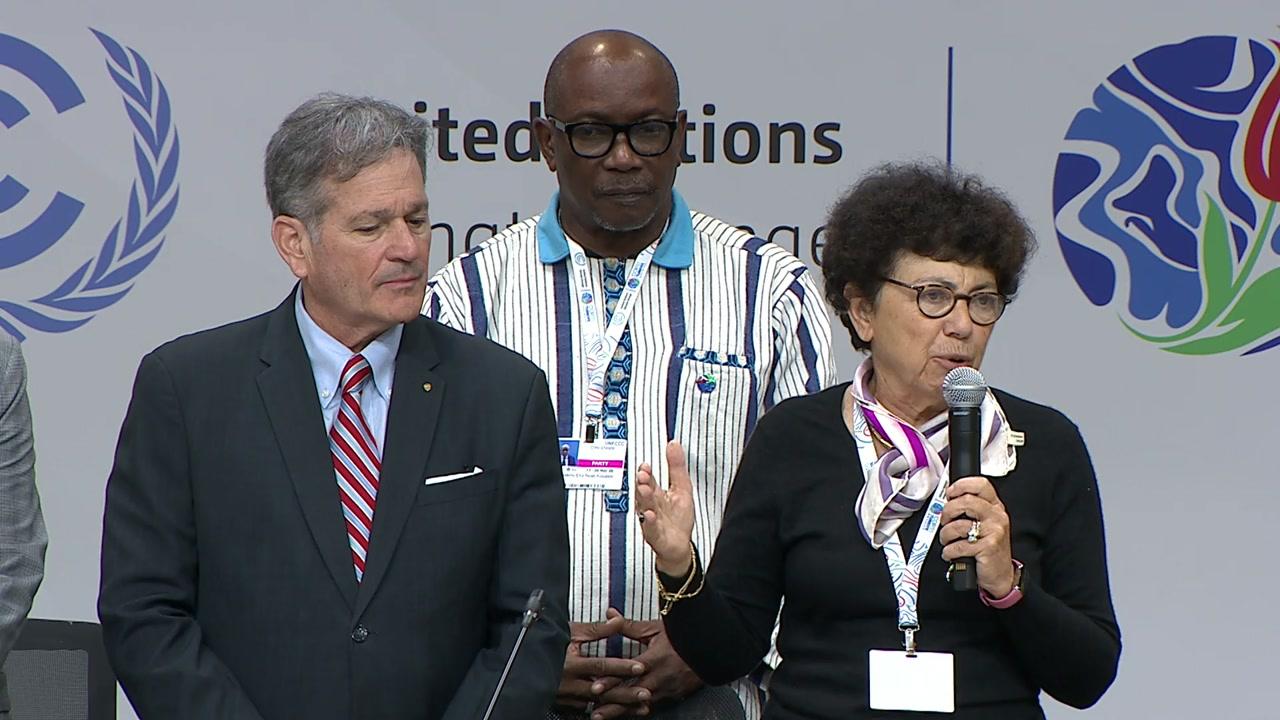
Eight-Nation Bloc Rejects COP31 Draft That Omits Fossil Fuels
COP 31 Press Conferences • United NationsNovember 20, 2026
Locunity is an independent informational service and is not an official government page for this commission. All information is sourced from public footage and an analysis of official agendas with the aid of responsible, fact-checked AI. to report an error or omission.
A coalition of eight countries used a Nov. 20, 2026, press conference at COP31 to reject the draft cover decision, which they said never mentions fossil fuels but devotes four paragraphs to carbon capture. No vote was taken. The ministers set out six minimum principles for the final declaration and said they would push for them until the end, though France stopped short of threatening to block a deal.
- Draft cover decision omits fossil fuels while giving four paragraphs to carbon capture, ministers say
- Panama sets six minimum principles, including a transition away from fossil fuels and methane cuts
- Finland calls the offer "not enough," citing no plan to address 1.5C overshoot
- France won't commit to blocking a final text without a fossil-fuel phase-out
- Small island states press for finance, calling international law their "only shield"
A Draft Without Its Main Subject
Why it matters: Fossil fuels account for about 80% of emissions, speakers noted. They argued that a cover decision ignoring them would send the wrong signal on the Paris Agreement's 1.5C pathway.
The basics: A cover decision is the overarching political text a COP adopts at its close. CCUS, or carbon capture, utilization and storage, refers to technologies that trap carbon dioxide emissions rather than avoid them.
Where things stand: Monique Barbut, France's Minister of Ecological Transition, Biodiversity and International Climate and Nature Negotiations, chaired the session. She said the draft contains "no mention of fossil fuel at all" while it includes four paragraphs on CCUS.
Panama's minister went further. "It is not acceptable to have a COP or a cover document that does not even mention fossil fuels, and we simply will not put up with it," said the Minister of Panama.
Another minister in the coalition called the draft directionless. Finland zeroed in on ambition and on overshoot, the risk that global temperatures temporarily exceed the 1.5C limit. "I think that the offer we have on the table is not enough," said Finland's minister.
The ask: The coalition requested, at minimum, language on the transition away from fossil fuels, which delegates abbreviated as TAF. Speakers also described methane cuts by oil and gas producers as cost-saving. They framed the reductions as a near-term win, not an economic burden.
The other side: A questioner asked how many countries would stand with Panama and refuse to consent to a final agreement without a fossil-fuel phase-out. Barbut declined to tie France's position to any single item. "I will see the final text," said Barbut.
Decisions and stakeholder impacts: The session was informational, with no motions or votes. The gap between Panama's "will not put up with it" and France's wait-and-see answer matters. Public pressure is not a commitment to block consensus, and COP texts are adopted by consensus. That leaves fossil-fuel producers and the COP presidency room to judge how firm the coalition's line really is.
Panama Draws Six Lines in the Sand
Why it matters: The six points define the coalition's minimum bar for supporting a final COP31 text. They also give negotiators a checklist to measure the next draft against.
Where things stand: Panama's minister listed the principles the group wants in any final declaration:
- Science as the foundation of the outcome
- A clear transition away from fossil fuels
- Fair contributions to climate finance from those with the greatest responsibility
- Clean and immediate electrification
- Accelerated methane reductions
- Greater coordination among the three Rio Convention COPs on climate, biodiversity and desertification
The final point reaches beyond the climate talks. It calls for linking the climate track to the parallel biodiversity and desertification treaty bodies, which emerged from the same Rio process.
What's next: The minister said the group would push until the end of negotiations to get all six included.
Who Pays: Finance and Survival
Why it matters: The fight over who pays could decide whether vulnerable states see real support in the final package.
Where things stand: Panama's minister summed up the coalition's finance position in four words: "You pollute, you pay." The minister said the biggest emitters, along with the largest producers and consumers of petroleum, must contribute.
Barbut said developed countries must take responsibility. She added that fast-growing emitters must also start paying. That position widens the donor base beyond the traditional industrialized nations and is likely to face resistance from large emerging economies. Barbut also noted that some countries are on the verge of disappearing.
A minister from a Pacific small island state tied the issue to the multilateral system itself. "We are small states and the only shield we have is international law," said the Minister. The minister urged the COP31 presidency to reflect high-ambition submissions in the next text.
Decisions and stakeholder impacts: Small island and climate-vulnerable states gain the most if finance language tracks responsibility for emissions. Major petroleum producers and consumers, and fast-growing emitters, would carry new expectations. The presidency now faces public pressure from a bloc that spans Europe, Latin America, Africa and the Pacific.
Looking Ahead
The coalition named in the event title included France, Panama, Belgium, Côte d'Ivoire, Finland, Greece, Solomon Islands and Sweden. Representatives of Côte d'Ivoire, Spain and Guatemala also spoke. The next draft of the cover decision will show whether the presidency moves toward fossil-fuel language, and whether France's "I will see the final text" hardens into a red line.