
Faith Leaders Pledge Climate Money at COP31, Urge US to Rejoin
COP 31 Press Conferences • United NationsNovember 20, 2026
Locunity is an independent informational service and is not an official government page for this commission. All information is sourced from public footage and an analysis of official agendas with the aid of responsible, fact-checked AI. to report an error or omission.
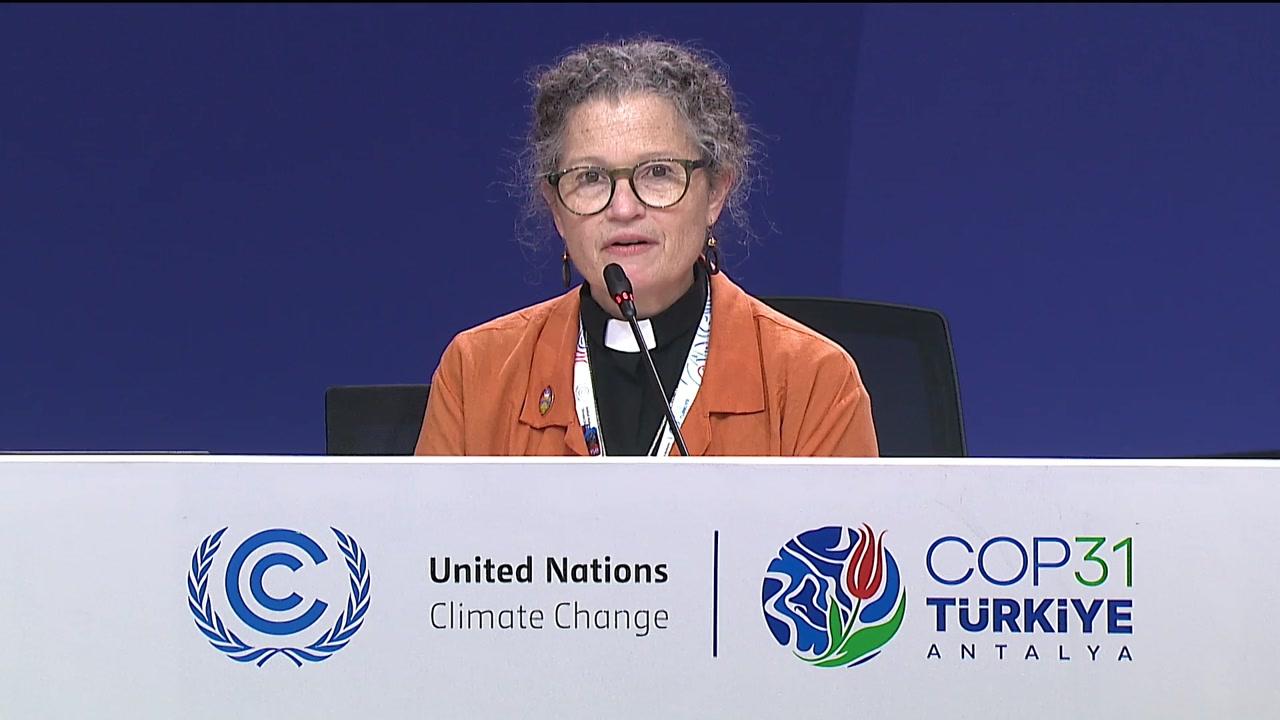
Three major U.S. Protestant denominations used a COP31 stage on Nov. 20, 2026, to show they are putting money behind climate goals: $1 million from the Evangelical Lutheran Church in America (ELCA), $1 million in United Methodist solar and battery grants, and a Presbyterian plan to divest most fossil fuel holdings by 2030. Their joint message, delivered at a Texas Impact Education Fund press conference, was that American civil society is "all in" and Washington needs to follow.
- ELCA Church Council votes $1 million to mitigate climate change.
- United Methodists announce $1 million in grants for church solar and battery storage.
- Presbyterians to remove most fossil fuel investments by 2030 through their foundation and pension board.
- Faith leaders press the U.S. government to recommit to global climate policy and finance.
- Q&A links military spending to climate harm, offers playbook for congregations and skeptics.
Churches Put Money on the Table
Why it matters: Mainline denominations are moving institutional capital toward clean energy and away from fossil fuels. They are pairing that money with direct pressure on the U.S. government while federal engagement in the global climate process is in question.
Where things stand: The press conference, titled "American Faith Communities Are All In," was hosted by Texas Impact and moderated by Regina Banks, representative, Texas Impact. No decisions or votes were taken at the event itself. The commitments announced there came from each denomination's own governing bodies.
Three announcements anchored the session:
- ELCA: "The ELCA's governing body, the Church Council, just this week voted to invest $1 million to mitigate climate change," said Bishop David Nagler, Evangelical Lutheran Church in America, Pacifica Synod. He also cited the church's work in 52 countries.
- United Methodist Church: The Rev. Dr. Becca Edwards, speaking on behalf of United Methodist bishops, cited $1 million in grants to help churches install solar panels and battery storage.
- Presbyterian Church (U.S.A.): Elder B. Moorhead, executive director, Texas Impact, and a ruling elder in the Presbyterian Church (U.S.A.), said the Presbyterian General Assembly directed the Presbyterian Foundation and the Board of Pensions to remove most fossil fuel investments by 2030.
The Right Rev. Phyllis Spiegel, Bishop, Episcopal Diocese of Utah, rounded out the panel.
The basics: Divestment means selling holdings in fossil fuel companies, usually from endowments or retirement funds. For a church pension board, that shift reaches clergy and lay employees' retirement savings, not just congregational budgets.
The other side: The speakers acknowledged their limits. They said church resources are small relative to global need. A $1 million commitment is a signal, not a financing solution, in a process where climate finance is measured in far larger sums.
Decisions and stakeholder impacts: Congregations that win United Methodist grants stand to cut energy costs and gain backup power through battery storage. Presbyterian pension and foundation investors will see their portfolios shift over the next several years. Fossil fuel companies lose a set of long-standing institutional shareholders. Each pledge is a denominational decision, so none binds the U.S. government or any other public body.
'Time for Our Government to Get Back In'
Why it matters: The faith leaders presented themselves as a counterweight to federal disengagement from the global talks. They framed civil society commitments as proof that Americans support stronger climate action.
Where things stand: Organizers called on leaders to raise their ambition and recommit to the Paris Agreement process. The United Methodist statement asked officials for ambitious action on mitigation, adaptation and climate finance. Mitigation means cutting emissions. Adaptation means preparing for climate impacts already underway.
Moorhead closed the session bluntly: "Civil society in the United States is all in. It is time for our government to get back in and get to work," said Elder B. Moorhead, executive director, Texas Impact.
Decisions and stakeholder impacts: The appeal carries no formal weight in the COP31 negotiations. Its value is political. It shows that U.S. denominations with national memberships and investment arms are aligning their money with Paris-era goals. Texas Impact, a Texas-based interfaith organization, positioned itself as the convener of that message at the international level.
Q&A: War Emissions, Pews and Climate Skeptics
Why it matters: The audience questions shifted the conversation from pledges to practice. The answers showed how faith networks could scale climate action congregation by congregation and how they plan to engage skeptics.
Where things stand: Lindsay Cook, an audience member who identified as a Quaker, asked U.S. advocates to address military spending and the emissions produced by war. Bishop Nagler agreed, and the panel broadly accepted that military spending harms the climate.
Juliana Lewis, a Presbyterian church member from North Carolina, asked how to persuade church leaders to prioritize climate advocacy and investing. Panelists offered concrete, building-level steps:
- Install electric vehicle chargers and solar on church property.
- Start composting programs.
- Open church buildings as cooling centers.
- Draw on baptismal covenant language to frame climate care as a faith commitment.
Barbara Rossing of the Evangelical Lutheran Church in America asked the panelists what gives them hope.
The other side: On climate deniers, panelists favored relational approaches over confrontation, citing Yale climate communication research. The approach acknowledges that skeptics often sit in the same pews as advocates.
Decisions and stakeholder impacts: No actions were taken. The ideas offered are aimed at local congregations, which control buildings, parking lots and budgets. Those are exactly the assets that can host chargers, solar arrays and cooling centers. Cooling centers in particular tie church property to public health needs during extreme heat, which matters to vulnerable residents in the communities these congregations serve.
What's next: The speakers did not announce specific dates or follow-up events. Readers tracking these commitments can watch for three things:
- How the ELCA deploys its $1 million.
- Which churches receive the United Methodist solar and battery grants.
- How the Presbyterian Foundation and Board of Pensions report progress toward the 2030 divestment target.