
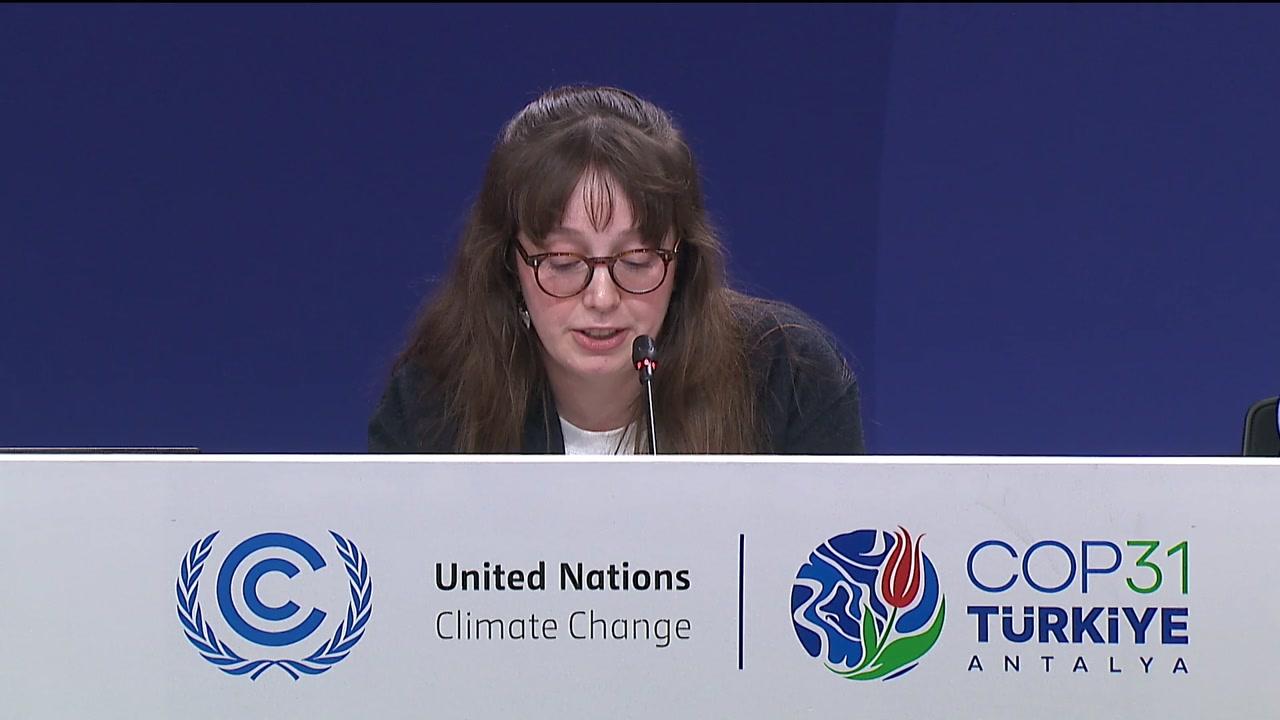
Advocates Press COP31 Presidents to Keep Fossil Fuel Roadmaps Alive
COP 31 Press Conferences • United NationsNovember 18, 2026
Locunity is an independent informational service and is not an official government page for this commission. All information is sourced from public footage and an analysis of official agendas with the aid of responsible, fact-checked AI. to report an error or omission.
Civil society experts used a Nov. 18, 2026, press conference at the COP31 climate summit to make a closing argument. Their message: national roadmaps for moving away from fossil fuels must survive in the summit's final political text. No decisions were made at the briefing, hosted by Sabancı University's Istanbul Policy Center. But speakers laid out the asks they will press on negotiators: roadmaps in the text, a just transition mechanism that actually works, stronger science language, and a coal phase-out plan from host country Türkiye.
- Fossil fuel roadmaps gain momentum, with a dozen countries named as moving on plans
- Just transition mechanism talks stalled, and the European Union's red lines were cited as a key obstacle
- Türkiye urged to set a time-bound coal phase-out, with modeling pointing to 2036
- About 75 countries back the "35 by 35" electrification pledge, and advocates want it in the final text
- Scientists warn overshoot is being "normalized" as cryosphere losses become irreversible
- Turkish NGOs say the COP presidency left repeated consultation requests unmet
Roadmaps Move From Taboo to Mainstream
Why it matters: Roadmaps are the main route for turning the transition-away-from-fossil-fuels language adopted at COP28 into national action. Whether they appear in the final decision will signal how seriously the summit treats that commitment.
Where things stand: Jennifer Morgan, senior fellow at the Fletcher School and 2026 Mercator IPC visiting senior fellow at the Istanbul Policy Center, said a growing list of countries is moving on roadmaps. She named France, the Netherlands, Germany, Finland, Denmark, Brazil, Chad, Ireland, Spain, Portugal, Luxembourg and Nigeria. She urged both COP presidents, from Türkiye and Australia, to carry the process forward.
"What used to be a taboo topic is now a normal topic," said Morgan.
The other side: The moderator questioned how much substance sits behind the announcements. Ümit Şahin, head of the Climate Change Program at the Istanbul Policy Center, Sabancı University, said that when looking at the national plans, "we see that most of them are really kind of copy-paste of their NDCs." NDCs are nationally determined contributions, the climate pledges each country files under the Paris Agreement. Şahin said political intent is what ultimately matters.
The question came from the floor as well. Nuran Erkul, a reporter with Anadolu Agency, asked how strong and implementable the announced roadmaps are, and what the panel wants from Türkiye and Australia on the phase-out.
Morgan conceded part of the point. "For Germany, it's true, it's not new policy," she said. She argued that Germany's roadmap still makes the country's transition explicit. She added that the plans differ by country, and she praised Brazil's roadmap for its capability metrics.
Decisions and stakeholder impacts: No action was taken. The exchange suggests roadmaps are uneven in quality, which leaves their value dependent on political follow-through. Countries already on the list gain diplomatic cover. Fossil-dependent hosts face sharper scrutiny, especially Türkiye as COP president.
What's next: Pınar Gayretli of Climate Network Türkiye called on Türkiye to commit to its own national roadmap. Speakers expect the Turkish and Australian presidencies to decide whether the roadmap process continues beyond COP31.
Just Transition Talks Stall as Coal Test Looms
Why it matters: Coal supplies 34% of Türkiye's electricity and 20% of its emissions. That makes the host country's domestic energy policy a test of its credibility as COP president.
Where things stand: Onur Akkül, just transition lead at the Istanbul Policy Center, described a deadlock over the Belém-Antalya Mechanism. The proposed mechanism is meant to support a fair shift for workers and communities away from fossil fuel economies.
"As the COP31 enters its final 2 days, there is no concrete progress on the establishment of the just transition mechanism," said Akkül.
He said developed countries, led by the European Union, have set red lines around a permanent mechanism and a financial framework.
Domestic pressure: Akkül welcomed Türkiye's National Just Transition Strategy. He flagged financing gaps and delays in the plan, and he criticized purchase guarantees for coal power. Citing Istanbul Policy Center modeling, he argued the economics support an exit.
"Türkiye actually can phase out coal by 2036 without undermining the country's macroeconomic indicators," said Akkül.
He called for a time-bound coal phase-out and a declaration of no new coal.
The youth question: Hilal Steinmetz, a public commenter who said she works with young people, asked whether the negotiations address students and youth with fewer opportunities, not only workers. Akkül said youth and other groups have been heard in the talks.
"Just transition can only deliver when it is designed for all the economy itself and all the social groups as well," said Akkül.
Decisions and stakeholder impacts: Without a mechanism, coal workers and regions have no dedicated international support channel. Developing countries also lose a financing avenue. A Turkish phase-out date would affect utilities, coal-region workers and investors holding guaranteed-purchase contracts.
Turkish NGOs Say Presidency Kept Them Out
Why it matters: Limited access for civil society undercuts the host country's claim of inclusive leadership. At the same time, its coal policy sits uneasily with its stated fossil fuel goals.
Where things stand: Pınar Gayretli, speaking for Climate Network Türkiye, a network of 17 organizations, said repeated outreach went unanswered.
"Since Türkiye was confirmed as a COP31 host and president, we have repeatedly requested a meeting with COP president and a structured consultation mechanism," said Gayretli.
She said Türkiye's 2035 NDC permits emissions to keep rising. She also said two coal projects are being pursued and that purchase guarantees for new coal plants run to 2045.
Decisions and stakeholder impacts: The network is asking for three things:
- Abandon new coal
- Commit to a national fossil transition roadmap
- Create structured participation for civil society
Domestic advocates are the most direct losers from closed doors. The presidency risks reputational costs if those complaints follow it out of the summit.
Final Text Fight: Finance, Pledges and Overshoot
Why it matters: The cover decision is the summit's main political text. Its wording shapes follow-on climate action and the science that the next global stocktake relies on.
Where things stand: Öykü Şenlan said the most recent lengthy draft drew reactions from almost 50 countries and groups. Ministers were set to meet the evening of Nov. 18 to produce a new draft. Şenlan said "almost 75 countries support the 35 by 35 electrification pledge" and urged that it be reflected in the text. She pressed for three more things in the decision:
- Keep the roadmaps in
- Strengthen adaptation finance
- Reference overshoot
Overshoot refers to temporarily exceeding the 1.5-degree warming limit before bringing temperatures back down.
The science warning: Pam Pearson, director of the International Cryosphere Climate Initiative, said science is being questioned inside the negotiations.
"I'm afraid that overshoot is being almost normalized in these rooms," said Pearson.
Pearson cited a Nov. 2 report from UNEP and her organization, which found the following:
- Sea level rise of 2 to 9 meters is already committed
- The Mount Ararat glacier will likely disappear before 2050
- Emissions must fall about 5% a year
She called the current research and systematic observation language the strongest in years and said negotiators must defend it. She added that the IPCC must be able to deliver its reports before the second global stocktake.
Decisions and stakeholder impacts: Low-lying and glacier-dependent communities have the most at stake in how overshoot and sea level rise are framed. Countries backing electrification would gain a formal anchor if the pledge lands in the text.
Looking Ahead
Ministers were expected to meet the evening of Nov. 18 to produce a new cover decision draft. Advocates will be watching whether fossil fuel roadmaps, adaptation finance, overshoot language and a just transition mechanism survive into the final text as COP31 heads into its closing days.