
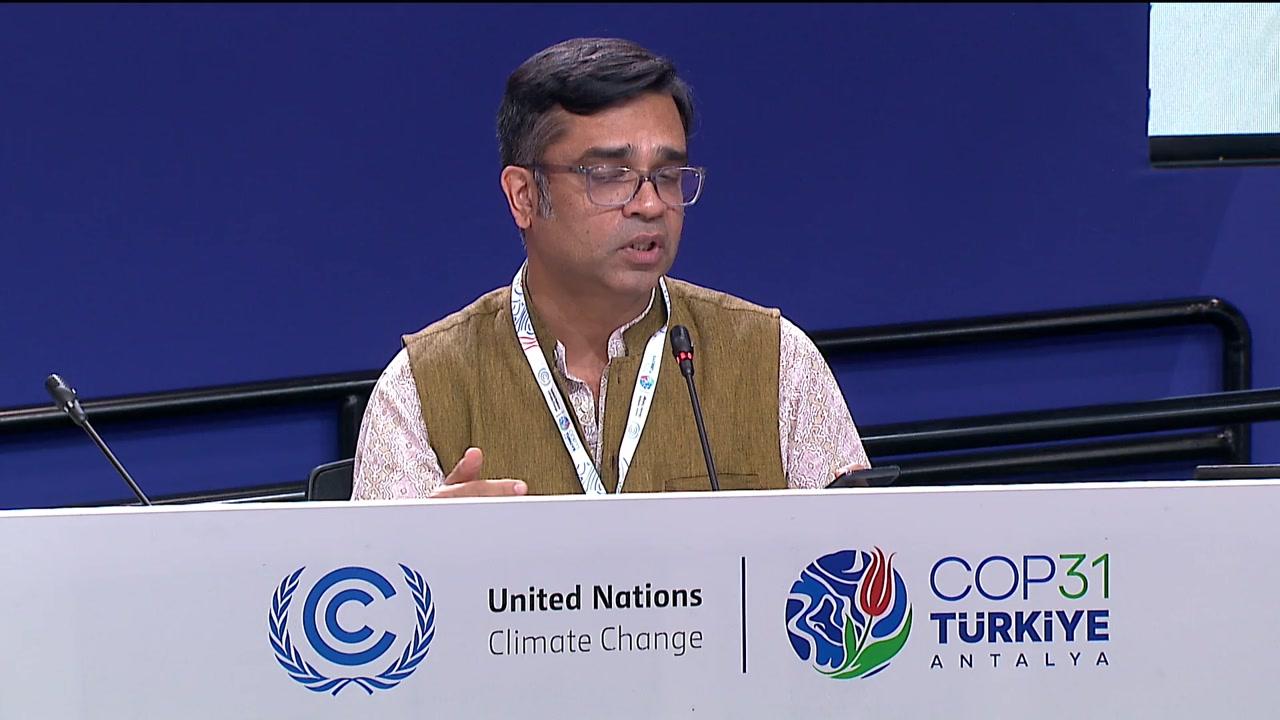
Oxfam at COP31: Richest Pollute Most While Rich Nations Stall on Finance
COP 31 Press Conferences • United NationsNovember 17, 2026
Locunity is an independent informational service and is not an official government page for this commission. All information is sourced from public footage and an analysis of official agendas with the aid of responsible, fact-checked AI. to report an error or omission.
Oxfam used a Nov. 17, 2026, press conference at COP31 to argue that the climate crisis is an inequality crisis. The richest people drive emissions, while the poorest absorb the losses. Its leaders paired that data with a warning: developed countries are resisting the finance commitments meant to close the gap, and talks could end with no negotiated text on key finance questions.
- Top 0.1% emit more than the bottom 50%, according to Oxfam's Disaster Divides report.
- 144 private jets have arrived since COP31 began, Oxfam said.
- 57% of 156 Turkish women's cooperatives lost income to climate events.
- Oxfam warned of a no-text outcome as developed nations avoid Article 9.1 talks.
- Oxfam said taxing private jets could raise $45 billion yearly.
Disaster Divides: Who Emits, Who Pays
Oxfam opened with its central argument: emissions are concentrated at the top, and climate damage lands at the bottom. Executive Director Amitabh Behar led with the Disaster Divides report. Speakers from Türkiye and the Philippines then grounded those numbers in local losses.
Why it matters: The framing moves the COP31 debate from "how much" climate finance is needed to "who should pay." It treats wealth inequality as both a cause of the crisis and a way to fund solutions.
Where things stand: Behar said the top 0.1% emit more than the bottom 50% of people. He also pointed to the top 1%'s contribution to heat waves and to the 780 million people facing hunger. He used the summit itself as evidence.
"Since the COP started, we have seen 144 private jets arrive here," said Behar, Executive Director of Oxfam International.
The Türkiye picture: Gökçen of Oxfam KDV, Oxfam's affiliate in Türkiye, said the country's richest 85,000 people emit more than its poorest 22.9 million.
- Oxfam surveyed 156 women's cooperatives across 45 provinces.
- 57% reported losing income to climate events.
- 9 in 10 said they were not consulted on climate policy.
A representative of the Devrek Güneşi Women's Cooperative spoke in Turkish through an interpreter. She described losing income and being shut out of policymaking.
The Philippines picture: Joshua Villalobos spoke on behalf of two groups. He is lead of the Negrosanon Initiative for Climate and the Environment (NICE) and a climate justice campaigner with Oxfam Philippines. He described recovery from Super Typhoon Tino and the strain of energy poverty. He called for adequate finance delivered as grants rather than loans, and urged negotiators to reject what he called false solutions.
Decisions and stakeholder impacts: No decisions were made. The briefing sets out the evidence Oxfam will use in negotiations. Three groups sit at the center of its case:
- Frontline communities, such as women's cooperatives and typhoon-hit regions, bear the losses.
- The highest emitters, including private jet users, are its targets for accountability.
- Governments are being asked to reflect domestic inequality in their national climate plans.
Finance Talks: Oxfam Warns of Empty Outcome
Nafkote Dabi of Oxfam International gave a blunt read on where negotiations stand. She said ambition is lacking on nearly every finance track.
Why it matters: The outcomes will decide whether the $300 billion climate finance goal agreed at COP29 can actually be delivered. They will also decide whether adaptation funding reaches communities like those described earlier in the briefing.
Where things stand: Dabi described four areas of concern:
- Just transition mechanism: The proposed mechanism has no finance attached. She called it a talk shop.
- Article 9.1: In the Climate Finance Work Program, developed countries are avoiding discussion of this provision.
- Adaptation baseline: The $120 billion adaptation baseline may be removed from the text. Developed countries are also resisting calls to triple adaptation finance.
- Adaptation Fund: Pledges at that evening's pledging event were expected to be small.
The basics: Article 9.1 of the Paris Agreement says developed countries shall provide financial resources to help developing countries. That is why debates over it are so contested.
The other side: No developed-country negotiators spoke at the briefing. As Oxfam described it, wealthy nations may prefer a no-text option on finance rather than accept new obligations. Oxfam warned that result would leave unclear how the $300 billion goal will be mobilized.
Decisions and stakeholder impacts: No formal decisions were made. If the adaptation baseline is dropped and pledges stay thin, developing countries face weaker guarantees on adaptation money. Groups such as NICE and the Turkish cooperatives would wait longer for support.
What's next: Oxfam is calling for a finance roadmap before COP32.
Tax the Top: Oxfam's Revenue Pitch
During questions from journalists, Oxfam pushed back on the claim that the world lacks money for climate action. Josh Gabbatiss of Carbon Brief and Francis Ontomwa of Kenya's Standard Media Group asked about the finance work program and how to pressure major emitters.
Why it matters: Oxfam pointed to specific revenue sources. That shifts the debate from whether funding exists to whether governments will raise it.
Where things stand: Oxfam estimates two potential sources of funding:
- Taxing private jets could raise $45 billion a year.
- Taxing fossil fuel companies' excess profits could raise $400 billion.
"So the money exists," said Dabi of Oxfam International.
Dabi and Behar named several ways to apply pressure:
- Fair taxation of extreme wealth and polluters.
- National climate plans, known as NDCs, that reflect inequality within countries.
- Sustained public pressure.
- An international panel on inequality.
Decisions and stakeholder impacts: The tax proposals are advocacy positions, not measures under negotiation at the briefing. They would shift costs to fossil fuel companies and wealthy private jet users. They would also give finance negotiators a counter to budget-constrained governments.
Looking Ahead
Oxfam expected Adaptation Fund pledges at that evening's event to be small. The group will keep pressing for a finance roadmap before COP32, and it warned that a no-text outcome on finance remains possible.