
Coalition Launches Voluntary Food Systems Declaration at COP31, Eyes Permanent Agenda Slot
COP 31 Press Conferences • United NationsNovember 12, 2026
Locunity is an independent informational service and is not an official government page for this commission. All information is sourced from public footage and an analysis of official agendas with the aid of responsible, fact-checked AI. to report an error or omission.
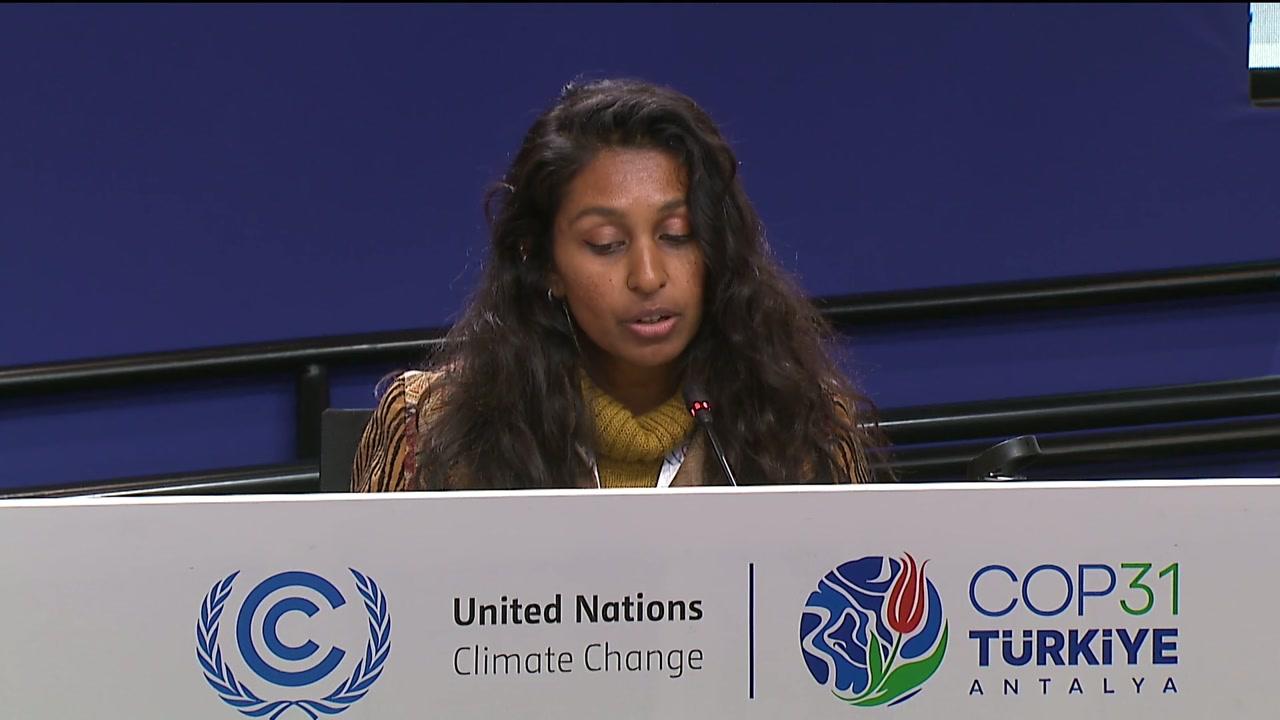
Food produces about one-third of global emissions, yet it has no dedicated track in UN climate talks. At a Nov. 12, 2026, press conference at COP31, the True Animal Protein Price Coalition (TAP Coalition) launched a non-binding declaration meant to change that, with three first endorsers and a roadmap to make food a standing COP agenda item starting at COP32.
- Voluntary food systems declaration launched with first endorsements from Central African Republic, Jordan and a Pacific regional organization.
- Standing COP agenda item proposed from COP32, plus a UN synthesis report from COP33.
- Youth advocates back the declaration but push for binding commitments and mandatory labeling.
- Advocates and a Brazilian researcher press presenters on school-meal procurement, meat-industry lobbying and farm emissions data.
A Food Track for the Climate Talks
Why it matters: Presenters said food systems account for about one-third of global emissions, with meat and dairy responsible for roughly half of food-related emissions. The declaration seeks to give food a COP-level pathway comparable to the fossil fuel transition language in prior negotiations.
The basics: NDCs, or nationally determined contributions, are the climate plans each country submits under the Paris Agreement. The UNFCCC, the UN Framework Convention on Climate Change, is the treaty body that runs the annual COP negotiations.
Where things stand: The Declaration on Transition Towards Sustainable, Diversified, and Low-Emitting Food Systems invites countries to:
- Add national food strategies to their NDCs.
- Align public procurement and school meals with low-emitting diets.
- Explore fiscal measures.
- Include methane targets.
The document is voluntary. André Nolkemper, chair of the board of the TAP Coalition, moved to head off a predictable line of attack from agricultural interests.
"It does not call for eliminating meat or dairy. It calls for a gradual and equitable shift," said Nolkemper.
The press conference was led by the TAP Coalition, whose director and founder is Jeroen Remmers. Beyond the declaration text, the coalition laid out a follow-up sequence: a standing food agenda item at COP from COP32 onward, a UNFCCC synthesis report from COP33, and a coalition conference in 2027 or 2028.
The legal angle: Presenters also argued that the 2025 International Court of Justice advisory opinion strengthens the case for state action on food emissions. In their view, the opinion gives the voluntary text more force than its non-binding status suggests.
Decisions and stakeholder impacts: There was no vote. The declaration was formally launched with first endorsements from Central African Republic, Jordan and a Pacific regional organization. No major agricultural exporter was named among the early signers.
The stakeholders break down this way:
- School-meal programs and public caterers would feel the change first if governments act on the procurement language.
- Livestock and dairy producers face potential fiscal measures and methane targets. However, the text stops short of mandates, and presenters said it does not call for eliminating meat or dairy.
- Smaller and climate-vulnerable states gain a platform. The early endorsers suggest that is where the coalition is building first.
Youth Advocates: Make It Mandatory
The other side: The strongest pushback came from allies who want the declaration to go further, not from skeptics. Davina, advocacy manager at Youth and Environment Europe, endorsed the declaration but urged binding commitments.
On labeling, she was blunt. The measure "must become a mandatory measure. It shouldn't be a voluntary one," said Davina.
Why it matters: This is the core tension in the effort. A voluntary text makes it easier for governments to sign on, but it gives them little reason to follow through. Youth groups are signaling that they will keep pressing to turn the declaration's invitations into obligations as it moves toward COP32.
Q&A: Procurement, Lobbying and Bad Data
Three audience members pushed presenters on how the declaration would work in practice.
Procurement: Naman, regional liaison for Asia for the Plant Based Treaty, asked how school-meal procurement mandates would be carried out inside institutions. Presenters pointed to two models:
- Dutch caterers that use price differentiation to steer choices.
- Local cooperatives.
Lobbying: Juan, of Plant-Based Treaty Spain, asked how advocates can engage governments facing heavy meat-industry lobbying, citing Spain and Colombia. Presenters described four sources of leverage:
- Building coalitions with farmers rather than against them.
- The Dutch meat tax proposal as a model.
- Legal obligations flowing from the ICJ opinion.
- The EU's 2040 climate target.
Measurement: Camila, of the Getúlio Vargas Foundation in Brazil, raised the most technical concern. She asked how to measure emissions on varied tropical farms so farmers are not penalized based on bad data. The answer acknowledged the limits:
- Denmark needed five years of preparation for its approach.
- EU monitoring protocols have been slow to develop.
Why it matters: The exchange showed what the declaration does not yet resolve. Fiscal measures and methane targets depend on credible farm-level data. Producers in tropical countries are wary of being measured with emission factors built for other climates. For advocates working at the national level, the roadmap presenters offered relies on coalitions, legal pressure and patience.
Looking Ahead
The coalition's next milestones are a push for a standing food agenda item at COP32, a UNFCCC synthesis report targeted for COP33, and a coalition conference in 2027 or 2028. The questions to watch are which additional countries sign on before COP32, and whether any major meat or dairy producer joins.