
Laos Seeks $15.5B in Climate Aid, Leaves Key Questions Unanswered
COP 31 Press Conferences • United NationsNovember 18, 2026
Locunity is an independent informational service and is not an official government page for this commission. All information is sourced from public footage and an analysis of official agendas with the aid of responsible, fact-checked AI. to report an error or omission.
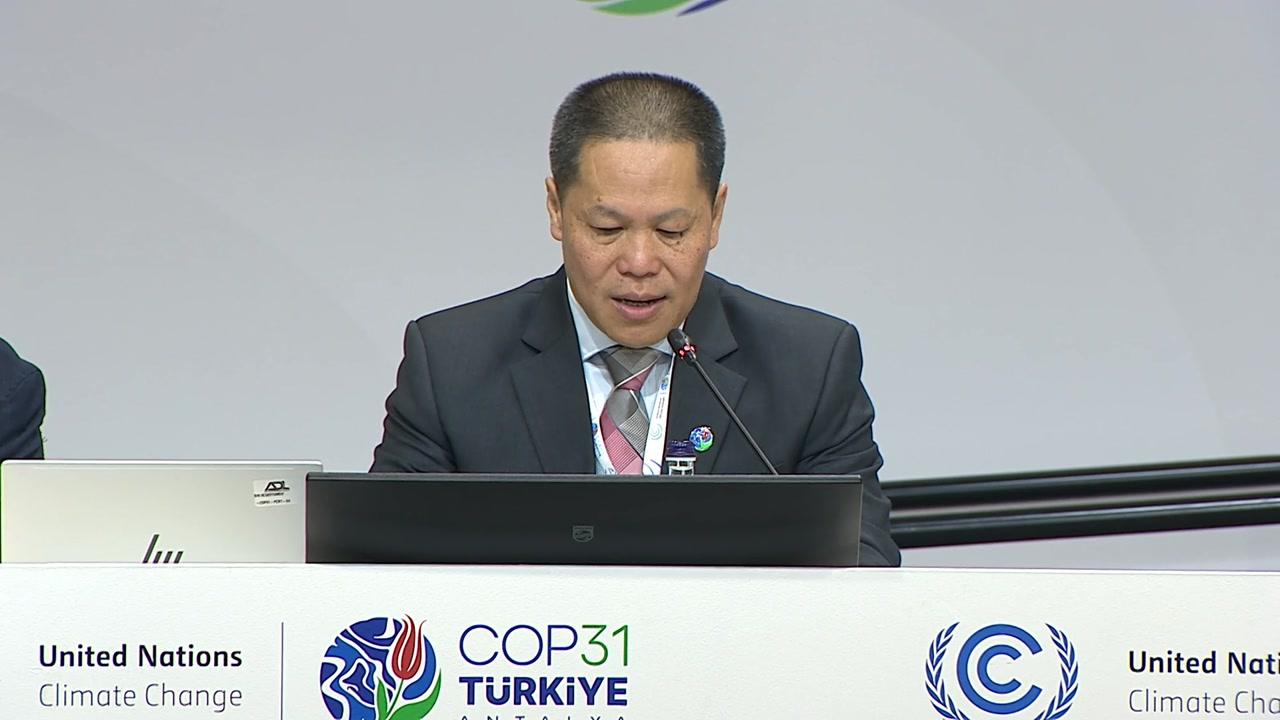
Lao PDR's finance ministry came to a COP31 press conference on Nov. 18, 2026, with a $20.5 billion climate plan and a clear request: roughly three-quarters of it must come from abroad. When reporters asked whether the plan has been published, why it missed its deadline and what a credible global finance pathway would look like, the deputy finance minister referred much of the detail to another ministry. The briefing showed both how much least developed countries need outside money and how hard it is to turn climate plans into fundable projects.
- NDC 3.0 costs about $20.5B, with roughly $15.5B needing international support
- Reporters pressed on NDC publication and the missed deadline, and the question went unanswered
- Laos graduates from Least Developed Country status Nov. 24, which raises the stakes of the financing gap
- Peers from Fiji, Sri Lanka and Eswatini advised Laos on green bonds, taxonomy and project readiness
Questions Outpace Answers on the Climate Plan
The basics: An NDC, or nationally determined contribution, is each country's climate plan under the Paris Agreement. The NCQG, or New Collective Quantified Goal, is the global climate finance target that developed countries are expected to deliver under the U.N. climate process.
Why it matters: The press Q&A was the longest stretch of the briefing, about 12 minutes. It tested whether Laos' finance appeal comes with the policy detail investors and donors usually want to see. On the most basic transparency question, whether the plan is public, reporters left without an answer.
Where things stand: Reporters from three outlets pushed past the prepared remarks:
- Joe Lowe, a reporter with Climate Home News, asked whether the NDC has been published and why it missed the deadline.
- Lowe also asked what $120 billion a year in adaptation finance would let Laos do.
- Caroline Varin, a reporter with Argus Media, asked what a clear NCQG delivery pathway would look like for Laos.
- Another reporter asked about the country's electrification target.
The Deputy Minister of Finance of Lao PDR said his ministry's role is to secure financing. He referred questions on the NDC and the electrification target to the agriculture and environment ministry. The publication question went unanswered.
The private-sector pitch: One questioner asked which projects private investors could finance and how Laos makes them bankable. The deputy minister answered with more specifics. He cited:
- Hydropower, wind and solar
- A revised investment law from 2024
- Nine priority sectors
- Public-private partnerships
Decisions and stakeholder impacts: The briefing was informational, and no formal action was taken. The split between ministries is typical of many governments: finance ministries raise money, and line ministries write the technical targets. Reporters, analysts and would-be investors are left without a single point of contact who can explain both what Laos will do and how it will pay for it.
What's next: The NDC questions now sit with Laos' agriculture and environment ministry. Watch whether the plan is published and whether it includes the electrification target reporters asked about.
The $15.5 Billion Ask
Why it matters: Laos says most of its climate plan depends on money from abroad. It is also about to lose some of the special treatment that comes with Least Developed Country (LDC) status, with graduation set for Nov. 24.
Where things stand: The deputy minister opened with the delegation's central message.
"Lao PDR is ready to raise its climate ambition, and it needs clear finance to do so," said the Deputy Minister of Finance of Lao PDR.
He reaffirmed Laos' commitment to the Paris Agreement and its 1.5-degree warming limit. He made the case with disaster data:
- 31 disasters struck Laos between 2000 and 2024.
- They affected 4.3 million people.
- They cost about $595 million.
The full NDC 3.0 is priced at about $20.5 billion. About $15.5 billion of that, or roughly 75%, would require international support.
The finance toolkit: The deputy minister described a Climate and Sustainable Finance Hub inside the Ministry of Finance. He backed several funding tools:
- Result-based payments, which release money after verified outcomes
- Climate sovereign bonds
- Carbon markets under Article 6.2 and 6.4 of the Paris Agreement. Article 6.2 covers country-to-country trading of emissions reductions, known as internationally transferred mitigation outcomes, or ITMOs. Article 6.4 sets up a U.N.-supervised crediting mechanism.
He also asked for technical assistance and greater private-sector participation.
The pressure on donors: The deputy minister urged developed countries to deliver a clear pathway to $300 billion a year by 2035. That framing puts the burden on wealthy nations' follow-through, not just on Laos' own planning.
Decisions and stakeholder impacts: No formal action was taken. Several groups have a stake in what happens next:
- Lao residents face recurring climate disasters, and their exposure depends on whether outside money arrives.
- Carbon-market developers and buyers see an openly willing Article 6 partner.
- Private investors are being invited in, but the bankable pipeline remains the open question.
- Donor governments are being asked to make the $300 billion pathway concrete.
What's next: Laos graduates from LDC status Nov. 24.
Peers to Laos: Get Projects Ready First
Why it matters: Laos' peers say money is not the only bottleneck; having projects ready to finance matters too. That bears directly on Laos' $15.5 billion ask.
Where things stand: Kishore Rajan, Deputy CEO of the Global Carbon Council, summarized a UNEP/UNDP side event held with the Coalition of Finance Ministers for Climate Action. At the event, finance officials from Fiji, Sri Lanka and Eswatini offered Laos practical advice:
- Publish a green bond framework, and issue bonds only when budgeted projects are ready.
- Don't let bonds replace adaptation grants.
- Build a national green taxonomy, a classification system defining which investments count as green.
- Treat guarantees as contingent liabilities, meaning potential future debts on the public books.
- Use grants to pay for early project studies.
Rajan relayed the message from the chair of the LDC Group, which captured the problem.
"Least developed countries have submitted their climate and adaptation plans, but too few projects are ready to finance," said Rajan.
Decisions and stakeholder impacts: The advice reinforces some of Laos' strategy and adds caution to the rest. Climate sovereign bonds, which Laos backs, come with conditions: they should not replace adaptation grants, and they create debt risk if issued before projects are ready. For finance ministries in countries like Laos, the most immediate need may be grant money for project preparation, more than large capital pledges.
Looking Ahead
Laos graduates from Least Developed Country status Nov. 24. Its NDC 3.0, along with the electrification target reporters asked about, now rests with the agriculture and environment ministry.