
Vanuatu Joins Fossil Fuel Subsidy Coalition, Pledges Roadmap by COP32
COP 31 Press Conferences • United NationsNovember 17, 2026
Locunity is an independent informational service and is not an official government page for this commission. All information is sourced from public footage and an analysis of official agendas with the aid of responsible, fact-checked AI. to report an error or omission.
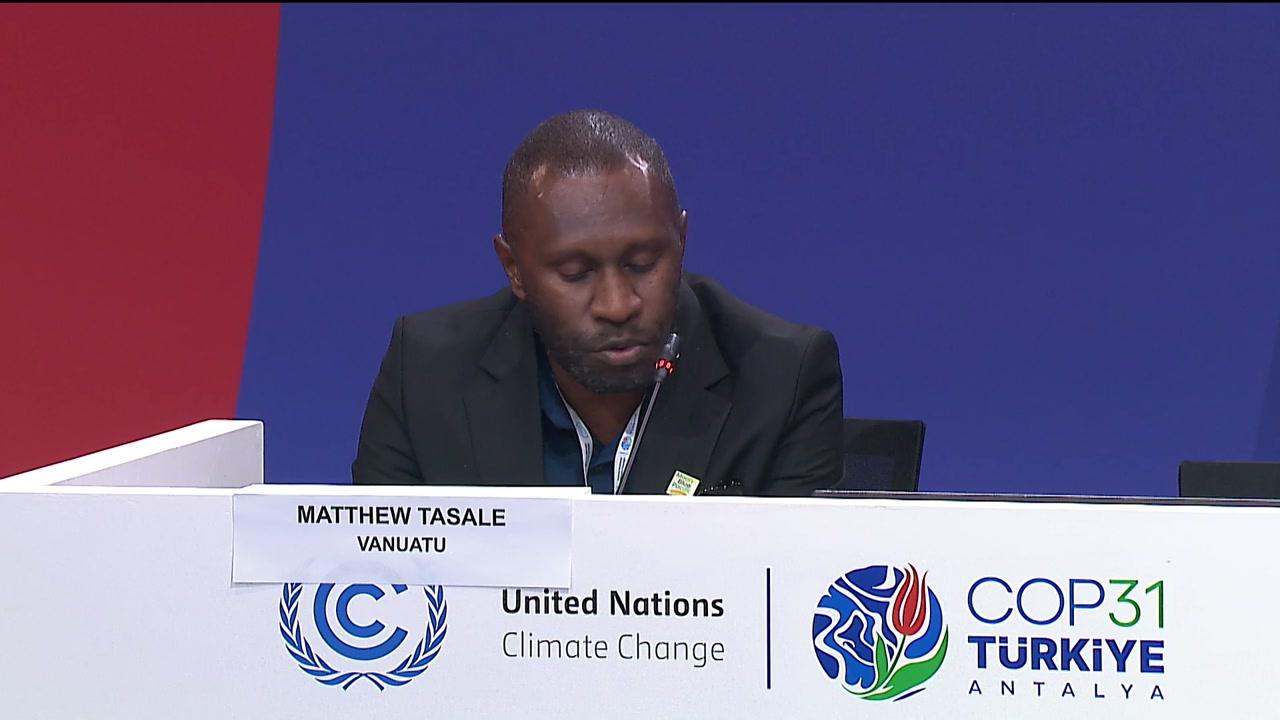
Vanuatu used a Nov. 17, 2026, COP31 press conference to announce it is joining the Coalition on Phasing Out Fossil Fuel Incentives (COFIS). It committed to inventory its fossil fuel subsidies and publish a national phase-out roadmap by COP32 in Ethiopia. Panelists also argued that the voluntary COP30 roadmap on transitioning away from fossil fuels will matter only if governments turn it into national plans with real timelines.
- Vanuatu joins COFIS and commits to a subsidy inventory and national roadmap by COP32
- Tuvalu also joining the coalition, the moderator announced
- Marshall Islands became the first small island developing state to publish a subsidy inventory
- Pacific regional roadmap planned ahead of the 2027 conference co-hosted by Ireland and Tuvalu
- Panelists warn the voluntary COP30 roadmap depends on national follow-through
Pacific Nations Take Aim at Fossil Subsidies
The basics: COFIS is a coalition of countries working to identify and phase out public support for fossil fuels. The Marshall Islands and the Netherlands co-chair it. The International Institute for Sustainable Development (IISD) hosts its secretariat.
Why it matters: Subsidy inventories are the first step toward a phase-out. A country has to map where public money supports fossil fuels before it can redirect that money. Two more Pacific members strengthen a small-island bloc ahead of a 2027 conference in Tuvalu.
Where things stand: A Vanuatu government representative spoke on behalf of a minister and confirmed the country is joining COFIS. The representative cited the International Court of Justice advisory opinion as part of the rationale.
"States cannot claim to be fighting climate change while subsidizing its primary cause," said the Vanuatu government representative.
Vanuatu made two commitments:
- A subsidy inventory and national roadmap by COP32 in Ethiopia
- Work toward a Pacific regional roadmap for the 2027 conference co-hosted by Ireland and Tuvalu
The moderator then welcomed Tuvalu as a new coalition member.
Setting the pace: The Marshall Islands has already done the groundwork Vanuatu is now promising.
"The Marshall Islands recently published its first fossil fuel subsidy inventory, becoming the first small island developing state to do so," said Tina Stege, Climate Envoy of the Marshall Islands. Stege also described the planned Pacific regional roadmap.
Decisions and stakeholder impacts: The press conference involved no votes or formal decisions. The announcements are political commitments, not binding obligations. Finance and energy ministries in Vanuatu now own the inventory work. The coalition gains Pacific voices, and the COFIS co-chairs and IISD secretariat take on a larger membership. Taxpayers and energy users in member countries are the people most directly affected. Inventories show where public money goes, and that sets up later debates over pricing and support programs.
What's next: Vanuatu's inventory and national roadmap are due by COP32 in Ethiopia. The Pacific regional roadmap is aimed at the 2027 Ireland–Tuvalu conference.
Turning a Voluntary Roadmap Into Real Plans
Why it matters: The COP30 Presidency roadmap on transitioning away from fossil fuels sets no binding deadlines. Panelists said its value depends on whether governments write national plans and act on them.
"Because it is voluntary and sets no binding deadlines, its impact will depend on whether governments use it to set clear timelines and follow through," said a panelist.
Where things stand: Panelists offered three views of what comes next.
- Defining success at COP31: One panelist said success at COP31 would include three outcomes:
- continued space for dialogue on the transition
- recognition of electrification in the final decision
- the presidency carrying the roadmap forward
- Where national plans can live: Another panelist said national plans do not need a new home. They can sit inside nationally determined contributions (NDCs), which are countries' climate pledges under the Paris framework, or inside national energy strategies. They can also be submitted as input to the second Global Stocktake (GST2), the periodic review of collective climate progress.
- A parallel track: A third panelist described the Santa Marta process and the second conference in Tuvalu. The panelist framed both as complements to the United Nations climate negotiations, not replacements.
The other side: The third panelist also acknowledged the central obstacle: many developing countries depend on fossil fuel revenues. Any roadmap that ignores that fiscal reality risks stalling. This is why subsidy inventories and national plans paired with finance discussions came up repeatedly during the hour.
Decisions and stakeholder impacts: No decision was taken. The practical upshot is a shift from global pledges to national paperwork. The work moves to NDC revisions, energy strategies and Global Stocktake submissions. Energy ministries and climate negotiators gain leverage in that shift. Fossil revenue–dependent economies face the hardest trade-offs.
What's next: Watch whether the COP31 outcome text in Antalya preserves a continued dialogue on transitioning away from fossil fuels and references electrification. Also watch which governments file national plans as Global Stocktake input.
Looking Ahead
COP32 in Ethiopia is the deadline for Vanuatu's subsidy inventory and national roadmap. The 2027 conference co-hosted by Ireland and Tuvalu is the next checkpoint for a Pacific regional roadmap.