
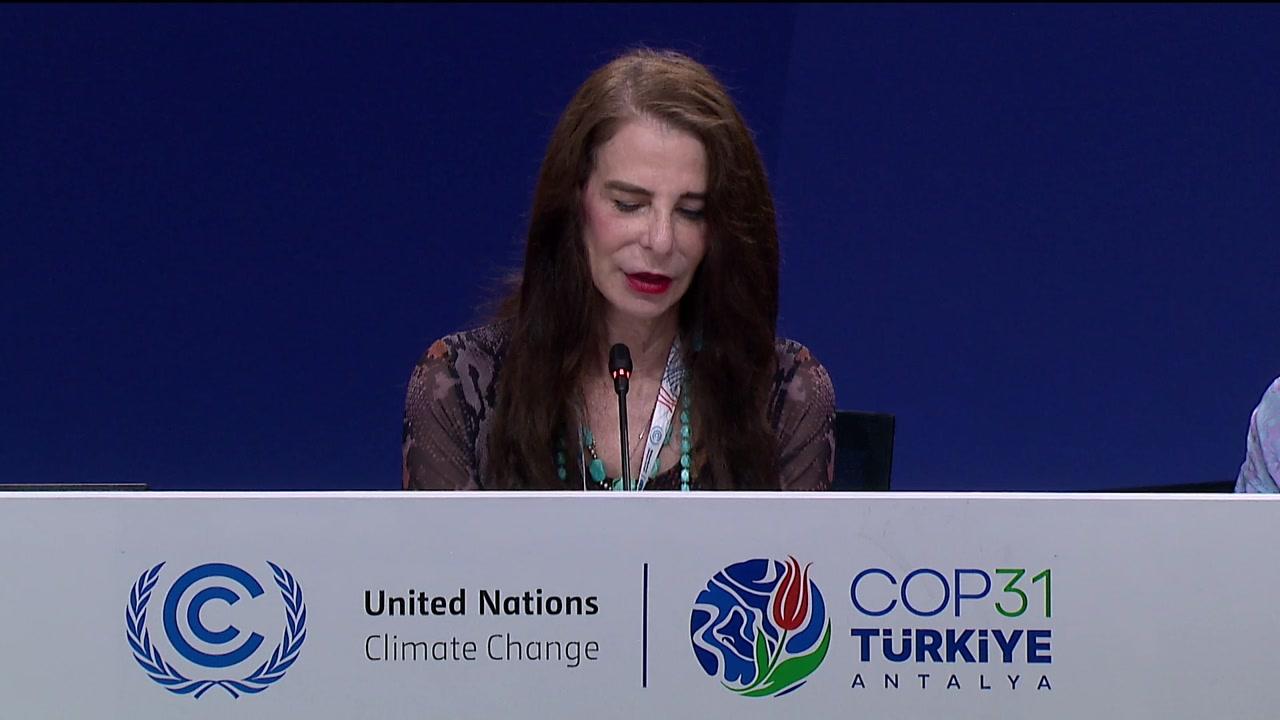
Rights of Nature Coalition Grows to Six Nations at COP31
COP 31 Press Conferences • United NationsNovember 17, 2026
Locunity is an independent informational service and is not an official government page for this commission. All information is sourced from public footage and an analysis of official agendas with the aid of responsible, fact-checked AI. to report an error or omission.
Three more governments, Palau, the Dominican Republic and Colombia, signed on to a state coalition pushing the United Nations to recognize nature's legal rights. The announcement came Nov. 17, 2026, at a COP31 press conference where advocates also reported progress on a European petition and argued that market-based climate tools have failed. No formal decisions were made, but the event showed governments and civil society organizing on parallel tracks toward a Universal Declaration on the Rights of Nature.
- For Nature Coalition of States doubles to six countries as Palau, the Dominican Republic and Colombia join at COP31
- WECAN circulates a policy brief and a draft Universal Declaration concept to embed Rights of Nature in climate talks
- European Citizens' Initiative reaches 75,000 signatures toward a 1 million threshold that would require a European Commission response
- Indigenous speakers reject carbon markets and demand free, prior and informed consent
A State-Led Bloc Takes Shape
4Nature Panama Director Kelly Wellenturf delivered the headline news.
"Here at COP31, Palau, the Dominican Republic, and Colombia have joined the For Nature Coalition of States," said Wellenturf.
The basics: Rights of Nature is a legal approach that treats ecosystems as rights-holders rather than property. Advocates want those rights recognized in a UN declaration.
Why it matters: The coalition now spans Latin America, the Caribbean and the Pacific. It gives the effort a government-led channel inside the UN system, so it no longer depends on advocates alone.
Where things stand: Panama, Tonga and Vanuatu launched the coalition, according to Wellenturf. She said Panama's president announced at the UN General Assembly that the country would lead efforts toward a declaration. The three new members bring the total to six.
The event's moderator, Osprey Orielle Lake, founder and executive director of the Women's Earth and Climate Action Network (WECAN) and a governing council member of the Global Alliance for Rights of Nature (GARN), set the legal backdrop. She cited a July 2025 advisory opinion from the Inter-American Court of Human Rights. She also said Rights of Nature has advanced in more than 40 countries.
Lake said WECAN is circulating two documents. The first is a policy brief on embedding Rights of Nature in the UN's just transition work program, the climate talks' track on shifting economies away from fossil fuels. The second is a draft concept for the Universal Declaration.
Decisions and stakeholder impacts: This was an informational press conference, and no votes were taken. Coalition membership was reported by an advocacy group partner, not announced by officials from the joining governments. Organizers also described a parallel Civil Society Coalition running alongside the state bloc.
What's next: Organizers invited additional governments to join the state coalition. They also invited civil society groups to join the parallel coalition.
Europe's Petition Test: 1 Million Signatures
Stella Bongiorno, European Hub Coordinator for the Global Alliance for the Rights of Nature, brought the campaign closer to home for European residents. She said a European Citizens' Initiative, a formal petition tool that can force a response from Brussels, opened Oct. 13. Since then, she said, "in just over a month, we have already collected 75,000 signatures."
Why it matters: If the initiative reaches 1 million signatures across seven member states within a year, the European Commission must formally respond. That would move the debate from activist campaigns onto the EU's policy agenda.
Where things stand: Bongiorno argued that European environmental law regulates how much harm is permitted while still treating nature as property. The initiative seeks a directive recognizing ecosystems as legal entities with rights to exist, regenerate and be restored. Under the proposal, citizens would serve as their legal representatives.
She pointed to Spain's Mar Menor as a reference case. She also cited campaigns for the Odra, Rhine and Danube rivers, the Baltic Sea and the Venice Lagoon.
Decisions and stakeholder impacts: The petition remains well short of its goal, at roughly 7.5% of the required total. The proposed model of citizen representation would give residents and local groups a direct legal role in defending specific waterways. Under current law, regulators set the limits on permitted harm.
What's next: The signature drive continues. The one-year collection window sets the clock.
Indigenous Voices: 'The Air Is Not for Sale'
The press conference's sharpest critique came from Indigenous speakers. They challenged the market logic that has shaped UN climate negotiations.
Why it matters: Speakers argued that any Rights of Nature framework must be led by Indigenous peoples. They said it must also guarantee free, prior and informed consent, the principle that communities can approve or reject projects affecting their lands before those projects begin.
Where things stand: Jocabed Solano, a Kuna speaker from Gunayala, Panama, described nature as family. She called for free, prior and informed consent in any rights framework.
Casey Camp Hornick, Environmental Ambassador for the Ponca Nation and a WECAN board member, argued that nature's rights are inherent rather than granted by governments. She also rejected the premise of carbon trading.
"The air is not for sale to be in the carbon markets," said Camp Hornick.
The other side: Carbon markets remain a central tool in UN climate negotiations, and the speakers framed their critique against that negotiating reality. Closing remarks at the event argued that market mechanisms have not worked over 31 years of climate talks.
Decisions and stakeholder impacts: No formal action resulted. The remarks signal friction ahead for the coalition. Advocates are courting governments while rejecting market mechanisms those same governments continue to negotiate. Indigenous nations and communities stand to gain the most if consent requirements are written into any declaration. Carbon market participants face the most pressure from the movement's direction.
Looking Ahead
Watch whether more governments join the For Nature Coalition of States during COP31, and whether WECAN's just transition policy brief gains traction with negotiators. In Europe, the citizens' initiative needs to grow from 75,000 to 1 million signatures across seven member states within its one-year window to trigger a formal European Commission response.