
Regional Climate Network Calls Nuclear a "False Solution" at COP31
COP 31 Press Conferences • United NationsNovember 13, 2026
Locunity is an independent informational service and is not an official government page for this commission. All information is sourced from public footage and an analysis of official agendas with the aid of responsible, fact-checked AI. to report an error or omission.
Climate advocates from Eastern Europe, the Caucasus and Central Asia used a COP31 press conference in Antalya on Nov. 13, 2026, to argue against new reactors in their region, citing war damage at Ukraine's nuclear sites, Soviet-era uranium waste and dependence on Russia's nuclear industry. The briefing was organized by RICDOG and featured speakers from the Climate Action Network Eastern Europe, Caucasus, and Central Asia (CAN-EECCA). It also introduced a regional methane position aimed at delegates negotiating this year's summit outcome.
- Nuclear "a false solution": CAN-EECCA says reactors are too slow, too costly and too risky for the region
- Four demands include halting new nuclear and fossil projects and redirecting energy finance
- Rosatom dependency and IAEA limits flagged as risks as Central Asia plans reactors
- Five-part methane plan calls for measurable national targets, leak repair and public data
- Kazakhstan's satellite data plan held up as a regional model for methane oversight
Climate Network Draws a Hard Line on Nuclear
Why it matters: Central Asian states are planning new reactors. Meanwhile, the war in Ukraine has turned nuclear plants into security liabilities. The fight over which projects get financed will shape the region's energy mix for decades.
Where things stand: CAN-EECCA opened with a blunt framing.
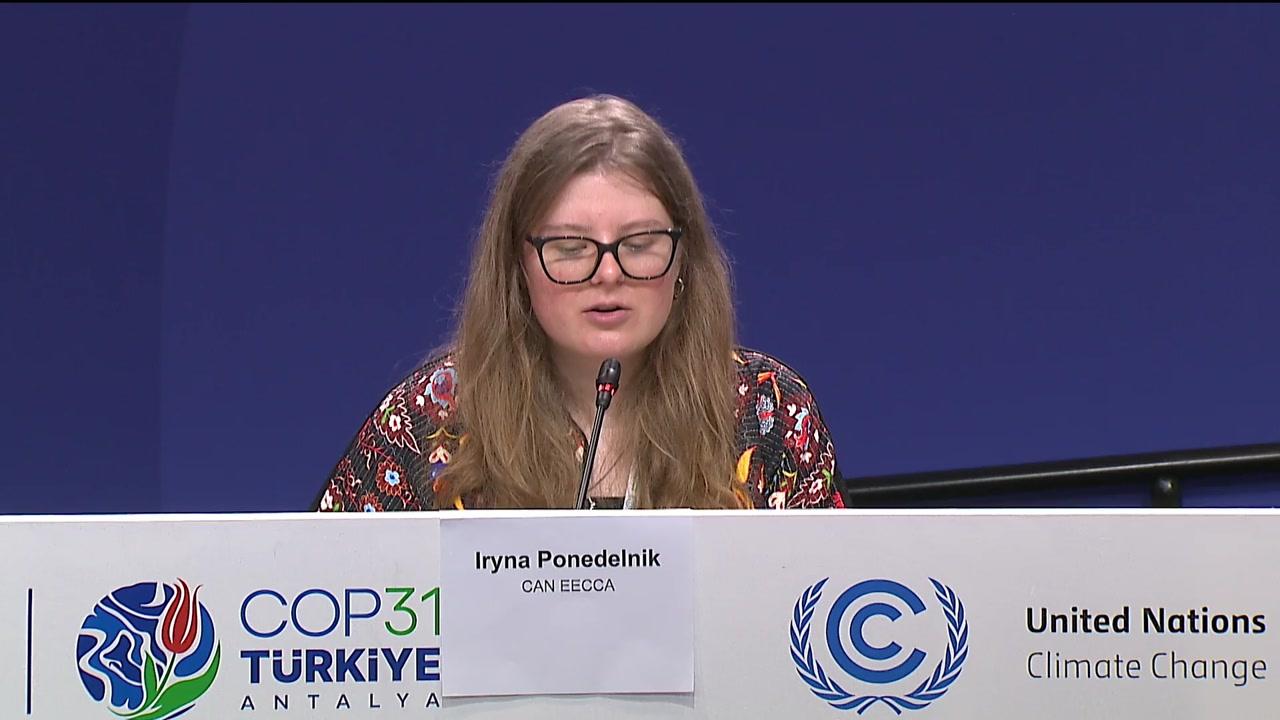
"Our position is clear. Nuclear power in our region is a false solution to the climate crisis," said Ira Panizelnik, Coordinator, Climate Action Network Eastern Europe, Caucasus, and Central Asia.
Panizelnik made her case on time and money first. She said reactors take seven to nine years to build, compared with one to three years for wind and solar, and cost three to five times more.
She then turned to safety and legacy. She noted that 40 years have passed since Chernobyl. She also pointed out that Ukraine's Zaporizhzhia plant has been shelled and occupied. She added that more than 800 million tons of Soviet-era uranium waste remain in Central Asia.
The four demands: Panizelnik laid out the network's asks:
- Stop new nuclear and fossil fuel projects and subsidies
- Prioritize efficiency, renewables and grid investment
- Redirect public and private finance accordingly
- Guarantee transparency and public participation in energy decisions
She also moved to preempt the obvious rebuttal that opposing reactors means keeping coal and gas online. "Rejecting nuclear does not mean supporting fossil fuel," Panizelnik said.
War, Rosatom and a watchdog's limits: Oleksii Pasiuk, Executive Director, ECO Action, brought a Ukrainian security lens to the argument. He said Zaporizhzhia has lost external power nearly 50 times. He also said the sarcophagus covering Chernobyl's destroyed reactor was hit by a drone, and that roughly half a billion euros is being sought for repairs.
Pasiuk argued that the International Atomic Energy Agency (IAEA), the UN's nuclear watchdog, has no influence on the ground. He also warned that nuclear power distracts from negotiations under the UN Framework Convention on Climate Change (UNFCCC), the treaty process behind the annual COP summits.
His sharpest warning was about supply chains. Rosatom, Russia's state nuclear corporation, is backing reactors in Central Asia. Pasiuk said that by doing so, "they're building dependency."
The other side: No nuclear industry or government representatives spoke at the briefing. Reporters asked no questions, so the network's claims went unchallenged in the room.
Decisions and stakeholder impacts: This was an advocacy event, and no action was taken. Still, the message is aimed at energy ministries, development lenders and climate finance providers weighing regional projects.
- Renewable developers and grid builders stand to gain if finance shifts as the network demands.
- Reactor vendors and Rosatom-linked projects are the direct targets of the campaign.
- Residents near legacy uranium sites and frontline Ukrainian communities are central to the network's safety case.
A Methane Blueprint Aimed at the Cover Decision
Why it matters: Methane drives one-third of global warming, according to the network. It said cuts in the energy sector are cost-efficient within five years. Advocates also see a chance for methane language in the COP31 cover decision, the summit's overarching political text.
Where things stand: Vasily Yablokov, a Germany-based methane expert, presented CAN-EECCA's regional position. He said it was inspired by UN Secretary-General António Guterres' call at London Climate Action Week.
The position has five parts:
- Targets: Measurable methane goals written into national climate commitments
- Sector measures: Leak detection and repair, an end to routine venting and flaring, coal mine methane controls, support for farmers and waste-sector action
- Monitoring: Better emissions inventories and direct measurement
- Transparency: Public data and defined roles for civil society
- Finance: Polluter-pays funding, framed around the health benefits of cuts
A regional model: Yablokov singled out Kazakhstan for its progress. He said the country "announced plans to use satellite data in national methane regulation." That approach would let independent observation check what governments and companies self-report.
Decisions and stakeholder impacts: No formal action was taken. If adopted, the recommendations would land hardest on oil, gas and coal operators, who would face leak-repair and flaring rules. Farmers and waste managers would see new programs paired with support. Civil society groups would gain a formal monitoring role.
What's next: The network plans to compare national methane reporting against independent data. It also plans to run trainings with European partners.
Looking Ahead
Watch whether methane language survives into the COP31 cover decision. Also watch how Central Asian governments respond as reactor plans and Rosatom partnerships face growing civil society scrutiny.