
Advocates Press Governments for Plant-Based Food Plans by COP32
COP 31 Press Conferences • United NationsNovember 19, 2026
Locunity is an independent informational service and is not an official government page for this commission. All information is sourced from public footage and an analysis of official agendas with the aid of responsible, fact-checked AI. to report an error or omission.
Plant-Based Treaty and ProVeg used a Nov. 19, 2026, COP31 press conference to call on governments to write national action plans for plant-based food systems by COP32 in 2027. The vehicle is the Belém Declaration, a pledge that more than 100 entities have signed, backed by city endorsements and a policy brief linking animal agriculture to emissions, deforestation and land use. No votes or formal decisions were taken. The session was an advocacy briefing aimed at shaping the next two years of climate negotiations.
- Belém Declaration asks governments for plant-based national action plans by COP32 in 2027
- More than 100 entities have signed; Denmark's 2023 plan held up as the model
- 81 cities have endorsed the Plant-Based Treaty, with programs from Bhutan to Amsterdam
- Policy brief says food systems produce about one-third of greenhouse gas emissions
- ProVeg pitches farmer-transition projects in Brazil and Portugal as proof that a just transition is possible
The Ask: National Plans, Two-Year Clock
Why it matters: National action plans are how governments turn climate pledges into budgets, procurement rules and farm policy. The groups are trying to put food systems into those plans before COP32. They also argue that public procurement and city purchasing power could shift large volumes of meals.
Where things stand: Viola Pizzuto, ProVeg Youth Board member (Italy), laid out the Belém Declaration's core request. She said it calls on governments to begin "drafting national action plans for plant-based food systems."
The declaration has more than 100 signatories and sets COP32 in 2027 as the target. Pizzuto pointed to Denmark's 2023 plan as a model. The groups present these plans as adaptable roadmaps that each government can fit to its own conditions.
Cities as the proving ground: Naman Derya, regional liaison for Asia and India, Plant-Based Treaty, said 81 cities worldwide have endorsed the treaty. He described its three demands: relinquish, redirect and restore.
Derya cited programs in Bhutan, Amsterdam, Getafe, Portugal, Somerville and Jataí. In Bhutan, the work centers on school feeding. The strategy builds from the bottom up: local endorsements and municipal meal programs become evidence that national negotiators can point to.
Farmers at the table: Greta Scott, ProVeg Youth Board member (United Kingdom), said the transition must include farmers and workers. Her stated goal is "to ensure that no one is behind in the transition." She cited ProVeg Brazil's Cultiva project and the ISAP legume initiative in Portugal as examples of just-transition work.
From the floor: One audience member asked a question that could not be fully heard. Derya restated it as a question about what the global initiative is and how it is used in negotiations. The presenters then discussed using endorsements as leverage in those talks.
A second audience member asked how the presenters' age shapes their advocacy, and whether audiences of different ages receive the message differently. The presenters said they tailor their messages to each audience.
The other side: Only advocates for the two organizations presented. No government negotiators, farm groups or industry representatives spoke, so the session included no direct rebuttal of the declaration's demands.
Decisions and stakeholder impacts: No motions or votes were taken.
- Cities: municipal governments with large meal programs, such as schools, are the near-term targets for procurement shifts.
- Farmers and agricultural workers: they face the largest change. ProVeg is betting that transition projects like Cultiva and ISAP can reduce resistance.
- National governments: the declaration's signatories are pressing them to act. COP32 is the benchmark the groups will use to measure progress.
What's next: The groups want governments to draft plant-based national action plans before COP32 in 2027.
The Data Case: Animal Agriculture's Footprint
Why it matters: The policy brief is the evidence base behind the declaration. Its argument is simple: if food is roughly a third of the problem, it belongs at the center of Paris Agreement implementation.
Where things stand: Juan Pablo Casadiego, scientific advisor and campaigner and campaign coordinator in Spain, Plant-Based Treaty, presented the brief, titled "Transforming Food Systems to Deliver on the Paris Agreement." He said food systems "generate approximately one-third of the greenhouse gas emissions."
The numbers presented: Casadiego cited these figures for animal agriculture:
- About 53% of the food sector's emissions
- 41% of deforestation over two decades
- 80% of agricultural land
- About 17% of calories and 38% of protein supplied
That gap between land used and food produced is the brief's central efficiency argument.
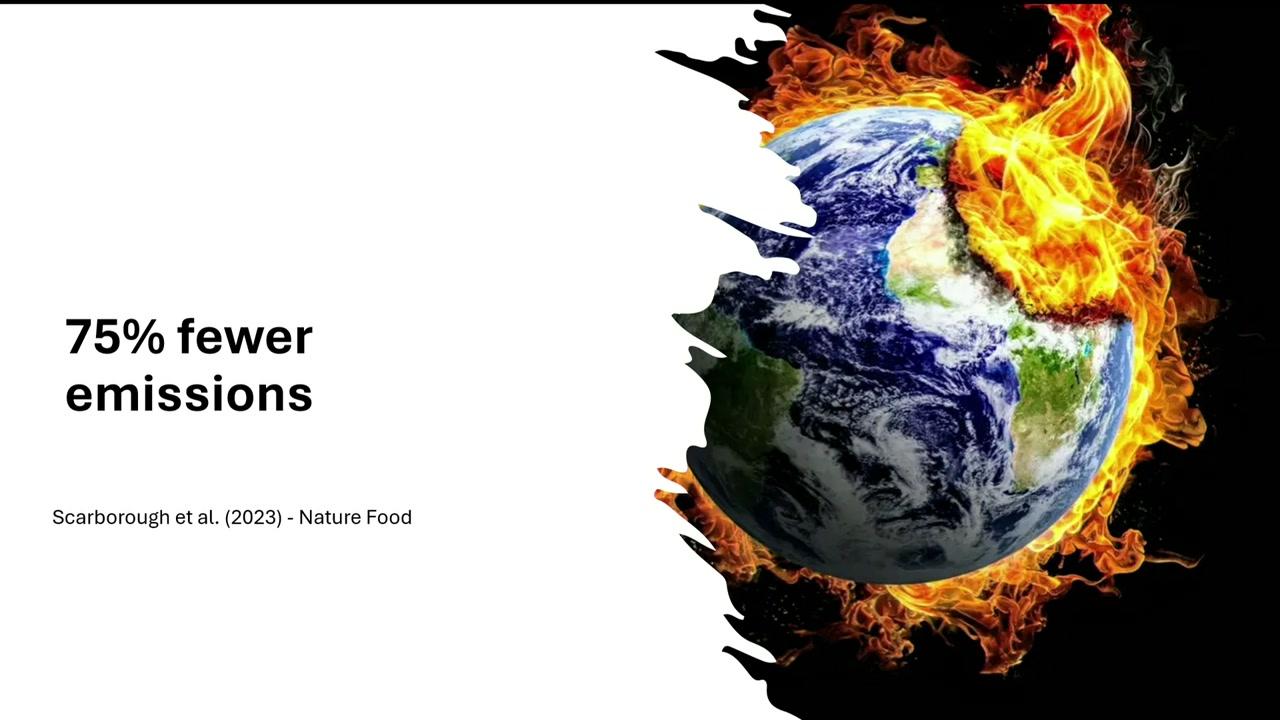
The claimed upside: Casadiego said plant-based diets could cut emissions and land use by 75% and water use by 54%. He also noted health benefits of legumes, tying the climate pitch to public health.
The other side: These figures came from the presenting advocates. No other speakers at the session challenged or independently assessed them.
Decisions and stakeholder impacts: This was informational only. Health advocates gain a climate argument for legume-forward diets. Livestock-dependent regions face the policy implications if governments adopt the brief's framing.
What's next: The brief is meant to support the push for national action plans ahead of COP32.
Looking Ahead
COP32 in 2027 is the deadline the groups set for governments to produce plant-based national action plans. City officials should watch for endorsement requests and procurement proposals tied to the Plant-Based Treaty.