
Climate Panel Pitches Ocean Iron Plan to Pull CO2 Below 300 PPM
COP 31 Press Conferences • United NationsNovember 18, 2026
Locunity is an independent informational service and is not an official government page for this commission. All information is sourced from public footage and an analysis of official agendas with the aid of responsible, fact-checked AI. to report an error or omission.
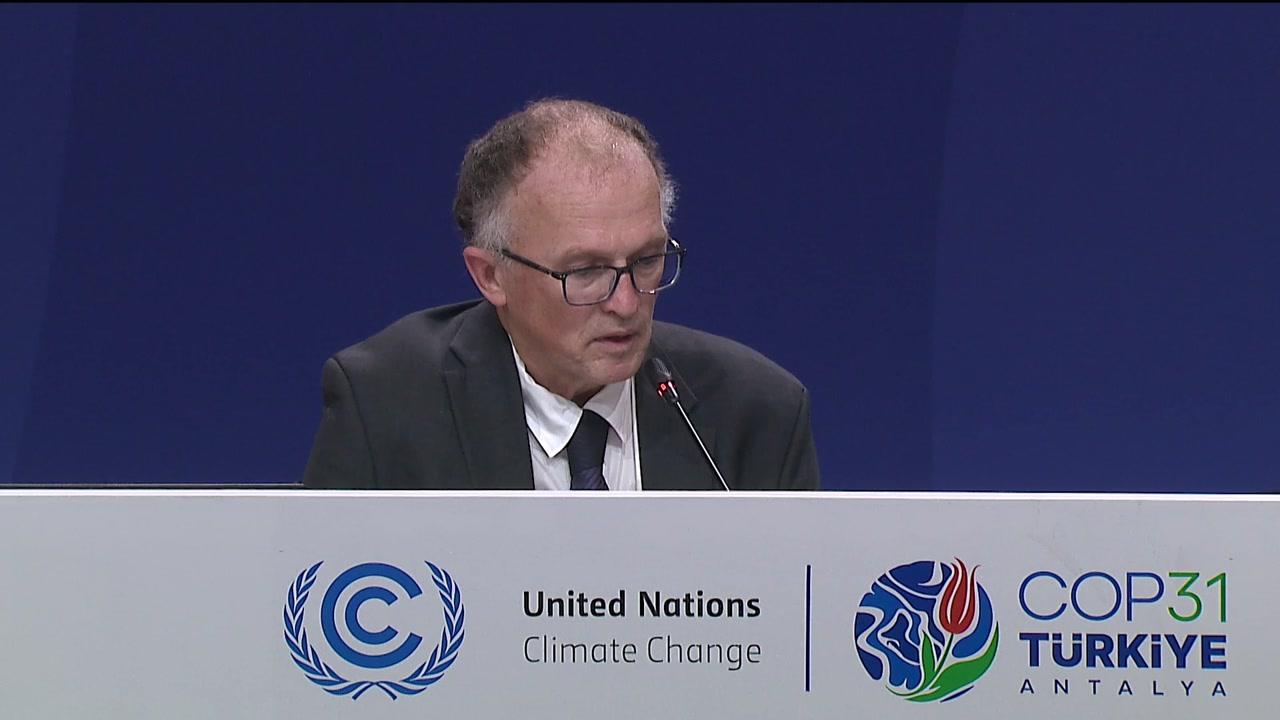
A Climate Emergency Forum press conference at COP31 on Nov. 18, 2026, made the case that net zero is not enough. Panelists argued that seeding swirling ocean currents with iron could pull carbon dioxide back to last-century levels. The pitch now depends on a study off Mexico's coast, unpublished safety papers and a long-shot bid to amend an international ocean treaty.
- Ocean iron "climate restoration" pitched as a path to CO2 below 300 ppm
- Mexico coast eddy study near Acapulco expected to produce data by April
- London Protocol amendment sought: Advocates want a coalition of nations to revise a 2008 iron restriction
- No governments engaged yet, pending publication of peer-reviewed papers
- Questioners press on safety, politics and proof behind a 60 billion ton-per-year claim
The Pitch: Iron, Eddies and a 300 PPM Target
The basics: Ocean iron fertilization adds iron to seawater to trigger growth of phytoplankton, microscopic marine plants that absorb carbon dioxide. This proposal targets downwelling eddies, which are swirling currents that pull surface water downward. Parts per million, or ppm, measures CO2 concentration in the atmosphere.
Why it matters: Panelists argued that reaching net zero would still leave global temperatures near their peak for centuries. If the approach is validated, it would offer a measurable way to remove carbon already in the atmosphere, which could reshape climate strategy beyond emissions cuts.
Where things stand: Peter Fiekowsky, founder of the Foundation for Climate Restoration, who is also affiliated with Eddy Carbon Research, framed the goal in generational terms.
"Climate restoration means giving our children the same CO2 levels that we had last century," said Fiekowsky.
He defined that target as below 300 ppm. He cited ice ages and volcanic eruptions as natural precedents for large drawdowns of atmospheric carbon. Those were cases where nature, not people, moved the planet's carbon balance.
The practical test is a study off Acapulco, Mexico, that uses naturally occurring eddies. Organizers expect data by April. The approach is designed to be localized rather than broadcast across open ocean, which positions it as a narrower intervention than the large-scale geoengineering schemes that have drawn criticism in past climate talks.
Paul Beckwith, a climate systems scientist on the panel, focused on urgency.
"The rate of global warming has doubled in the last couple decades," said Beckwith.
He warned of tipping risks to the AMOC, the Atlantic Ocean circulation system that carries heat northward. He also suggested a messaging shift: presenting the work as ecosystem restoration rather than as a carbon-removal technology. That framing could matter for public acceptance, a theme that dominated the question-and-answer session.
Decisions and stakeholder impacts: This was an informational press conference with no motions or votes. Advocacy groups, including the Foundation for Climate Restoration and Eddy Carbon Research, gain a COP31 platform for their case. Researchers face a high evidentiary bar. Governments have not yet been asked to act. Coastal waters off Mexico serve as the proving ground.
What's next: Study data is expected by April. Any policy movement hinges on those results and on peer-reviewed publication.
The Treaty Wall: London Protocol Becomes the Real Fight
The basics: The London Protocol is an international agreement that governs what may be put into the ocean. A 2008 extension restricts adding iron to seawater, which is the core mechanism of this proposal.
Why it matters: Even strong science would not clear the legal path on its own. Deployment would require nations to change the treaty, which makes international diplomacy and public trust the gating factors.
Where things stand: Fiekowsky said a coalition of nations is being sought to amend the London Protocol. He acknowledged the effort is at an early stage.
Jessica Solórzano of AIDA asked which governments are cooperating and what political challenges the initiative faces. Fiekowsky answered plainly.
"We have not begun working with governments because we don't have the papers published yet," said Fiekowsky.
That sequencing puts publication first, government engagement second and treaty change last. Safety papers are still awaiting publication. Panelists also addressed skepticism toward large-scale interventions and the safety claims behind the approach.
The other side: Questioners probed the proposal from several angles. Charlotte, a questioner from Ohio State University, asked what originally prompted the London Protocol's prohibition on adding iron to the ocean, and the panel discussed the restriction's origins.
Charles Gregoire, affiliated with the Climate Emergency Forum and the International Society for Ecological Economics, asked what the 2027 study would need to show to justify the claim that the method could remove 60 billion tons of CO2 per year. That question sets the benchmark skeptics will likely apply when results arrive.
Not every questioner was skeptical. Alex Carlin of the Center for Media and Democracy applauded the effort. Carlin noted that volcanoes and dust storms deliver similar material to the ocean at larger scale with no recorded negative effects.
Panelists also discussed failure scenarios. Their fallback, described as a "Plan B," is to study how nature drove past drawdowns.
Decisions and stakeholder impacts: No action was taken. Environmental legal advocates such as AIDA are watching the political feasibility. Academic and economic researchers are focused on proof of scale. Treaty parties hold the ultimate veto through the London Protocol.
What's next: Supporters plan to publish the safety papers, then begin engaging governments and building a coalition to pursue an amendment. No timeline for the treaty effort was given.
Looking Ahead
The next markers to watch are the Acapulco eddy study data, expected by April, and publication of the safety papers. Together they will determine whether advocates can credibly take the London Protocol amendment effort to governments.